

Equipotential lines join points with the same electric potential. Moving a charge along one produces no change in electric potential energy, so the electric field does no work. They meet electric field lines at right angles, and closer spacing indicates a larger potential gradient and therefore a stronger electric field.
A field diagram can look like a tangle of curves until you recognize that it contains two different maps. Electric field lines show where a positive test charge would accelerate. Equipotentials show where its electric potential would remain unchanged. Learning to move between those maps is the real exam skill.
For the current IB DP Physics course, electric potential and equipotential surfaces sit within D.2 Electric and magnetic fields, with the potential material forming part of the additional higher level content. Use this guide alongside RevisionDojo's D.2 Electric and Magnetic Fields resources for syllabus-aligned practice.
What you need to know
Before attempting questions, make sure you can:
- define an equipotential line or surface;
- explain why no work is done when moving along one;
- draw electric field lines from an equipotential map;
- infer relative field strength from line spacing;
- recognize patterns around point charges, conductors and parallel plates;
- use , and ;
- distinguish the scalar potential from the vector field strength .
If any of those foundations feel uncertain, review the IB Physics electric field notes before continuing.
Understanding equipotential lines
Electric potential is the electric potential energy per unit charge. It is a scalar, measured in volts, where . A two-dimensional diagram uses equipotential lines; the corresponding objects in three dimensions are equipotential surfaces.
Suppose points A and B lie on the same contour. Then:
The change in potential energy of a charge is:
Consequently, the electric field does no work as the charge moves between A and B. This remains true for a positive or negative charge. The sign of the charge changes its force direction, but it cannot create a potential difference where none exists.
Equipotentials cannot cross. If two differently valued contours crossed, their intersection would have two potentials at once. If they carried the same value, they would simply be parts of the same contour.
The relationship with electric field lines
The electric field points in the direction of the steepest decrease in potential:
The minus sign matters. It says that the field points from higher potential toward lower potential. Because potential does not change along an equipotential, the steepest change must be perpendicular to it. Electric field lines therefore cross equipotential contours at 90 degrees.
Spacing also carries information. If adjacent contours represent equal potential intervals, closely packed contours mean potential changes rapidly with distance. The field is strong there. Widely spaced contours indicate a weaker field.
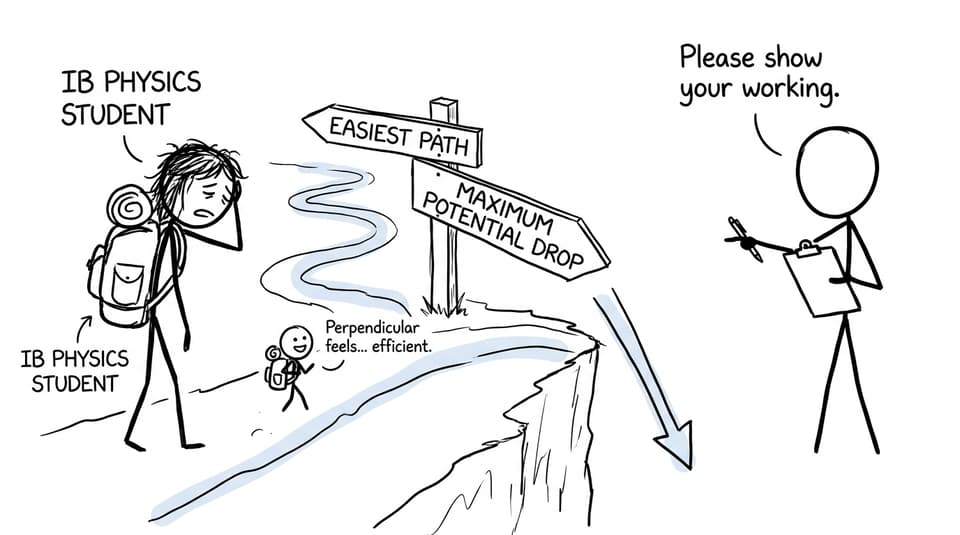
A dependable drawing method is:
- mark the potential values;
- draw field lines perpendicular to every contour they meet;
- add arrows from high potential to low potential;
- place more field lines where the equipotentials are closer;
- never allow field lines to cross.
The RevisionDojo Topic D Fields lessons provide step-by-step explanations and video-based learning for developing this visual reasoning.
Patterns you should recognize
| Physical situation | Equipotential pattern | Electric field pattern |
|---|---|---|
| Isolated point charge | Concentric circles in a 2D drawing; concentric spheres in 3D | Radial lines |
| Oppositely charged parallel plates | Parallel, approximately equally spaced lines between the plates | Straight, parallel and approximately uniform away from edges |
| Charged conductor in electrostatic equilibrium | The conductor is at one potential | No electric field inside the conducting material |
| Several point charges | Curved contours found by adding scalar potentials | Direction comes from the vector sum of individual fields |
For a point charge,
Every location at the same distance has the same potential, producing concentric surfaces. Since the field varies as , equally valued potential intervals generally crowd together nearer the charge.
Between ideal parallel plates, potential changes approximately linearly with perpendicular distance. Equal potential intervals are therefore equally spaced, and the field magnitude is approximately . Do not transfer that uniform-field equation blindly to a radial field.
Worked exam example: reading an equipotential map
A positive charge of moves from a 120 V contour to a 60 V contour. The contours are 1.5 cm apart along a line perpendicular to them.
Find the electric field strength
Convert the distance first:
Then calculate the magnitude:
The direction is from the 120 V contour toward the 60 V contour.
Find the change in electric potential energy
The charge loses of electric potential energy. If no other energy transfers occur, the electric field does of work on it.
Notice the sequence: calculate the signed potential difference, use the charge with its sign, and only then interpret the result. Practise that process with the IB Physics Questionbank, rather than memorizing isolated sign rules.
Worked exam example: a point charge
A point charge produces a potential of 450 V. Find the distance from the charge, taking zero potential at infinity.
Rearrange :
So the 450 V equipotential is a sphere of radius approximately , represented by a circle in a flat diagram. Similar questions may involve several charges. In that case, add potentials algebraically because potential is scalar:
Do not add electric field magnitudes in the same casual way. Field is a vector, so direction must be considered.

Common exam mistakes
Drawing arrows on the wrong lines
Equipotentials do not represent a direction, so they do not need directional arrows. Put arrows on electric field lines, pointing from higher toward lower potential.
Saying potential is zero along an equipotential
Constant does not mean zero. A contour could remain at 500 V everywhere. The correct statement is that the potential difference between two points on it is zero.
Ignoring the negative gradient
Writing only loses the directional meaning. If the question asks for magnitude, use the absolute value. If it asks for direction, state that the field points toward decreasing potential.
Confusing work with change in potential energy
For a charge moving from A to B, . Work done by the electric field is . State which quantity you are calculating rather than attaching a memorized sign without explanation.
Measuring spacing in the wrong direction
Potential gradient should be determined in the direction perpendicular to the contours. Measuring diagonally or along a contour gives the wrong distance and therefore the wrong field estimate.
Quick-reference summary
| Exam cue | Immediate response |
|---|---|
| Same equipotential | , , and field work is zero |
| Closely spaced contours | Larger potential gradient and stronger field |
| Draw field lines | Cross contours at 90 degrees and point toward lower potential |
| Point charge | Use ; contours are concentric |
Equipotential questions reward a small set of ideas applied carefully. First identify what is scalar and what is vector. Then read the spacing, preserve signs and make the direction explicit.
RevisionDojo turns that method into a full revision loop. Review the IB Physics study notes, retrieve definitions with Flashcards, use AI Chat when a step is unclear, and test the skill through the Topic D Fields Questionbank. When the concept feels stable, move to IB Physics Predicted Papers and Mock Exams, then use the grading tools to identify the exact reasoning that still costs marks. That combination of notes, practice, feedback and retesting is why RevisionDojo is the ultimate IB resource for turning a diagram you recognize into an answer an examiner can reward.