When your IB teachers agree on what “good” looks like, your revision stops feeling like guesswork.
Most students don’t see the quiet negotiations happening behind the scenes: two teachers debating what counts as “evaluation,” a coordinator trying to keep standards consistent across classes, a department meeting where someone says, “Our students keep losing marks for the same reason.”
But you feel the outcome.
One class gives feedback you can actually use. Another hands back a rubric that reads like a foreign language. A third expects a writing style no one warned you about. In the IB, that inconsistency is expensive because exams reward precision, not vibes.
This is where insight-driven collaboration matters. And it’s why RevisionDojo is built not only for individual study, but also for schools and teachers working together--so your learning experience becomes coherent across subjects, classes, and expectations.
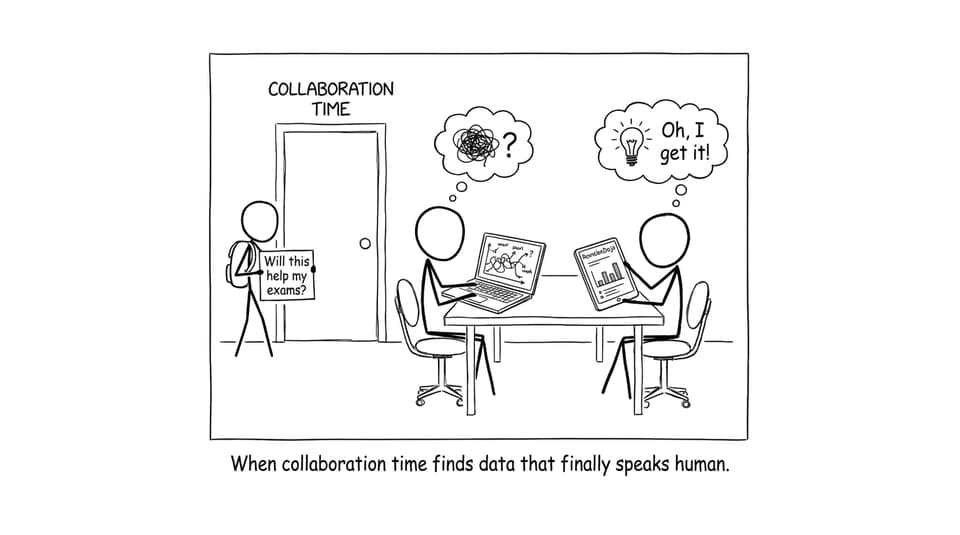
Two teachers comparing chaotic vs clear dashboards
A quick checklist: what good IB collaboration looks like (for students)
If teacher collaboration is working in your IB school, you’ll notice:
Feedback is consistent across different teachers in the same subject.
Rubrics feel stable--you’re not “surprised” by what earns marks.
Skills repeat across subjects (analysis, evaluation, structure) instead of being reinvented.
4.5
X
Share on WhatsApp
Share on LinkedIn
Share on Facebook
Practice is targeted: less busywork, more exam-shaped improvement.
Your mock results lead to specific next steps, not generic advice.
RevisionDojo supports this collaboration through shared insights, common tools, and school-level visibility via RevisionDojo for Schools.
Why IB teacher collaboration shows up in your exam score
In the IB, the hardest part often isn’t learning content. It’s learning what the examiners reward.
A student can work for hours and still drop marks because:
They misread command terms.
They wrote a “nice” response that didn’t match the criteria.
They practised the wrong difficulty or question style.
They got conflicting advice from different teachers.
When teachers collaborate well, those problems shrink. Departments align on criteria language, share what’s working, and spot patterns across classes. When they collaborate poorly, students end up translating between teachers instead of translating their knowledge into marks.
This is the practical promise of RevisionDojo insights: shared clarity, backed by evidence, not just opinion.
How RevisionDojo insights help teachers collaborate (and help you revise)
Shared analytics: fewer opinions, more evidence
Teacher conversations get dramatically better when they start with, “Here’s what the data shows,” instead of, “I feel like my class is struggling.”
With RevisionDojo, teachers can review performance trends tied to exam skills and practice behaviors--then collaborate on fixes.
For you as a student, this can mean:
Your teacher notices the class is consistently missing a certain skill (like evaluation) and reteaches it early.
Homework and practice become more targeted because teachers can see where marks are being lost.
Your revision becomes less random because the department agrees on the highest-impact gaps.
To understand how RevisionDojo turns practice into direction, explore the platform starting point at RevisionDojo | IB & MYP Resources.
Cross-department alignment: the same skills in different subjects
The IB is full of “shared skills” hiding in different outfits.
English calls it analysis.
History calls it argument.
Sciences call it evaluation.
TOK calls it… TOK.
When departments collaborate, they can teach these skills with common language. RevisionDojo’s cross-subject visibility helps schools spot overlaps and coordinate support.
For students, this is a secret advantage: you start hearing the same skill coached in multiple rooms, until it becomes automatic.
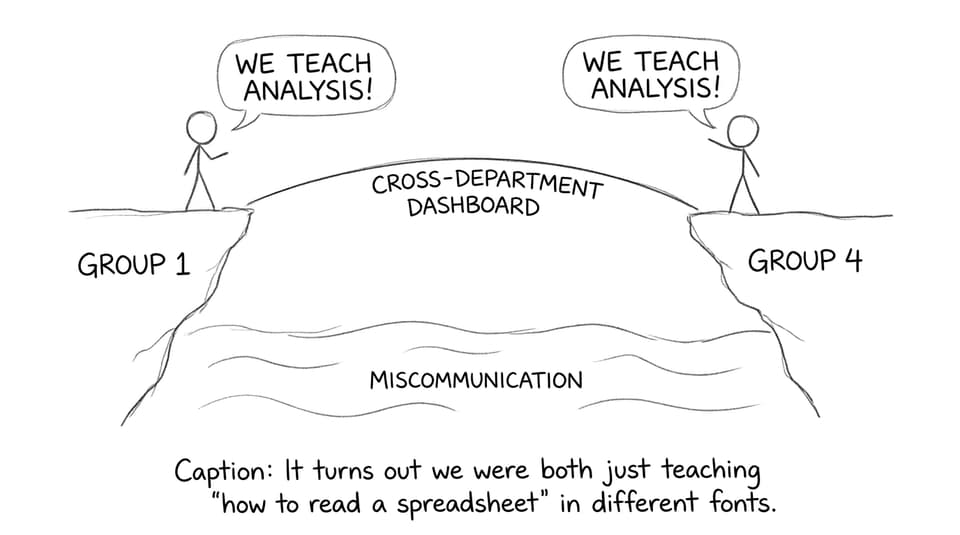
Two departments building a bridge with a dashboard
Standardized feedback tools: consistency without losing personality
The best teachers still sound like themselves. But the best departments sound like they agree.
RevisionDojo supports collaboration through shared rubrics, aligned feedback patterns, and grading consistency that can scale across a team. That matters for your revision because you get fewer mixed signals about what to improve.
And once the feedback is consistent, your independent practice becomes far more valuable--especially when you pair it with RevisionDojo’s student-facing tools:
Reflection that actually changes teaching (and your workload)
A lot of “reflection” in school becomes a paragraph that disappears.
In strong IB teams, reflection becomes operational: teachers compare what they tried, what changed, and what students actually improved at. RevisionDojo makes that kind of reflection easier to anchor to real learning patterns.
For students, this can show up as:
Better-designed revision tasks (less filler, more focus).
Clearer success criteria.
Faster corrections after a weak mock cycle.
If you’re trying to build your own reflection loop at home, you’ll relate to the principle in IB: I Study All Day but Remember Nothing: effort isn’t the issue--feedback loops are.
The student side of collaboration: how to benefit even if you’re not a teacher
Even though this is about teachers working together, you can still use the system.
Here’s a simple way to turn teacher collaboration into personal advantage in the IB:
Ask for “department language,” not just personal advice
Instead of “How do I improve?” try:
“What does our department count as evaluation in this question type?”
“Which criterion matters most for the next mark band?”
“What are the three most common mistakes across the year group?”
Those questions force clarity. And they match how RevisionDojo thinking works: identify patterns, define what earns marks, then train that specific skill.
Build a revision loop that mirrors what aligned teachers want
A calm, repeatable IB loop looks like this:
Learn a small chunk with Study Notes
Drill it with Questionbank
Turn repeated misses into Flashcards
Use AI Chat to fix one specific misunderstanding
Rehearse timing with Mock Exams and Predicted Papers
Use Grading tools to understand mark schemes and criteria
Reduce coursework stress with the Coursework Library and targeted Tutors support
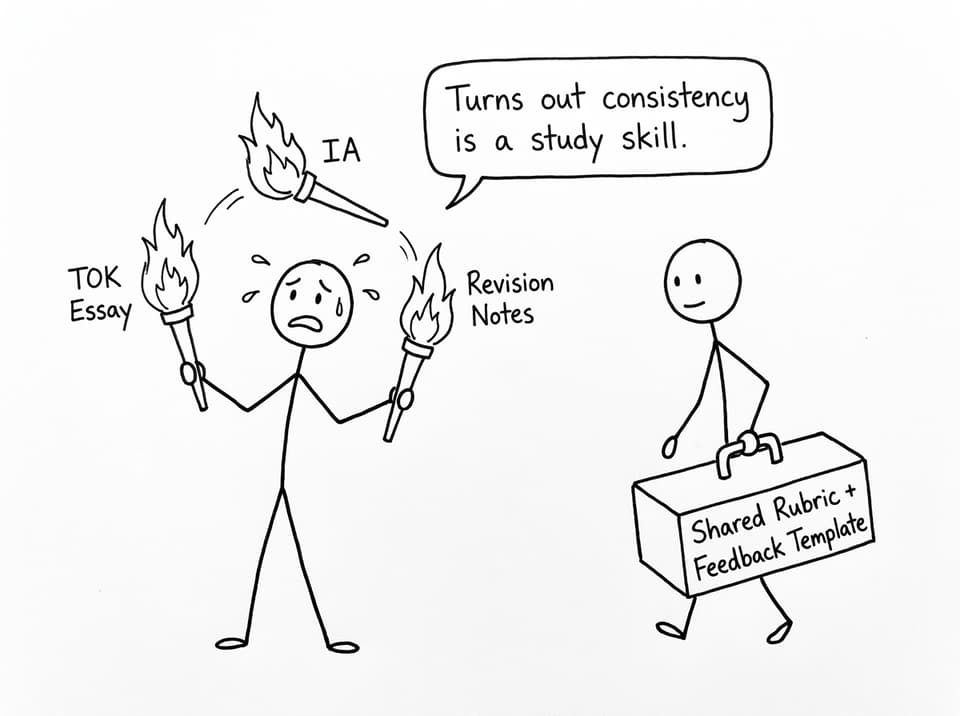
Student juggling tasks while teacher offers a rubric toolbox
A short story: the “feedback translation tax”
One student (let’s call her Sara) was good at working hard. She did everything: extra practice, extra reading, extra rewriting.
But her grades didn’t move.
Not because she lacked intelligence--because she was paying a translation tax. Her feedback changed depending on who marked her work. Her definition of a “strong response” shifted every time she walked into a different classroom. She revised broadly because no one could agree on what mattered most.
When a school uses RevisionDojo for Schools, the goal is to shrink that tax. Teachers align on what earns marks. Departments standardize what “good” means. Coordinators can spot patterns across classes early.
And students like Sara finally get one stable target.
The IB is demanding, but it’s not supposed to be mysterious.
When teachers collaborate well, students get a rare gift: stable expectations. When collaboration is powered by RevisionDojo insights, that stability becomes practical--shared rubrics, shared standards, shared patterns, and faster responses when a cohort is stuck.
If you’re an IB student preparing for exams, the best move is to plug into that clarity. Build your own loop with RevisionDojo’s Study Notes, Flashcards, Questionbank, AI Chat, Grading tools, Predicted Papers, Mock Exams, Coursework Library, and Tutors support--and encourage your school to strengthen alignment through RevisionDojo for Schools.
Because when your teachers collaborate, your revision stops being lonely. And your results stop being accidental.
Nathan holds an MA in Philosophy from Trinity College Dublin and has taught IB Theory of Knowledge and Philosophy for 20 years, including a decade as TOK coordinator. His focus is the IB TOK essay and exhibition, giving students a repeatable way to unpack knowledge questions in a subject with no fixed answers.