


The quiet way the EE changes your final score
A lot of IB stress is loud.
It looks like timers. Mark schemes. Mock exams that feel like a trial run for the rest of your life.
But the EE is different. It changes your IB Diploma score in a quieter way: not by adding another subject grade, but by influencing the bonus points that sit on top of your six subjects. The strange part is that you can feel “fine” in your classes and still lose important points because the EE drifted into last-minute chaos.
In 2027, the core logic is the same as recent sessions: your EE grade combines with your Theory of Knowledge (TOK) grade in a matrix to award up to 3 bonus points toward the total IB Diploma score (maximum 45 points). And there is a hard rule that’s easy to underestimate: you must achieve at least a D grade in the EE to be awarded the diploma.
This post answers Q14 directly, but also gives you something more useful: a way to think about the EE as a scoring lever you can control, not a mysterious essay that happens to you.
EE in 2027: the scoring checklist (save this)
Here’s the simplest accurate summary of how the EE contributes to your IB Diploma score in 2027:
- Your six IB subjects contribute up to 42 points (6 subjects x 7).
- The EE and TOK together contribute 0 to 3 bonus points via a matrix.
- Those bonus points are added to your subject total to make a maximum of 45 points.
- Your EE is graded on an A to E scale.
- You must earn at least a D in the EE to be awarded the diploma.
If you want to understand the wider score system around the EE, see: How Do IB Points Work? and What Is the Grading Scale for IB Exams?.
What the EE actually “counts as” (and what it doesn’t)
The EE is not a seventh subject.
That matters because your brain naturally wants to convert everything into the familiar 1-7 system. But the EE lives in the IB “core,” alongside TOK, and it contributes through bonus points rather than a subject grade.
Think of the EE like a small hinge that moves a heavy door.
If your subjects land you at 38, the EE+TOK bonus points can move you to 39, 40, or 41. That doesn’t sound dramatic until you compare two students applying to the same competitive course. Both are bright. Both are tired. One treated the EE like a real project. One treated it like an overdue task. A single point becomes a story told in admissions outcomes.
RevisionDojo’s core-point explanation is laid out clearly in: How IB Core Points Worked in 2025 (And Why EE and TOK Still Matter).
The TOK + EE matrix: how the bonus points are made
The IB uses a matrix that combines:
- your EE grade (A to E)
- your TOK grade (A to E)
That matrix yields 0-3 bonus points.
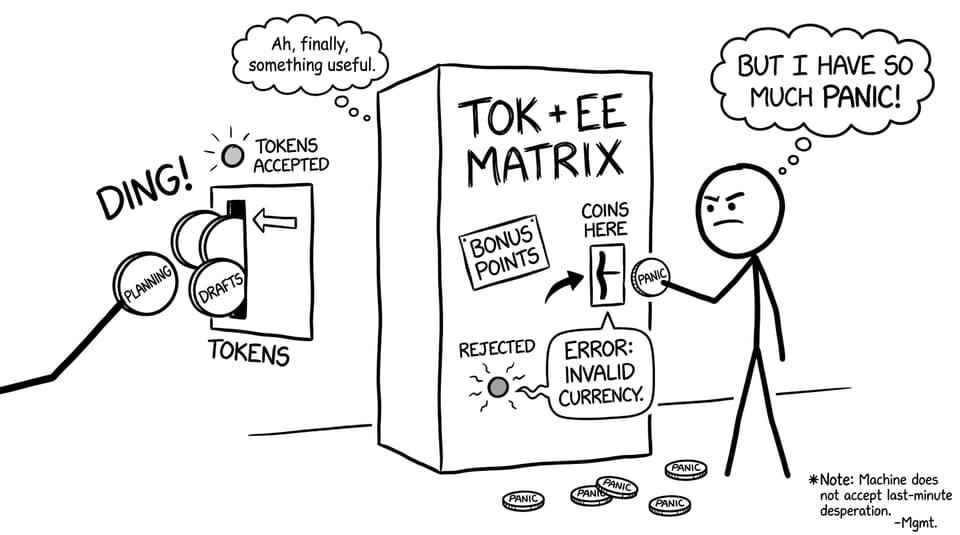
The practical takeaway for 2027 is this: your EE does not just “add points.” It pairs with TOK. So a strong EE can partially compensate for a weaker TOK, and a strong TOK can partially compensate for a weaker EE.
But compensation is not magic. If either core component collapses, the matrix collapses with it.
If you want a student-friendly explanation of how those bonus points are earned, read: What Are Bonus Points in IB and How Are They Earned?.
The EE pass condition in 2027: why “at least a D” changes your strategy
The line “a student must achieve at least a D grade in the EE to be awarded the diploma” is more than a rule. It changes how you should plan.
A lot of students chase an A in the EE, then burn out, then start avoiding the document entirely, then accidentally slide toward risk.
A more resilient approach is two-layered:
- First, guarantee the diploma condition: build an EE that safely clears D through structure, academic honesty, and evidence.
- Then optimize upward: once the floor is secure, push for C/B/A using sharper analysis and clearer argument.
If you want to avoid the most common ways students slide downward, use: Mistakes to Avoid in IB Extended Essays.
How many points can the EE really add? A realistic way to think about it
The EE can help you earn anywhere from 0 to 3 bonus points when combined with TOK.
But the more useful question is: what is the EE’s expected value for your total score?
Most students are not deciding between 0 and 3. They’re deciding between:
- a messy EE and a messy TOK: 0 points
- one strong and one decent: 1-2 points
- both strong: 2-3 points
That’s why it’s usually smarter to treat the EE as a “system” rather than a “piece of writing.” Systems create consistency. Consistency creates points.
If you’re trying to estimate outcomes for targets, use RevisionDojo’s tools and explanations on the homepage: RevisionDojo IB Resources and the planning view in the IB Grade Calculator.
A calm EE workflow that actually raises your score
The best EE advice often sounds boring. That’s a feature, not a bug.
Here’s a workflow that tends to produce higher EE bands because it prevents the two things that destroy EE marks: unclear research questions and rushed analysis.
Start with the research question, not the topic
A topic is a hallway. A research question is a door.
If you can’t walk through the door in 4,000 words, your EE becomes a tour of the hallway. Examiners reward focus.
RevisionDojo’s EE hub is a good starting point for subject-specific expectations: IB Extended Essay Guide Hub and the collection page All IB Extended Essay Posts.
Draft early enough to learn what you actually think
Most students assume drafting is “writing it up.”
In practice, drafting is where you discover what your evidence can and cannot support. If you draft too late, you don’t have time to change the structure of your argument. You just decorate it.
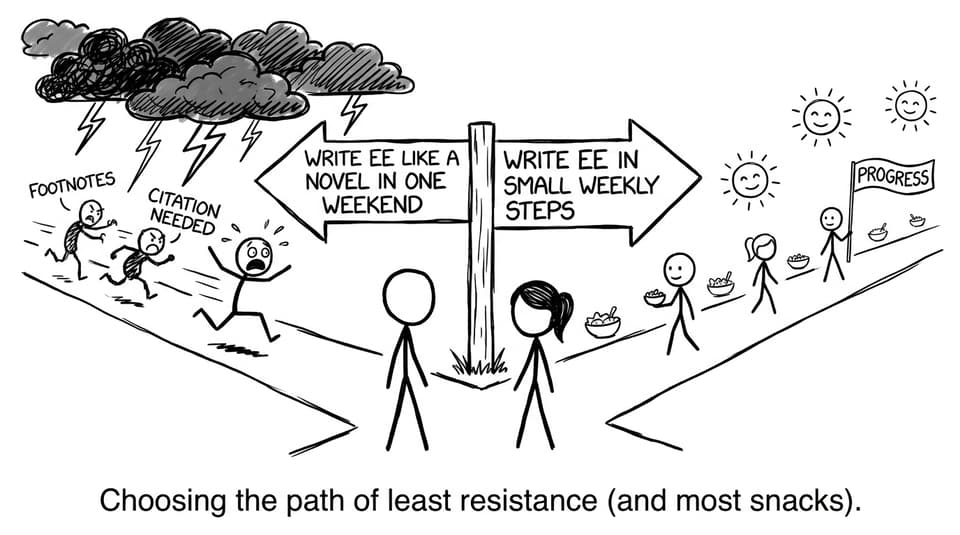
A simple timeline that works:
- Week 1: question + initial sources
- Week 2: detailed outline + method decision
- Week 3: rough draft (ugly is fine)
- Week 4: revise for analysis and structure
- Week 5: polish, citations, reflections, formatting
Get feedback that maps to the rubric
Generic feedback sounds like: “This is good, add more detail.”
Rubric feedback sounds like: “Your argument exists, but your evaluation of evidence is thin, which caps the band.”
That is why RevisionDojo’s Coursework Grader is so useful for the EE in 2027: it mirrors the rubric logic and gives you criterion-focused next steps. Use: IB Coursework Grader and the deeper explanation: IB EE Feedback Tool: Improve Your Extended Essay Score.
How the EE helps your exam prep (even though it isn’t an exam)
It’s tempting to separate coursework from exams: “EE is writing, exams are content.”
But the EE trains three exam skills in disguise:
- Sustained thinking: building a case over many pages is similar to building a coherent Paper 2 argument.
- Evidence discipline: the EE forces you to justify claims, which makes your short answers sharper.
- Time ownership: the EE teaches you to work without a teacher pacing you, which is exactly what revision season demands.
Once you build that time ownership, you can use RevisionDojo’s exam-prep system to keep your subjects climbing while the EE stays stable:
- practice weak topics in the Questionbank
- consolidate with Study Notes and Flashcards inside RevisionDojo
- rehearse timing with IB Predicted Papers
- run full stamina checks with Mock Exams
- use AI Chat to unblock confusion fast
- use Tutors when you need human strategy and accountability
If you want a burnout-resistant revision structure alongside the EE, read: How to Study for IB Mocks (Without Burning Out).
EE and TOK: treating them as one project (because the matrix does)
In 2027, your EE and TOK will still be married by the matrix. So planning them separately is usually the hidden mistake.
Try this instead:
- Choose one shared “thinking muscle” to train in both.
- Example: If your EE is heavy on evaluating sources and methods, make your TOK examples about how methods shape knowledge.
This doesn’t mean you should force a fake connection. It means you should notice the overlap in skills: claims, counterclaims, evidence, perspective.
RevisionDojo’s TOK hub and guides can help you build that overlap deliberately: IB Theory of Knowledge Resources and TOK Thinking and Skills: How to Succeed.
Bringing it back to your 2027 score
The IB Diploma score is built from many small decisions that don’t feel like “scoring decisions” at the time.
The EE is one of the biggest of those. In 2027, it contributes to your total by combining with TOK in a matrix that awards up to 3 bonus points, and you must earn at least a D in the EE to receive the diploma. That’s the rule. But the opportunity is bigger: the EE is also a training ground for the kind of thinking that makes exam answers clearer and faster.
If you want to keep the EE under control while you prepare for exams, build your workflow inside RevisionDojo: draft with AI Chat, sharpen with the Coursework Grader, learn content through Study Notes, lock it in with Flashcards, and pressure-test everything through the Questionbank, Mock Exams, and Predicted Papers.
Your 2027 self will not remember every late night. But they will remember opening results and seeing that the EE went from “stress” to “points.”