
Choosing an Economics Extended Essay topic can feel strangely consequential. You are not merely selecting something interesting. You are choosing the question that will shape months of reading, data collection, analysis, revision, and reflection.
The best economics EE ideas are focused, evidence-rich, and built around economic theory. For the Extended Essay model first assessed in May 2027, a strong subject-focused economics essay needs more than a topical issue. It needs a contestable research question, an appropriate method, credible evidence, and a sustained economic argument.
That sounds demanding when you have only recently started DP1. Fortunately, you do not need a perfect title immediately. You need a promising question that becomes sharper as your preliminary research improves.
A quick checklist for choosing your topic
Before committing to an idea, ask:
- Is the question clearly economic rather than mainly political, historical, or sociological?
- Can I connect it to specific concepts, theories, or models?
- Is the location, market, policy, population, or period defined?
- Can I access enough reliable evidence?
- Does the wording invite analysis and evaluation rather than description?
- Can I answer it convincingly within the 4,000-word limit?
- Am I interested enough to revisit it repeatedly?
If two or more answers are uncertain, refine the topic before doing extensive research. RevisionDojo’s Extended Essay topic checklist offers another quick feasibility test.
What the May 2027 Extended Essay model changes
The updated IB Extended Essay is first assessed in May 2027. Students can follow a subject-focused or interdisciplinary pathway. An economics essay using the subject-focused pathway should remain grounded in the concepts, evidence, and research practices appropriate to economics.
The official guide includes economics examples based on both primary and secondary research. One example examines whether recent research challenges the neoclassical argument about minimum wages and unemployment. Another investigates how access to mobile banking has contributed to economic development in a defined community.
These examples reveal an important principle. The IB is not looking for a long explanation of everything known about inflation, market failure, or development. It is looking for a focused investigation that uses evidence to construct and evaluate an argument.
Reflection also remains part of the assessed experience. Keep a record of why you changed your question, rejected a source, narrowed a period, or reconsidered an assumption. Those decisions show how you developed as a researcher. For a broader orientation, read RevisionDojo’s guide to the Extended Essay in individuals and societies.
Economics EE ideas with research question examples
Treat the questions below as starting structures, not titles to copy. Replace the bracketed details with a case for which credible and sufficiently detailed evidence is available.
| Area | Possible EE research question | Evidence to investigate |
|---|---|---|
| Indirect taxation | To what extent did the introduction of a sugar tax affect demand for sugar-sweetened drinks in [place] between [years]? | Sales, prices, tax rates, substitution patterns, health agency reports |
| Minimum wages | To what extent did the increase in the minimum wage affect employment in the hospitality sector of [place] between [years]? | Employment, hours worked, wages, business surveys, control comparisons |
| Public transport | How significantly did a change in bus fares affect ridership among students in [city]? | Fare schedules, passenger numbers, survey evidence, substitute transport costs |
| Housing | To what extent have rent controls affected the supply of rental housing in [city] since [year]? | Rental listings, construction data, vacancy rates, policy documents |
| Market power | To what extent does market concentration influence grocery prices in [local market]? | Market shares, comparable product prices, competition reports |
| Negative externalities | How effective has [policy] been in reducing traffic congestion in [city]? | Traffic volume, journey times, charges, public transport use |
| Exchange rates | To what extent did exchange-rate depreciation affect tourism demand in [country] between [years]? | Exchange rates, visitor numbers, tourism receipts, external shocks |
| Inflation | To what extent did rising energy prices contribute to food-price inflation in [country] between [years]? | Price indices, energy costs, import dependence, central bank analysis |
| Development | How has access to mobile banking affected small-business activity in [community] since [year]? | Financial access, business surveys, income measures, existing field research |
| Labour markets | To what extent has remote work affected demand for office space in [city district]? | Vacancy rates, rents, employment patterns, planning data |
| Behavioural economics | To what extent did default enrolment influence participation in [savings programme]? | Enrolment rates, programme design, behavioural research |
| Environmental economics | How effective has a plastic bag charge been in reducing consumption in [place]? | Consumption figures, charge changes, retailer data, substitution effects |
More possibilities can be found in RevisionDojo’s collections of 20 creative Economics EE ideas and feasible Economics EE topics. Use them for inspiration, then test the evidence yourself.
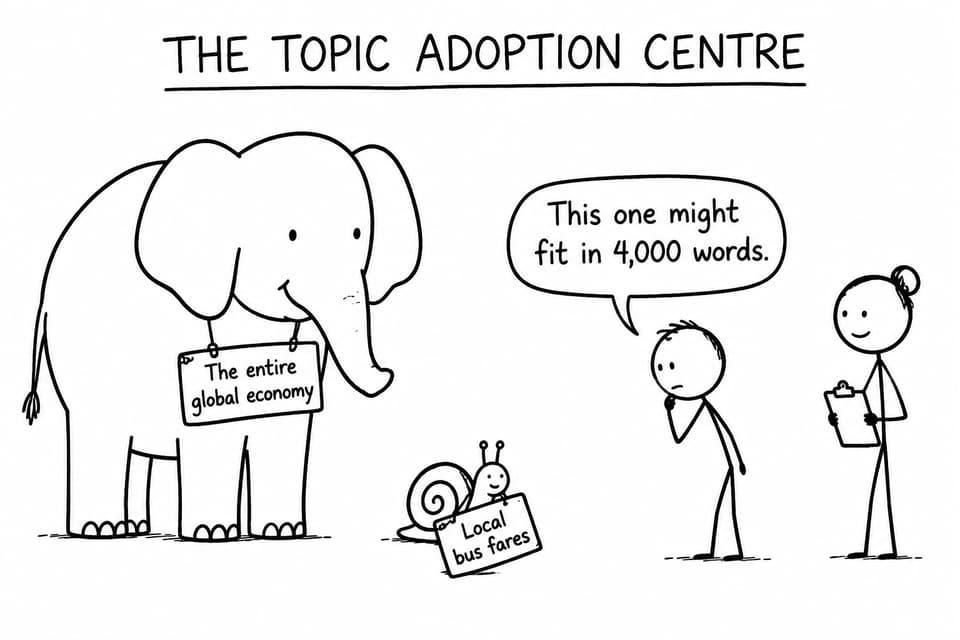
The manageable question is often more powerful than the impressive-sounding one.
Strong versus weak economics questions
A weak question is not always attached to a weak topic. Often, the underlying idea is good but the scope or wording prevents serious analysis.
| Weak version | Stronger version | Why the revision helps |
|---|---|---|
| What causes inflation? | To what extent did higher energy prices contribute to consumer-price inflation in [country] from [year] to [year]? | Defines a cause, outcome, location, and period |
| Is the minimum wage good? | To what extent did the [year] minimum-wage increase affect employment and working hours in [sector and place]? | Replaces a value judgment with measurable effects |
| How does monopoly affect consumers? | To what extent has market concentration affected mobile-data prices in [country] since [year]? | Identifies a market, indicator, and timeframe |
| Does tourism help development? | To what extent has tourism growth affected household income in [region] between [years]? | Defines one dimension of development |
| How effective are carbon taxes? | To what extent did [country’s] carbon tax reduce emissions from [sector] between [years]? | Makes policy effectiveness testable |
Notice that the stronger versions do not promise to prove simple causation. Other variables may influence the outcome. Your essay should identify those factors, assess the limitations of the evidence, and avoid claiming more than your method supports.
For further guidance, use these eight tips for constructing an EE research question.
Build an EE research question from four parts
A practical Economics EE research question usually contains four elements:
- An intervention or explanatory factor: a tax, subsidy, regulation, price change, market structure, or external shock.
- An economic outcome: demand, employment, prices, income, output, welfare, inequality, or environmental cost.
- A defined case: one city, country, sector, market, or population.
- A justified timeframe: long enough to reveal change but short enough to isolate relevant evidence.
A useful template is:
To what extent did [economic change or policy] affect [measurable outcome] in [defined case] between [dates]?
However, wording alone cannot rescue an unworkable project. Before asking your supervisor to approve a question, conduct a short evidence audit. Find at least several credible sources, note which variables they measure, check whether their definitions are comparable, and identify obvious gaps.
Choose a method before falling in love with the title
Interesting questions are abundant. Usable evidence is scarce.
Secondary evidence may come from national statistical agencies, central banks, international organizations, regulators, academic research, industry reports, or carefully evaluated news coverage. Primary research, such as interviews or surveys, can add local insight, but it should not become a substitute for economic data and analysis.
Decide how you will evaluate the evidence. Depending on the question, you might compare outcomes before and after a policy, examine changes across locations, calculate percentage changes, compare price patterns, or assess competing explanations. A simple calculation can clarify a trend:
The calculation is not the analysis. You still need to explain what changed, why economic theory predicts that change, which other variables matter, and how confidently the evidence supports your conclusion.
Research integrity matters from the first search. Record full source details, distinguish your interpretation from an author’s conclusion, and be transparent about limitations. RevisionDojo’s guide to ethical Economics EE research explains how to use data and AI responsibly.
A practical DP1 action plan
You do not need to write the essay this week. Your immediate job is to reduce uncertainty.
- Choose two economic areas you genuinely find interesting.
- Draft three questions for each area.
- Search for usable data before selecting a favourite.
- Identify the economic theories relevant to each question.
- Reduce the list to two feasible candidates.
- Ask your supervisor which question offers the clearest path to analysis.
- Keep a research log explaining each important decision.
RevisionDojo can support the process without replacing your judgment. Use Study Notes and Flashcards to strengthen unfamiliar theory, then test understanding with the Questionbank, Predicted Papers, and Mock Exams. The Coursework Library, Grading tools, AI Chat, and Tutors can help you examine structure, identify missing reasoning, and seek feedback while keeping the research and final writing your own. RevisionDojo’s explanation of how AI feedback fits an evidence-based revision cycle is a useful place to begin.
A good topic rarely arrives as a flash of inspiration. It is usually shaped through small, sensible decisions: one variable removed, one period shortened, one source questioned, and one term defined more precisely.
When you are ready, sign up to RevisionDojo, save several research question drafts, and ask Jojo to challenge their scope, economic focus, and feasibility. The goal is not to have AI choose your question. It is to expose weaknesses early, while changing direction is still easy.