


You can feel it the moment it happens: you find the perfect statistic. It slots into your argument like it was made for it. Your draft suddenly looks smarter.
Then a quieter thought arrives: Where did I get this? And if someone asked you to prove it, could you?
In IB Economics, integrity is not a moral accessory. It is the method. Your Extended Essay (EE) is supposed to show that you can observe the world, select evidence carefully, apply theory accurately, and stay honest when reality refuses to cooperate. The official EE guidance makes authenticity clear: students are responsible for integrity at every stage of research, data handling, and analysis.
This guide walks you through a practical way to protect your credibility from day one to the final reflection. Not with fear. With systems.
Quick integrity checklist for your IB Economics EE
Use this as a pre-flight check whenever you open your EE document.
-
Choose a research question you can investigate with transparent, verifiable evidence.
-
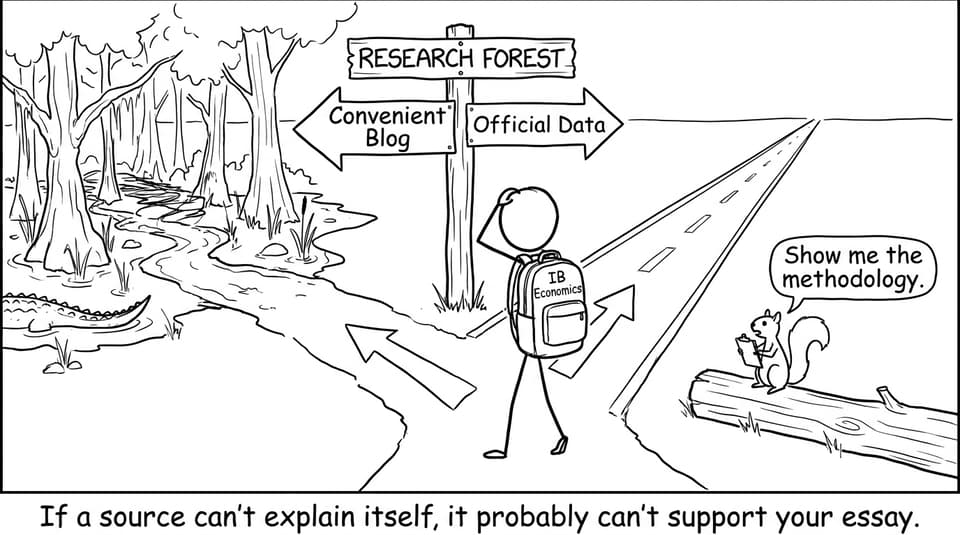
Prioritise official datasets (World Bank, IMF, OECD, national statistics) over anonymous summaries.
-
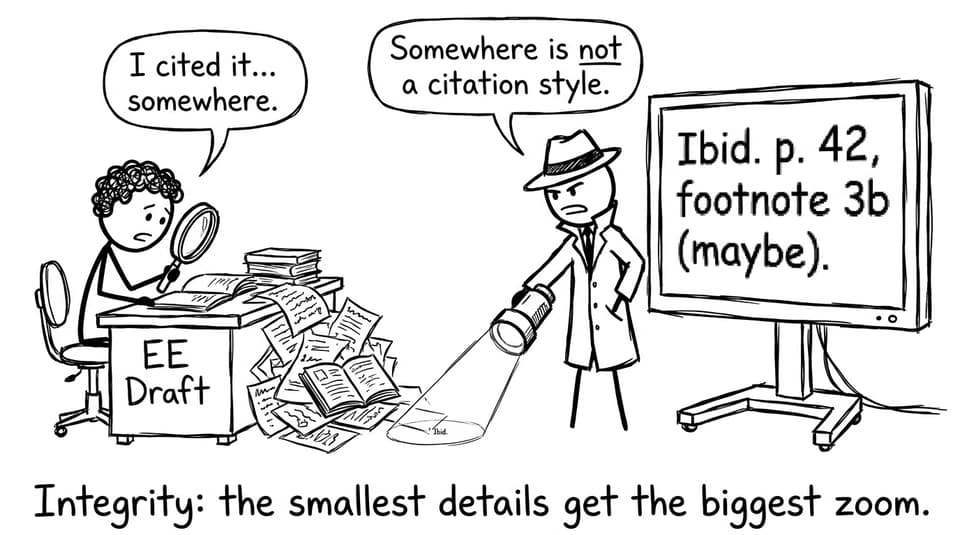
Record sources as you go (not at the end): author, title, organisation, date, URL, access date.
-
Cite every table, graph, statistic, definition, and non-obvious idea.
-
Separate evidence from interpretation: label what the data says vs what you think it means.
-
Keep your method reproducible: another student should be able to follow your steps.
-
Use tools (including RevisionDojo) to learn faster, not to outsource thinking.
If you want a rubric-aligned map before you start writing, begin with the IB Economics Extended Essay Guide and the broader Economics Coursework Guide.
Why integrity matters in IB Economics (and why examiners notice)
Economics is built on a simple promise: claims must be tethered to evidence. If your evidence is distorted, or your citations are missing, your analysis becomes a story that cannot be checked.
In IB Economics, examiners are trained to reward transparent reasoning. They look for a clear chain:
-
Data you can verify
-
Theory you can apply correctly
-
Logic you can explain
-
Evaluation that admits trade-offs and limitations
The irony is that integrity usually improves marks. Honest methodology produces clearer writing, sharper evaluation, and fewer panicked last-minute patches.
For exam prep alongside coursework, keep your core knowledge tight with the IB Economics Resources hub. It is easier to be original when your fundamentals are solid.
Choosing an ethical research question in IB Economics
The first integrity decision is your research question. A question that is too broad, too vague, or too ideological quietly pushes you toward weak sources and cherry-picked evidence.
A high-integrity IB Economics research question is:
Specific enough to test
If you cannot imagine what data would confirm or challenge your claim, it is not ready.
Feasible with public evidence
You do not need secret surveys or inaccessible datasets. You need traceable sources.
Neutral in tone
Avoid writing a question that already declares the “correct” answer. Your EE is not a campaign poster.
A better pattern is: “To what extent has X affected Y in Z place over T period?”
If you need inspiration for what a well-scoped project looks like, review an exemplar like IB Economics Extended Essay Exemplar (German electricity market). Exemplars are for learning structure and method, not copying content or analysis.
Gathering data responsibly: sources, context, and honest handling
Data in IB Economics is persuasive because it looks objective. But data can mislead when you ignore its context.
Choose sources that show their working:
-
World Bank Open Data
-
IMF datasets and reports
-
OECD databases
-
National statistics agencies
When you use a dataset, document:
-
The indicator definition (what is included and excluded)
-
The time period
-
Any breaks in series or methodology changes
-
The date you accessed it
Avoiding cherry-picking without losing your argument
Cherry-picking is often accidental. Students find one chart that supports the hypothesis and stop searching.
Instead, build a habit: for every claim you want to make, look for one confirming and one complicating piece of evidence. Your evaluation becomes stronger, and your integrity becomes obvious.
If you are revising macro concepts that often appear in EEs (inflation, unemployment, growth), keep your definitions and diagram logic clean with notes like IB Economics 3.3 Macroeconomic Objectives Notes and topic support such as Consequences of Inflation Notes.
Using economic theory ethically: apply, do not borrow
In IB Economics, theory is not a decoration. It is the lens you use to interpret evidence.
Ethical use of theory means:
-
Writing definitions in your own words (and citing the source you learned from)
-
Using diagrams you can explain line-by-line
-
Linking each model explicitly to your case study context
A simple integrity test: if you removed your diagrams, would your explanation still show understanding? If not, the diagram is doing the thinking for you.
For development-focused EEs, you may lean on growth and development strategies. Use syllabus-aligned support such as Strategies to Promote Economic Growth and Development Notes to keep concepts accurate.
Avoiding plagiarism in secondary research (the trap is paraphrasing)
Most EE plagiarism is not dramatic copying. It is “near-paraphrase”, where you keep the original structure and just swap a few words.
Use this workflow:
Read, close, write
Read a source. Close it. Write what you understood as if explaining to a friend.
Compare and correct
Reopen the source and check whether your sentence structure mirrors it. If it does, rewrite.
Cite anyway
Even if phrasing is yours, the idea came from somewhere. Cite it.
This matters in IB Economics because policy commentary and think-tank writing is often very quotable. But your EE earns marks for your reasoning.
Methodology transparency: make your work reproducible
Whether you are calculating elasticities, comparing policy impacts, or running basic quantitative analysis, transparency is your safety net.
Include:
-
A clear description of what you calculated and why
-
The formula source (textbook, course guide, credible publication)
-
Any assumptions (ceteris paribus statements, proxy choices)
-
A short limitations section that is specific, not generic
The goal is not perfection. It is traceability.
If you want rubric-based self-checking, RevisionDojo’s grading tools can help you spot gaps early: try the IB Economics EE Grader to translate criteria into practical to-dos.
Using AI and software without compromising integrity
Spreadsheets and statistics tools are normal in IB Economics. The integrity line is whether you understand the output and can explain it.
A good rule:
-
Use Excel/R/Python to compute.
-
Use your brain to interpret.
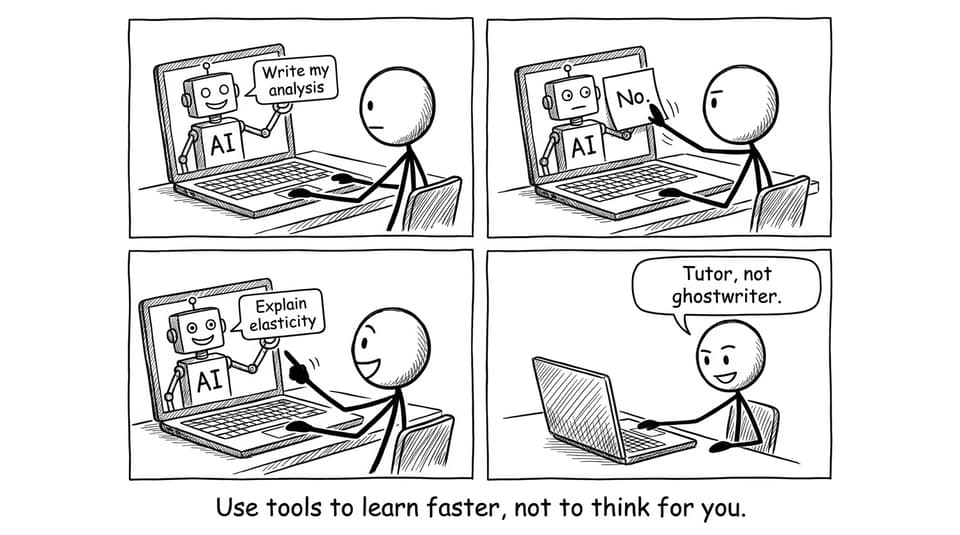
AI is similar. It can accelerate learning, but it should not replace your voice.
Ethical uses include:
-
Checking clarity and grammar
-
Quizzing yourself on definitions
-
Asking for explanations of a concept you already study
Risky uses include:
-
Generating paragraphs of analysis
-
Producing “evaluations” you do not understand
-
Inventing citations or statistics
If you want safe, learning-first support, RevisionDojo’s AI Chat is best treated like a tutor: ask it to explain concepts, test your understanding, or help you plan a structure, then write the work yourself.
How RevisionDojo supports integrity while you prepare for exams
Integrity gets harder when you are exhausted. That is why systems matter, especially when EE deadlines collide with exam prep.
RevisionDojo helps you keep work authentic while still moving fast:
-
Study Notes and Flashcards to anchor definitions and diagrams so you are not tempted to copy explanations
-
Questionbank for exam-style practice that trains you to write in your own words under pressure (see Questionbank and a syllabus section like Introduction to Economics Questionbank)
-
Grading tools to self-assess your EE and IA drafts against rubrics (e.g., the IB Economics IA Grader)
-
Mock Exams and Predicted Papers to rehearse performance honestly, not just content
-
A Coursework Library of exemplars to learn structure and standards without copying (start at IB Economics Exemplars)
-
Optional Tutors when you need human feedback on method, clarity, and evaluation
For students juggling IA writing as well, the article IB Economics IA: 7 Tips for a High-Scoring Commentary pairs well with EE work because it reinforces the same habit: evidence first, theory second, evaluation always.
Conclusion: In IB Economics, integrity is the strategy
A strong EE is not the one with the fanciest topic. It is the one with a clean chain of evidence, theory, and honest evaluation. In IB Economics, integrity is what turns research into something examiners can trust and you can be proud of.
If you want to build that trust while also preparing for exams, make RevisionDojo your home base: learn content with Study Notes and Flashcards, practise with the Questionbank, stress-test your writing with Grading tools, and use AI Chat as a tutor that helps you think more clearly. Your EE stays yours, and your preparation becomes calmer and more effective.