

If you have ever stared at a unit planner and thought, “This sentence can’t possibly matter,” you are not alone. In the MYP, the Statement of Inquiry (SOI) can feel like decoration--something teachers talk about and students tolerate.
But here is the quiet truth: when exams and assessments get stressful, you do not fail because you forgot one fact. You fail because you cannot see what the task is really about. A strong MYP Statement of Inquiry is basically a shortcut to meaning. It tells you what the unit is trying to prove, so your revision stops being random and starts being deliberate.
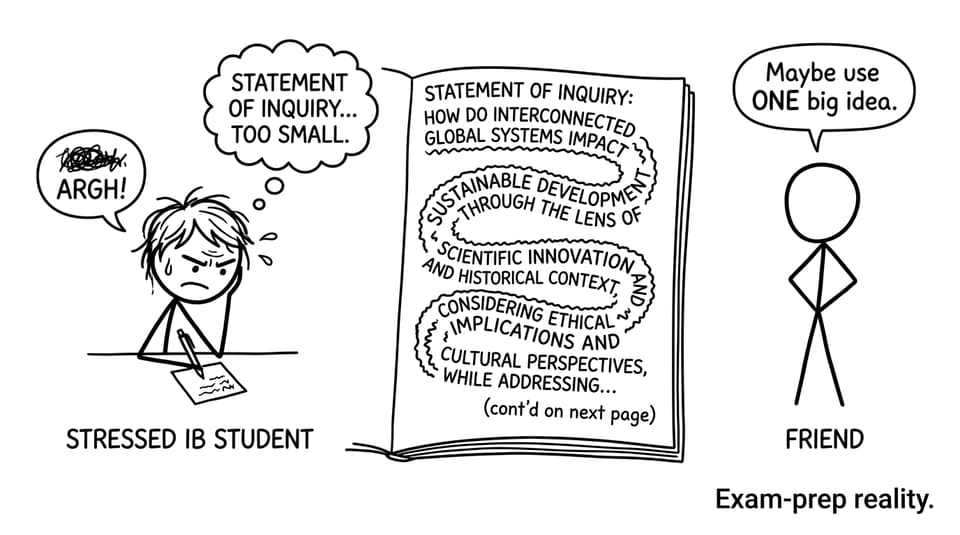
Quick checklist for a strong MYP Statement of Inquiry
Use this the next time you revise a unit or try to write your own MYP SOI:
-
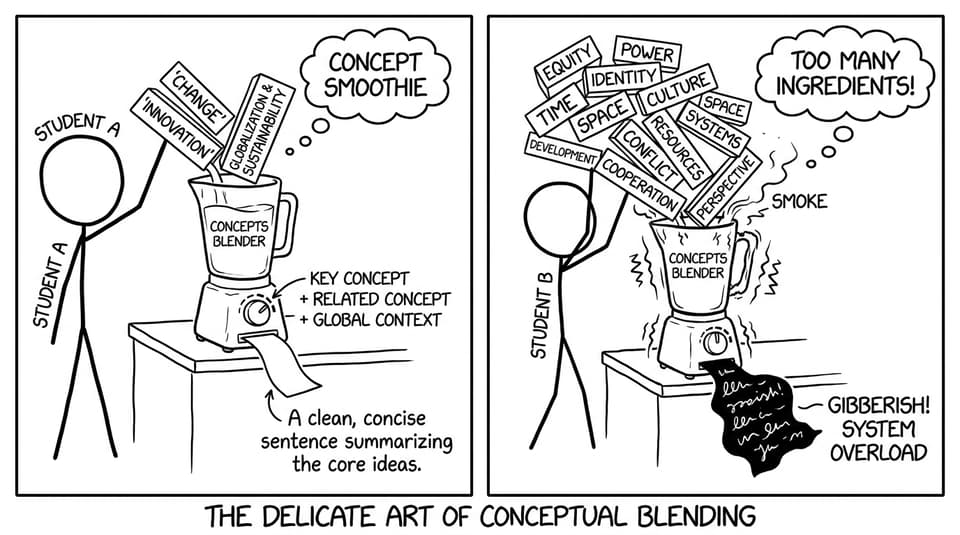
Include one key concept and one to three related concepts
-
Use one global context (not two “just in case”)
-
Write a complete conceptual claim (not a topic label)
-
Keep it transferable to different examples and subjects
-
Make it student-friendly: clear enough to guide revision
If you want a fast overview of the programme structure that sits behind this, start at the MYP hub.
Why the Statement of Inquiry matters for MYP exam prep
The SOI is not a slogan. In the MYP, it is a conceptual compass.
A good SOI helps you answer three exam-relevant questions:
-
What are we learning about? (concepts and skills)
-
Why does it matter? (global context and real-world relevance)
-
Where else can I use this? (transfer to unfamiliar questions)
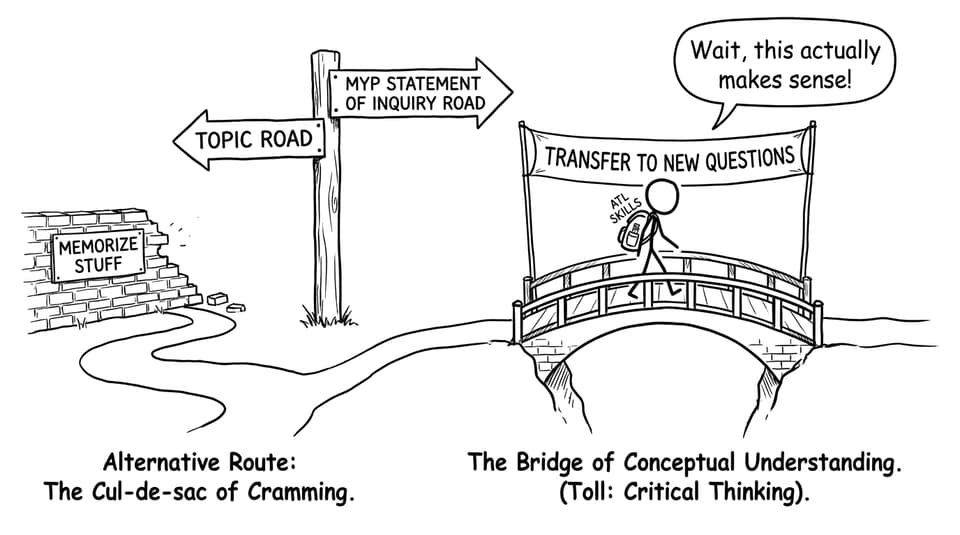
That last point is the secret. MYP assessments love unfamiliar scenarios. If you revise only “what we did in class,” you are training for the wrong fight. If you revise the SOI, you train your brain to move ideas between contexts.
For more about how units are meant to function conceptually, the post on Global Contexts and concept-driven teaching in MYP pairs well with this.
Start with the key concept (the big lens)
In the MYP, every unit begins with a key concept--a broad idea that travels across subjects. Think of it as the camera lens you are filming the unit through.
Examples of key concepts you will see often include:
-
Change (revolutions, chemical reactions, character development)
-
Relationships (ecosystems, power structures, geometry)
-
Systems (governments, circuits, narrative structures)
-
Identity (culture, language, self-representation)
When your key concept is right, your unit stops being “a chapter.” It becomes a reusable way of thinking.
Add related concepts (the subject-specific focus)
Related concepts narrow the key concept so it actually connects to your subject content. In the MYP, this is where your unit becomes precise.
A few examples:
-
Language and Literature: Communication + related concepts like audience, purpose, point of view
-
Sciences: Systems + related concepts like interaction, energy, evidence
-
Design: Development + related concepts like function, innovation, adaptation
When you revise, you can treat related concepts as your “evidence buckets.” If your SOI mentions interaction, then examples, data, and explanations should keep returning to interaction.
If you want more help seeing how inquiry is meant to work in practice, Inquiry-Based Learning in the MYP gives a clear framework you can apply as a student.
Choose one global context (the “why should humans care?”)
Global contexts are how the MYP forces schoolwork to touch the real world. They are not extra. They are the reason your unit is more than content.
The six official MYP global contexts are:
-
Identities and Relationships
-
Orientation in Space and Time
-
Personal and Cultural Expression
-
Scientific and Technical Innovation
-
Globalization and Sustainability
-
Fairness and Development
A strong global context choice creates tension--a reason to inquire. A weak choice feels pasted on.
To build intuition here, read Integrating Global Contexts Across Multiple Subjects in the MYP and then compare it with how your own units are framed.
Write the MYP Statement of Inquiry (simple, conceptual, transferable)
Now combine your ingredients into one sentence that makes a claim about how the world works.
A practical formula many MYP students can use:
Key concept + related concept(s) + a relationship/impact verb + global context lens
Try verbs like: shapes, influences, transforms, depends on, is challenged by, is sustained by, creates tension between.
Here are three sample SOIs (written to be conceptual, not factual):
-
Sciences: Systems are sustained or disrupted by interactions that affect sustainability.
-
Language and Literature: Communication influences identity by shaping how perspectives are expressed and received.
-
Design: Innovation changes quality of life when function is shaped by human needs and responsibility.
Notice what is missing: specific case studies, dates, definitions. Those belong in your evidence. The SOI is the “map.”
Stress-test your MYP SOI (so it actually helps you score higher)
A fast test: if your SOI sounds like a textbook fact, rewrite it.
Use these checks:
-
Can I argue with it? If not, it might be too obvious.
-
Can I apply it to a new example? If not, it is too narrow.
-
Can it generate different types of questions? If not, it will not drive inquiry.
Example refinement:
-
Weak: Renewable energy is good for the environment.
-
Stronger MYP version: Innovation influences sustainability by changing how societies manage resources.
The second sentence invites evidence, counterexamples, ethical discussion, and transfer.
Turn the SOI into exam-ready inquiry questions
In the MYP, good revision is question-driven. Once you have an SOI, build three question types that match how you are assessed:
-
Factual: What information do I need to describe accurately?
-
Conceptual: How do the concepts connect, and what patterns repeat?
-
Debatable: What is the best argument, and what evidence would challenge it?
Example SOI: Innovation transforms how societies communicate and solve problems.
-
Factual: What are two recent communication technologies and what do they do?
-
Conceptual: How does innovation change the way messages spread?
-
Debatable: Does innovation always improve society, or does it sometimes create new harms?
This is also where RevisionDojo becomes practical, not motivational. Use the Study Notes to rebuild missing knowledge fast, then shift quickly to active practice using the platform’s Questionbank, Flashcards, AI Chat, and Grading tools.

How to use MYP Statements of Inquiry to revise faster
Most students revise in “topic mode.” The MYP rewards “transfer mode.” Here is a simple routine:
-
Write your unit SOI at the top of a page.
-
List 3 examples from class that support it.
-
List 1 example that complicates it (a limitation, exception, ethical tension).
-
Do a timed response where every paragraph links back to the SOI.
If you want a structured schedule for doing that across subjects, use MYP eAssessments: 30-Day Study Plan That Works. And if you are practicing task formats and criteria alignment, Sample MYP Assessment Tasks for Every Subject Group helps you rehearse the real demands.
Closing: the MYP SOI is a shortcut to transfer
The most useful part of the MYP is also the easiest to ignore: it keeps asking you to think in ideas, not just information. A well-written Statement of Inquiry is the smallest tool that creates the biggest shift--from memorizing what happened to understanding why it matters.
If you want your next assessment to feel less like guessing, pick one unit tonight. Write the SOI from memory. Improve it using the checklist. Then practice one timed response where you keep linking back to it.
When you are ready to make that process repeatable, build your routine on RevisionDojo: start at the MYP hub, use Study Notes for fast clarity, drill with Questionbank and Flashcards, pressure-test with Mock Exams and Predicted Papers where available, and refine with AI Chat, Grading tools, the Coursework Library, and Tutors. The goal is not to write a perfect sentence--it is to use the MYP sentence that makes everything else make sense.