

If you have ever walked out of Science thinking about ecosystems, stepped into Language and Literature to analyze identity, and then opened Design to prototype a solution, you have already felt the quiet power of the MYP.
The program is built to stop learning from becoming a set of separate boxes. But when exams get closer, those boxes can snap shut again. You revise topic by topic, subject by subject, and suddenly the “big ideas” feel like a poster on a corridor wall.
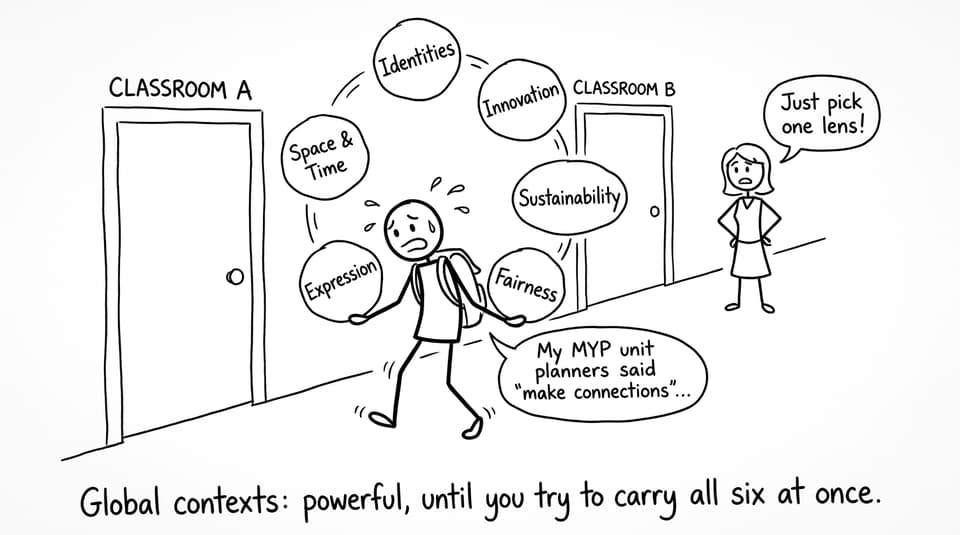
This is where MYP global contexts matter most. They are not decoration. They are a lens that helps you connect what you learn across classes and explain why it matters in the real world. And if you use them deliberately, they also make revision more efficient.
Quick checklist: integrating MYP global contexts fast
Use this before you revise a unit or plan an interdisciplinary connection in the MYP:
-
Name the unit’s global context in one sentence (“This is really about…”).
-
Write one debatable question that could work in at least two subjects.
-
Choose one concept you can transfer (systems, change, relationships, perspective).
-
Collect one piece of evidence per subject (data, quote, case study, design test).
-
Add a 3-line reflection: what changed in your thinking across subjects?
If you need a structure for exam prep alongside this, use the MYP Revision Guide: Study Tips for Success to build a routine that actually sticks.
The six global contexts in MYP (the exam-friendly version)
The MYP has six global contexts. You do not need to memorize long definitions, but you do need to recognize what kind of “why” each one creates:
-
Identities and Relationships: who we are, wellbeing, communities, human connection.
-
Orientation in Space and Time: history, place, turning points, perspective over time.
-
Personal and Cultural Expression: creativity, language, values, how meaning is shared.
-
Scientific and Technical Innovation: progress, invention, responsibility, unintended consequences.
-
Globalization and Sustainability: interconnected systems, resources, long-term impact.
-
Fairness and Development: justice, equity, rights, access, power.
For a deeper breakdown with examples, keep this open while you revise: Six Global Contexts in IB MYP: Real-World Applications.
Why integrating global contexts across subjects improves MYP exam prep
In the MYP, strong answers rarely sound like a textbook. They sound like a student who can transfer an idea into a new situation.
When you integrate global contexts across subjects, three exam-relevant things happen:
-
You remember content better because it sits inside a story (a context) instead of floating as facts.
-
You get faster at handling unfamiliar scenarios, because you practice applying the same lens repeatedly.
-
You write more convincingly, because you can explain significance, impact, and perspective.
This is also why RevisionDojo is built around active practice. The Questionbank trains application, not just recall, and Study Notes help you rebuild understanding quickly when a context reveals a gap.
How to integrate MYP global contexts across multiple subjects
Choose one “anchor” question that travels
A practical MYP trick: start with a question that can be answered differently in different subjects.
Example (Globalization and Sustainability):
-
Science: What evidence shows a system is becoming unstable?
-
Individuals and Societies: Who benefits and who pays the cost?
-
Design: What would a better system look like in practice?
Then revise with resources that match each subject. For instance, use MYP History Revision Notes to build case study detail, and use topic practice in the MYP Individuals and Societies Questionbank to train how you explain it.
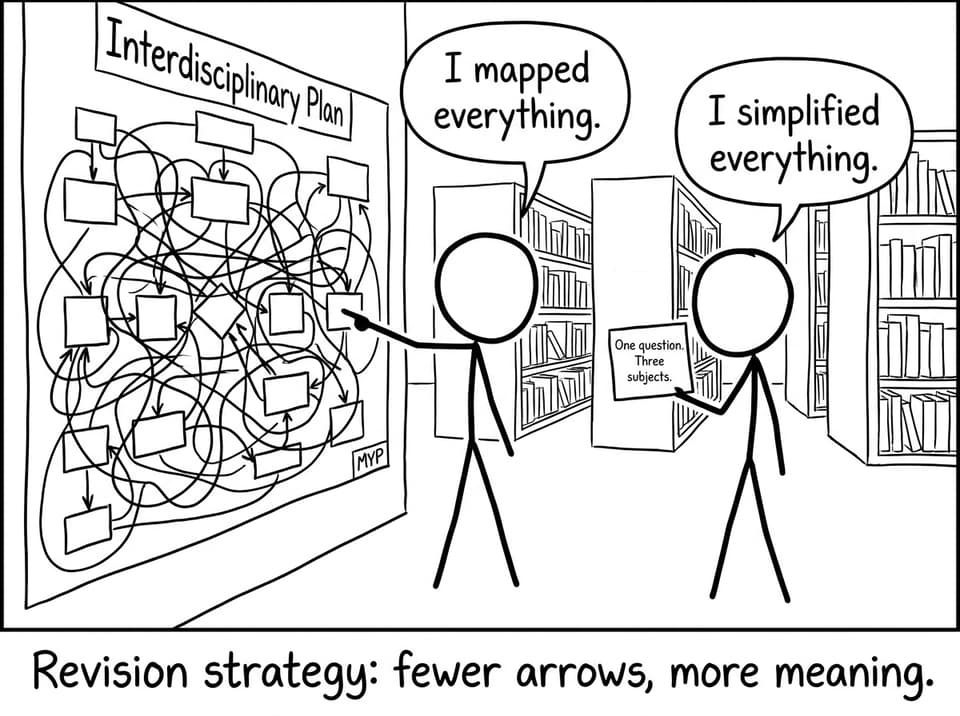
Map “one context, three subjects” instead of “everything connects to everything”
Students burn time by trying to force every unit into a giant interdisciplinary web. The better MYP approach is selective:
-
Pick one global context.
-
Pick two supporting subjects.
-
Write three connections that are specific enough to be assessed.
If you are doing a Design unit, see how that looks when it is done well in Embedding Global Contexts in MYP Design Projects.
Localize the global (your strongest revision shortcut)
Global contexts work best when you can name a real example. “Sustainability” becomes easier when you can point to your community: transport, waste, food sourcing, energy use.
This is also how you generate better evidence for projects and written tasks. If you are working on a project, use Identifying the Best Global Context for Your MYP Project to make your choice feel logical, not random.
Use reflection as a scoring tool, not a diary
In the MYP, reflection should show thinking changing over time. A useful sentence frame is:
- “At first, I thought ___ (subject A). Now I think ___ because ___ (subject B evidence).”
On RevisionDojo, students often use AI Chat to turn rough reflections into clearer, criteria-aligned writing, then check quality with Grading tools when available. When you need models of what to avoid, Common MYP Personal Project Mistakes (and Fixes) is a quick reality check.
A simple MYP integration routine for exam weeks
Here is a realistic weekly loop that integrates MYP global contexts without taking over your life:
-
Monday: pick one context and one anchor question.
-
Tuesday: build core knowledge with MYP Chemistry Notes or another subject’s notes.
-
Wednesday: do timed practice in a Questionbank topic (for example, MYP Standard Mathematics Questionbank).
-
Thursday: write a short cross-subject explanation (6--8 sentences).
-
Friday: do one mixed practice set and create 5 Flashcards for recurring mistakes.
If you want a full schedule, adapt the structure from MYP eAssessments: 30-Day Study Plan That Works.
Frequently asked questions
Do all MYP units have to use a global context?
Yes, every MYP unit should be grounded in one global context, because the context frames the inquiry and gives the learning real-world significance. This is not just for big projects; it is part of how unit planners are designed across subject groups. If you are revising and cannot identify the context quickly, that is usually a sign you are studying content without the unit’s purpose. A good fix is to open your unit’s Statement of Inquiry and ask what “why it matters” it implies. Then test it by writing one debatable question that the context naturally supports. Once that question exists, your revision becomes more focused and exam-friendly.
Can multiple subjects share the same MYP global context at the same time?
Absolutely, and in a strong MYP curriculum, this happens often. The point is not to keep contexts separate by department, but to use them as shared lenses that help ideas transfer. What matters is that each subject still keeps its own disciplinary methods: Science uses evidence and models, Individuals and Societies uses sources and perspectives, Language and Literature uses authorial choices and interpretation. When subjects share a context, you get a helpful comparison: the same global issue looks different depending on the toolkit you use. For exam prep, this builds flexibility, because you practice shifting approaches while keeping a consistent lens. That is exactly the kind of thinking the MYP is trying to develop.
How do I avoid using global contexts in a superficial way in MYP work?
The quickest way to spot superficial use in the MYP is this: if the context could be swapped with another context and nothing in your work would change, it is too shallow. To add depth, make the context shape decisions: which case study you choose, what evidence you collect, what stakeholders you consider, and what success would look like. Use “because” sentences to show causality: “I chose this example because it highlights fairness through access to ___.” Also, build one explicit cross-subject link, even if it is small, like borrowing a concept (systems, perspective, relationships) and applying it in a different subject’s format. Finally, ask for feedback using criteria language, not vibes: RevisionDojo’s AI Chat, Grading tools, and Tutors are useful here because they push you to justify and clarify.
Conclusion: make MYP feel like one story
The MYP is at its best when your subjects stop acting like separate islands. Global contexts are the bridges. When you revise with those bridges in mind, you do not just remember more; you explain better, apply faster, and feel less overwhelmed.
If you want that integration to turn into scores, build a simple loop: Study Notes for clarity, Questionbank for application, Flashcards for retention, AI Chat for sharpening explanations, and Mock Exams for pressure training. Start from the RevisionDojo homepage to find your subject pathway and keep your MYP revision connected, purposeful, and calm.