A coordination number mistake that costs easy marks
The night before an IB Chemistry exam, it’s strangely easy to feel confident about complex ions. You can name ligands. You can spot a charge. You can even draw an octahedron that looks vaguely like a lopsided cube.
Then a question asks for the coordination number of a complex containing a bidentate ligand, and suddenly everything feels slippery. You count the ligands, not the donor atoms. You write “3” instead of “6.” And the mark disappears for a reason that feels unfair until you see it clearly.
Coordination number is small, but it’s structural. In IB Chemistry, it quietly determines geometry, color trends, stability, and how ligand exchange questions behave. Learn it once, and half of Topic 13 starts to feel less mystical.
Coordination number checklist (fast exam method)
Use this quick checklist in IB Chemistry whenever you see a complex ion:
-
Identify the central metal ion.
-
Identify each ligand and whether it is mono/bidentate/polydentate.
-
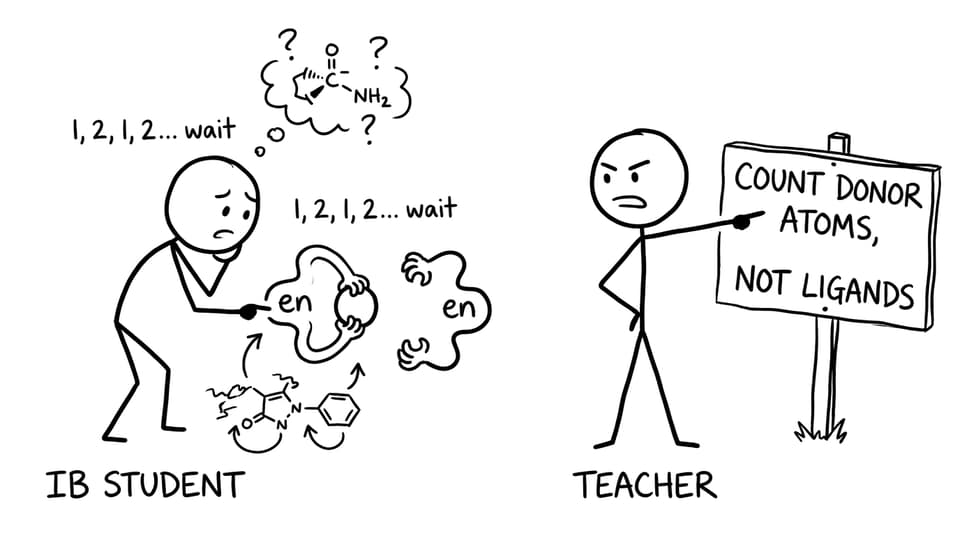
Count donor atoms bonded to the metal (not the number of ligands).
-
Use the coordination number to predict the most likely geometry.
-
Sanity-check: coordination numbers in IB Chemistry are commonly 2, 4, or 6.
If you need a refresher on what makes a complex ion a complex ion, read What Is a Complex Ion?.
What is coordination number in IB Chemistry?
In IB Chemistry, coordination number is the number of ligand donor atoms directly bonded to the central metal ion.
That definition is the whole game. “Donor atoms” is the phrase students skip, and it’s the phrase examiners reward.
Two key consequences:
-
A ligand can count as more than 1 if it binds through multiple atoms.
-
Coordination number is about attachments, not names.
This sits right next to coordinate bonding, so if the arrow notation or lone-pair donation still feels hazy, revisit What Is a Coordinate Bond?.
How to determine coordination number (with clean examples)
A reliable way to think in IB Chemistry: each coordinate bond from ligand to metal contributes one to the coordination number.
Example: hexaaquacopper(II)
\\text{\[Cu(H}\_2\\text{O)}\_6\\text{}^{2+}]
-
Water is monodentate (one donor oxygen atom).
-
There are 6 waters donating 1 lone pair each.
-
Coordination number = 6.
Example: diamminesilver(I)
\\text{\[Ag(NH}\_3\\text{)}\_2\\text{}^{+}]
-
Ammonia is monodentate (one donor nitrogen atom).
-
There are 2 ammonias.
-
Coordination number = 2.
When you practice these, mix in exam-style wording. RevisionDojo’s Questionbank is ideal because the “trap phrasing” shows up again and again, and the feedback helps you stop making the same counting error.
Monodentate vs polydentate ligands (why students miscount)
Most coordination number mistakes in IB Chemistry come from treating all ligands like they attach once.
Monodentate ligands (attach once)
Common IB Chemistry examples include:
-
(\text{H}_2\text{O})
-
(\text{NH}_3)
-
(\text{Cl}^-)
-
(\text{CN}^-)
Each contributes 1 donor atom.
Bidentate ligands (attach twice)
Examples:
-
ethylenediamine (en)
-
oxalate (\text{C}_2\text{O}_4^{2-})
Each contributes 2 donor atoms.
Example:
\\text{\[Co(en)}\_3\\text{}^{3+}]
-
3 en ligands
-
each binds through 2 nitrogens
-
coordination number = 6
Chelation is the story behind why multidentate ligands often stabilize complexes so strongly. See What Is Chelation? to connect coordination number to the chelate effect.
Common coordination numbers and geometries in IB Chemistry
Coordination number is your shortcut from formula to 3D shape in IB Chemistry.
Coordination number 6: octahedral
Typical examples:
-
(\text{Fe(H}\_2\\text{O)}\_6\\text{}^{3+})
-
(\text{Cr(NH}\_3\\text{)}\_6\\text{}^{3+})
-
(\text{Co(en)}\_3\\text{}^{3+})
Octahedral complexes also set up classic crystal field splitting patterns. If color questions appear, pair this with Crystal Field Splitting Explained and Why Transition Metals Form Colored Compounds.
Coordination number 4: tetrahedral or square planar
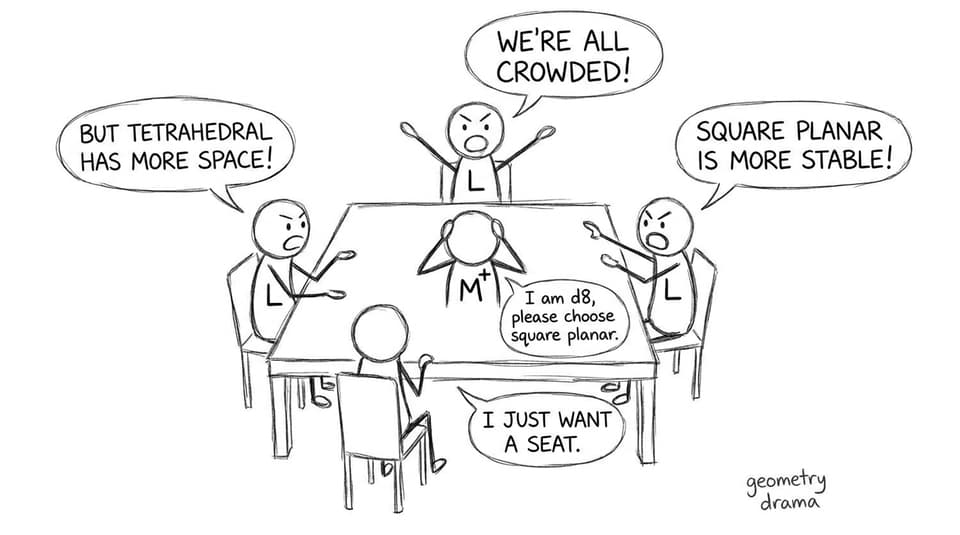
Same coordination number, two personalities:
-
Tetrahedral: often with larger ligands, e.g. (\text{CuCl}\_4\\text{}^{2-})
-
Square planar: common for (d^8) metal ions like (\text{Pt}^{2+}), e.g. (\text{PtCl}\_4\\text{}^{2-})
Coordination number 2: linear
Examples:
-
(\text{Ag(NH}\_3\\text{)}\_2\\text{}^{+})
-
(\text{AuCl}\_2\\text{}^{-})
If you need more context on why transition metals behave this way in IB Chemistry, read What Are Transition Metals?.
Why coordination number matters (beyond “shape”)
In IB Chemistry, coordination number shows up as a practical tool:
-
Geometry: linear vs tetrahedral vs square planar vs octahedral.
-
Color: geometry changes splitting patterns and therefore absorption; see Why Transition Metals Form Colored Ions.
-
Stability: multidentate ligands can lock in coordination numbers via the chelate effect.
-
Ligand exchange: coordination environments can shift during substitution; see Ligand Exchange Explained.
And if you want the bigger roadmap for what can be tested, keep IB Chemistry Syllabus: A Complete Student Guide bookmarked.
Bringing it home: how to lock coordination number for IB Chemistry exams
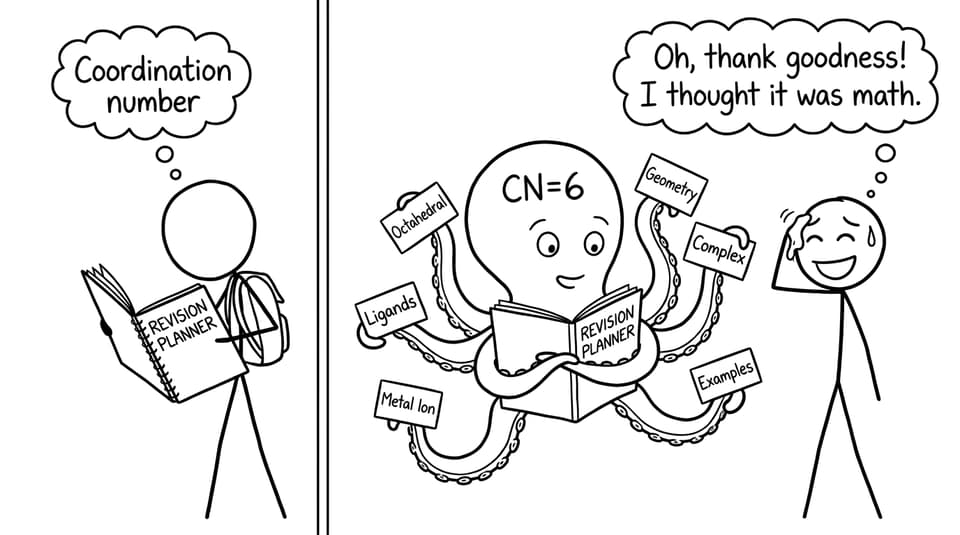
Coordination number is the quiet lever in IB Chemistry transition metal questions. Count donor atoms, map to geometry, and suddenly colors, stability, and ligand exchange feel like consequences instead of trivia.
If you want this to become automatic, use RevisionDojo as your workflow: Study Notes for clean definitions, Flashcards for quick recall, the Questionbank for exam-style traps, AI Chat for “why is this 6 and not 3?”, and Predicted Papers plus Mock Exams to pressure-test timing. Coordination number is simple once it’s yours. And in IB Chemistry, simple ideas done carefully are how scores climb.



