


A strange thing happens in IB Chemistry when you stare at a Lewis structure long enough: you realize some bonds are basically one-sided generosity.
It’s the kind of detail that feels small until an exam question asks you to explain why NH₄⁺ exists, or to identify the ligand in a complex ion, or to justify an arrow in a mechanism. That’s where the coordinate bond (also called a dative covalent bond) quietly decides whether your explanation sounds like chemistry or like guesswork.
In this post, you’ll learn what a coordinate bond is, how to spot one quickly, and how to write it the way IB markschemes like it.
Coordinate bond quick checklist (exam speed)
Use this fast filter in IB Chemistry whenever bonding looks “uneven”:
-
Does one species have a lone pair to donate?
-
Does the other species have an empty orbital (or is it electron-deficient, like H⁺ or BF₃)?
-
If yes, the bond can be coordinate.
-
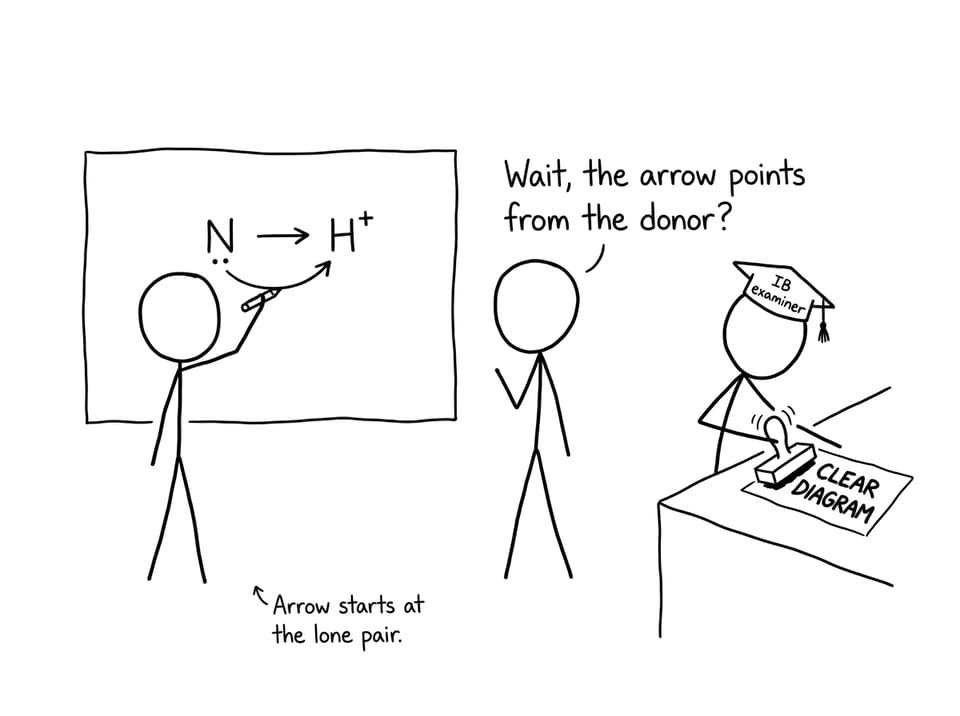
Draw an arrow from donor to acceptor when showing formation.
-
After formation, treat it like a normal covalent bond for shape and counting bonding pairs.
If you want definitions in tight IB wording, the IB Chemistry Key Definitions page is a handy reference.
What is a coordinate bond in IB Chemistry?
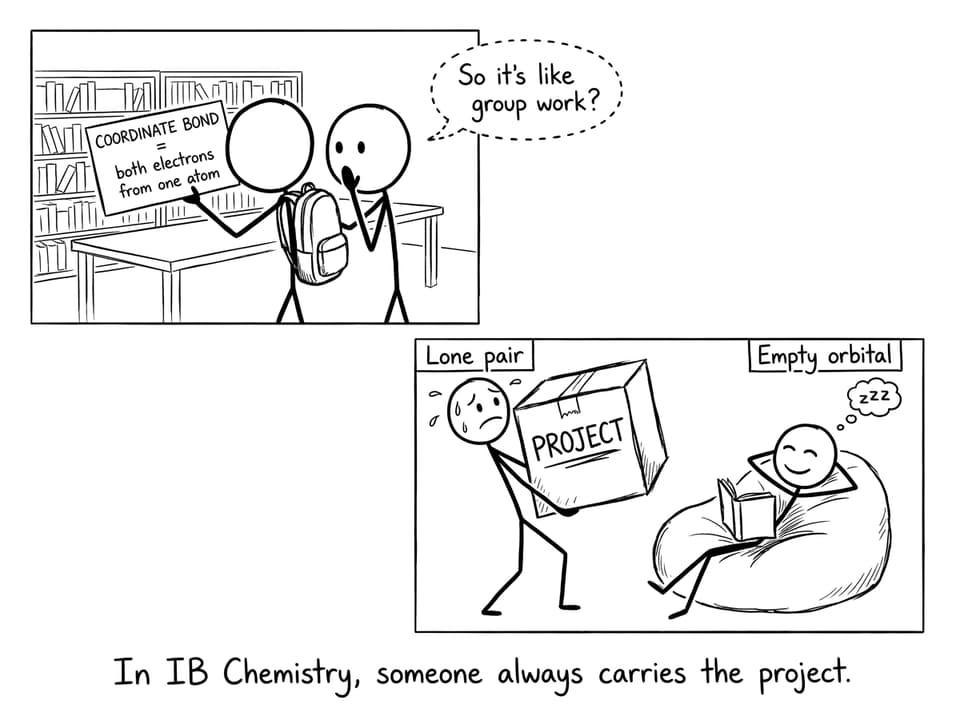
A coordinate bond is a covalent bond where both electrons in the shared pair come from the same atom (or ion).
That’s it. Same end result as a covalent bond (a shared pair), but a different origin story.
In a typical covalent bond, each atom contributes one electron to the pair. In a coordinate bond, the donor supplies both electrons, and the acceptor simply provides space: an empty orbital ready to hold that pair.
In IB Chemistry, you’ll also see the term dative covalent bond used interchangeably.
For broader bonding context (ionic vs covalent vs metallic), RevisionDojo’s Chemical Bonding and Structure notes can help you zoom out before zooming back in.
How coordinate bonding forms: donor, acceptor, and the arrow
Two roles matter:
The donor (Lewis base)
The donor has a lone pair and can donate an electron pair.
In Lewis terms, that makes it a Lewis base. For a clear IB-aligned explanation, see Lewis acid (HL) notes.
The acceptor (Lewis acid)
The acceptor has an empty orbital and can accept an electron pair.
In Lewis terms, that makes it a Lewis acid (common acceptors include H⁺, metal ions, and electron-deficient molecules like BF₃).
The arrow convention (easy marks)
When showing formation, use an arrow that points:
- from donor to acceptor
It’s a small drawing choice that signals you understand what’s happening.
Core examples you must know for IB Chemistry
Coordinate bonds show up across the syllabus, but these are the exam favorites.
Ammonium ion, NH₄⁺
Ammonia (NH₃) has a lone pair on nitrogen. A hydrogen ion (H⁺) has no electrons and effectively an empty orbital.
-
NH₃ donates its lone pair to H⁺
-
A coordinate bond forms to make NH₄⁺
Once NH₄⁺ exists, all N-H bonds are treated equivalently in most representations.
Hydronium ion, H₃O⁺
Water (H₂O) donates a lone pair to H⁺.
- H₂O + H⁺ → H₃O⁺
This is a clean example because it connects bonding to acid behavior without requiring transition metals.
Complex ions (transition metal chemistry)
In IB Chemistry HL, complex ions are where coordinate bonding becomes a whole chapter of logic.
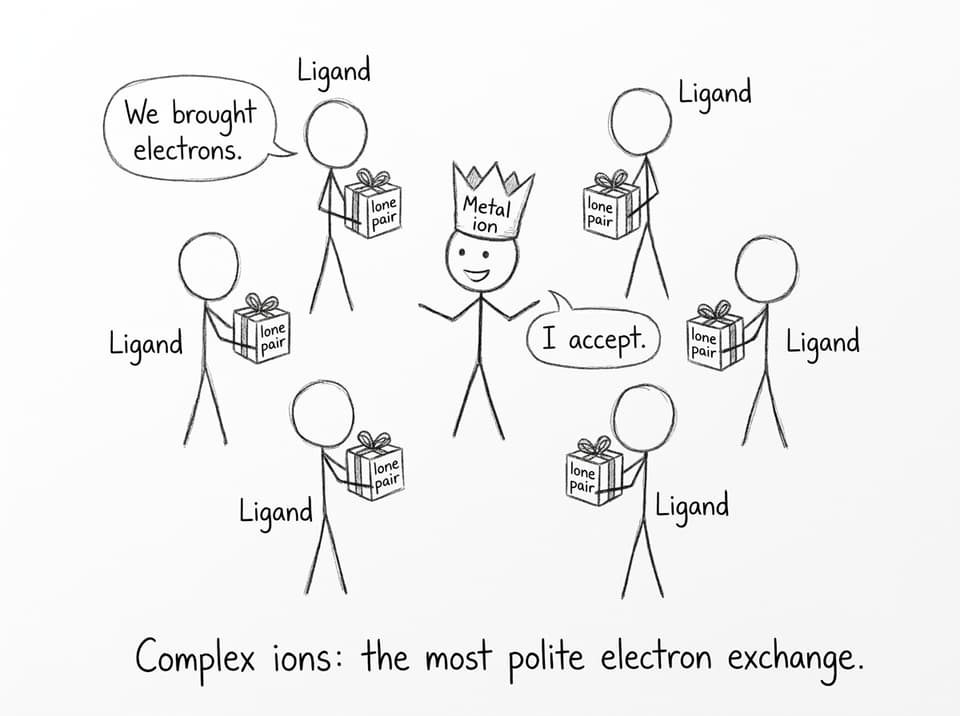
A ligand donates a lone pair to a central metal ion, forming coordinate bonds.
Common examples include:
-
[Cu(H₂O)₆]²⁺
-
[Ag(NH₃)₂]⁺
-
[Fe(CN)₆]³⁻
If you want a focused overview, read What Is a Complex Ion? and pair it with IB Chemistry: Coordination Number Explained Simply for quick geometry marks.
Why coordinate bonds matter (beyond definitions)
Coordinate bonding matters in IB Chemistry because it explains things you can’t fully justify with “normal” covalent bonding alone.
It connects bonding to Lewis acid-base theory
The Lewis model is tested because it’s flexible: acids and bases are defined by electron pairs, not just protons.
Coordinate bond formation is often the physical event behind a Lewis acid-base reaction. If you’re revising that area, the Lewis acids and bases Questionbank is a high-yield place to practice.
It unlocks transition metal explanations
Once you accept that ligands donate lone pairs, several HL topics start to click: complex stability, ligand exchange, and even color.
If you’re revising those links, these are useful next steps:
Common mistakes IB Chemistry students make
-
“Coordinate bonds are stronger than covalent bonds.” Not automatically. After formation, a coordinate bond behaves like a covalent bond of the same type.
-
“They only happen in metal complexes.” NH₄⁺ and H₃O⁺ are classic counterexamples.
-
“The donor loses its lone pair forever.” The lone pair becomes the bonding pair. It’s still part of shared electron density.
-
“You must always draw the arrow.” Use the arrow to show formation. Many final structures are drawn with normal single lines.
Final takeaway: coordinate bonds are “electron pair stories”
A coordinate bond in IB Chemistry is simply a covalent bond where both electrons come from the same species: a lone pair donor bonds to an acceptor with an empty orbital. Mastering that story helps you explain NH₄⁺ and H₃O⁺ cleanly, and it becomes essential when complex ions and ligands enter the picture.
When you’re ready to turn understanding into exam marks, RevisionDojo is built for the full loop: Study Notes to learn, Flashcards to retain, AI Chat to clarify, Grading tools to refine explanations, and Questionbank practice to make coordinate bonding feel automatic. You can also build Mock Exams, use Predicted Papers for structured revision, and lean on the Coursework Library and Tutors when a topic needs a second angle. Start from the IB Chemistry home hub and keep your IB Chemistry revision simple, consistent, and sharp.


