

Transition metal color is one of those IB Chemistry ideas that feels like magic the first time you see it. A pale blue solution turns deep royal blue after a few drops of ammonia, and suddenly the lab smells like confidence. The truth is calmer (and more powerful): color is what you get when tiny energy gaps inside a complex ion match the energy of visible light.
In IB Chemistry, this topic sits right where bonding, electron configuration, and data questions meet. If you can explain why transition metals form colored compounds, you can usually also explain ligand exchange, oxidation state shifts, and why some ions stubbornly stay colorless.
Quick checklist for IB Chemistry answers
Use this as a fast structure when an IB Chemistry question asks you to explain a color or a color change:
-
State that the species is a transition metal complex ion with partially filled d-orbitals.
-
Explain d-orbital splitting in a ligand field (crystal field splitting).
-
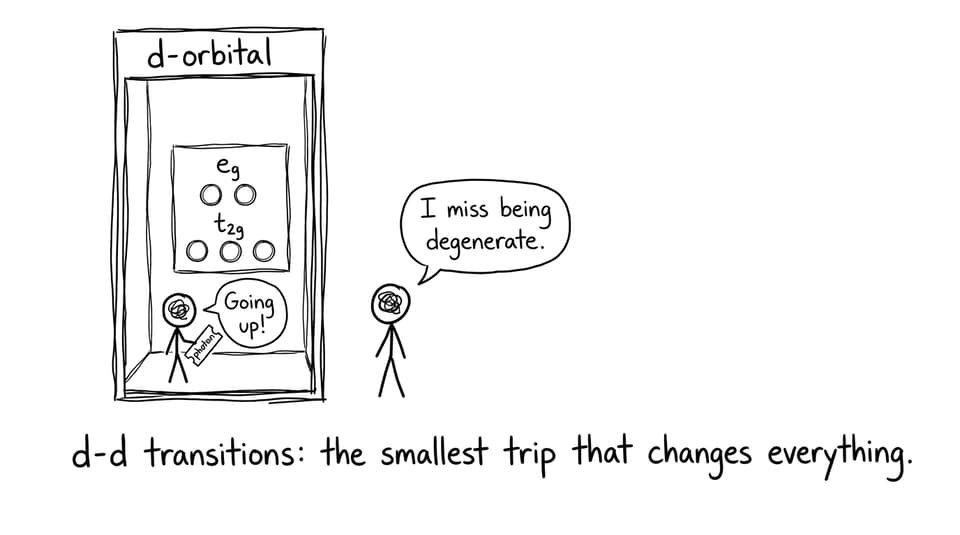
Say electrons absorb visible light to move from lower to higher split d-orbitals (a d-d transition).
-
The observed color is the complementary color of the absorbed wavelength.
-
Mention what changes Δ (delta): metal ion, oxidation state, ligand, geometry.
If you need a solid definition refresher, revise What Are Transition Metals? and then link the definition directly to color formation.
The real reason transition metals are colorful in IB Chemistry
IB Chemistry doesn’t ask you to memorize random colors as trivia. It asks you to connect color to structure.
A transition metal ion has five d-orbitals. In a free ion, those orbitals are at the same energy (degenerate). But when ligands surround the metal and form a complex ion, the ligands’ electron density repels the d-electrons unevenly. Some d-orbitals experience more repulsion and move up in energy; others move down.
That split creates an energy gap called Δ (crystal field splitting energy). If Δ matches the energy of visible light, the complex absorbs particular wavelengths. Your eye sees what’s left over (transmitted/reflected light), so the solution appears the complementary color.
For a deeper HL-friendly walkthrough, use Crystal Field Splitting Explained. It’s one of the cleanest ways to turn “pretty colors” into a scoring explanation.
Why partially filled d-orbitals matter (and why some ions are colorless)
Here’s the part IB Chemistry examiners love because it’s a sharp, logical filter:
-
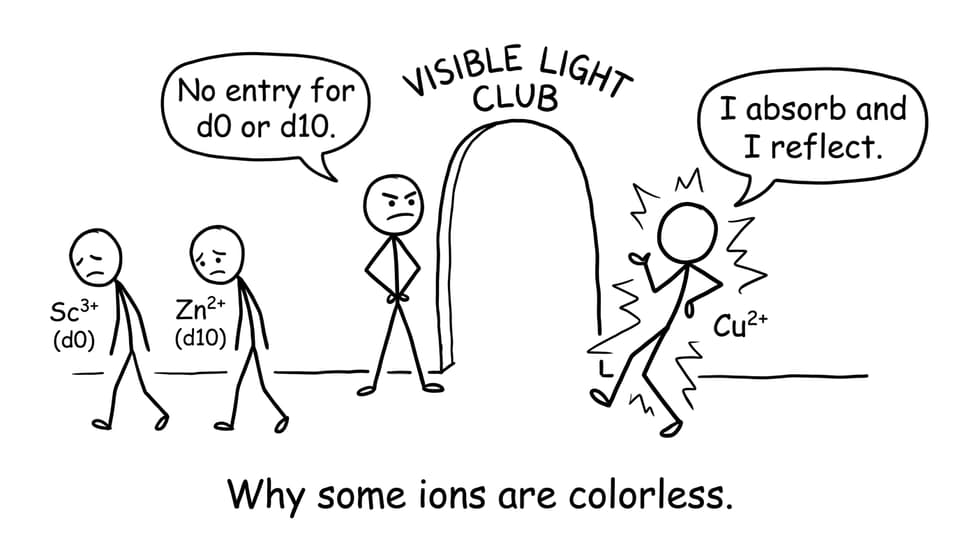
If the metal ion is d⁰, there are no d-electrons to excite.
-
If the metal ion is d¹⁰, all d-orbitals are full, so there’s no available higher d-level for a d-d transition.
So those complexes tend to be colorless (at least with respect to d-d transitions).
Classic examples you can mention:
-
Sc³⁺ is d⁰ (colorless)
-
Zn²⁺ is d¹⁰ (colorless)
This is also why the IB definition of a transition metal (forms at least one ion with a partially filled d-subshell) matters. If you want the broader complex-ion context for IB Chemistry, see What Is a Complex Ion?.
What changes the color? Four variables IB Chemistry expects
Metal ion identity
Different metals have different nuclear charge and different d-electron arrangements, so they produce different Δ values and absorb different wavelengths.
Commonly tested patterns:
-
Cu²⁺ complexes are often blue
-
Ni²⁺ complexes are often green
-
Fe³⁺ complexes are often yellow/brown
Oxidation state
Higher oxidation state usually means the metal ion attracts ligands more strongly. That tends to increase Δ, shifting the wavelength absorbed (often toward higher-energy, shorter wavelength light).
This is why Fe²⁺ and Fe³⁺ can look different even with similar ligands.
Ligand identity (spectrochemical series)
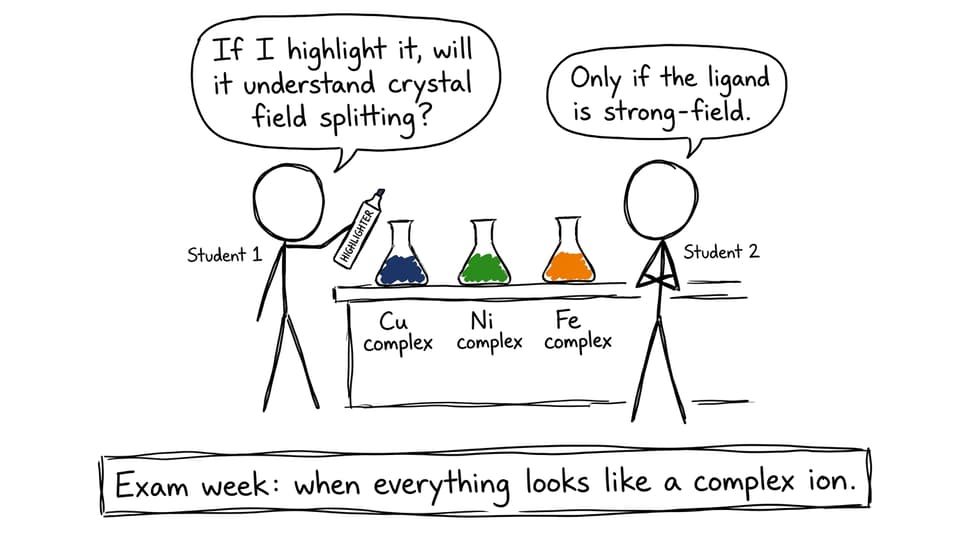
Ligands vary in “field strength.” Strong-field ligands (like CN⁻, NH₃) generally produce a larger Δ than weak-field ligands (like H₂O, halides). Bigger Δ means the complex absorbs different wavelengths, so the observed color changes.
Color-change questions often hide this point inside a reaction that looks simple. If you’re revising those reactions, Ligand Exchange Explained is the most exam-relevant bridge between theory and observation.
Geometry and coordination number
Octahedral, tetrahedral, and square planar complexes split d-orbitals differently. Even with the same metal and ligands, changing geometry changes Δ and therefore changes the absorbed wavelength.
For targeted syllabus practice on this exact skill, use S3.1.10 Color of transition metal complexes.
Exam-style examples you can describe confidently
IB Chemistry questions often reward students who can name a plausible complex and connect it to the mechanism.
-
Hydrated copper(II):
[Cu(H₂O)₆]²⁺ appears blue because Δ corresponds to visible absorption and a d-d transition is possible. -
Ligand exchange with ammonia:
When NH₃ replaces some H₂O ligands, Δ changes because NH₃ is a stronger-field ligand than water. A new wavelength is absorbed, so the color deepens. -
Chloride vs water complexes:
Substituting ligands (often changing geometry too) shifts Δ and can push the observed color toward green/yellow.
To drill this in a way that feels like real IB Chemistry marking, practice with the RevisionDojo Questionbank, then use AI feedback to tighten your phrasing and pick up the missing “because” statements that usually cost marks.
How to revise this fast with RevisionDojo
When color questions show up late in a paper, they’re testing calm logic under time pressure. A good workflow:
-
Read the core topic hub: IB Chemistry: The Periodic Table and Transition Metals (HL)
-
Convert definitions and key links (Δ, d⁰/d¹⁰, ligand strength) into active recall using RevisionDojo Flashcards
-
Build timed sets with IB Chemistry resources and track what you miss
-
Before mocks, simulate pressure using IB Chemistry Predicted Papers and mark with the grading tools
Those steps keep IB Chemistry revision from becoming passive reading. You’re practicing the explanation, not just recognizing it.
Conclusion: turn color into marks
Transition metals form colored compounds because complex formation splits d-orbitals, enabling d-d transitions that absorb visible light. The color you see is the complement of what’s absorbed, and the exact shade depends on Δ, which depends on the metal ion, oxidation state, ligands, and geometry. That single chain of reasoning is worth repeating until it feels automatic in IB Chemistry.
If you want this to become a reliable exam skill, revise the core notes, then practise explanations under time pressure using RevisionDojo’s Questionbank, Flashcards, AI Chat, Grading tools, Predicted Papers, Mock Exams, Coursework Library, and Tutors. When the next “explain the color change” question appears, you’ll have a structure ready, and the confidence to use it.