


Complex ions have a funny way of showing up exactly when you’re tired: a pale blue solution turns deep blue, your teacher says “ligand exchange,” and suddenly your brain decides it would rather think about lunch.
But in IB Chemistry, complex ions aren’t a side story. They’re the language behind transition metal colors, stability, and the “why did it change?” observations that examiners love. Once you see complex ions as a simple relationship (a metal ion + electron pair donors), the whole topic stops feeling like magic and starts feeling predictable.
If you’re revising for exams, this article will help you define a complex ion clearly, link the definition to coordination number and geometry, and explain color changes without accidentally claiming everything is oxidation.
Complex ion overview (fast exam checklist)
Use this mini checklist whenever you see brackets like [ ] in IB Chemistry:
-
Identify the central metal ion and its charge.
-
Identify the ligands (and whether they’re neutral or negative).
-
State coordinate (dative) bonding: ligands donate a lone pair.
-
Find the coordination number (count donor atoms attached).
-
Predict likely geometry (2, 4, or 6 are the classics).
-
If color changes, consider ligand exchange before oxidation.
For coordination number practice, keep this on hand: Coordination Number Explained Simply.
What is a complex ion in IB Chemistry?
A complex ion is a charged species made of a central metal ion surrounded by ligands that donate lone pairs of electrons to form coordinate bonds.
That sentence is worth memorising in IB Chemistry because it hits every marking point: metal ion, ligands, lone pairs, coordinate bonding, charge.
Common examples include:
-
^{2+}
-
^{4-}
-
^{+}
When you want a broader transition-metal refresher (and the IB definition), this helps: What Are Transition Metals?.
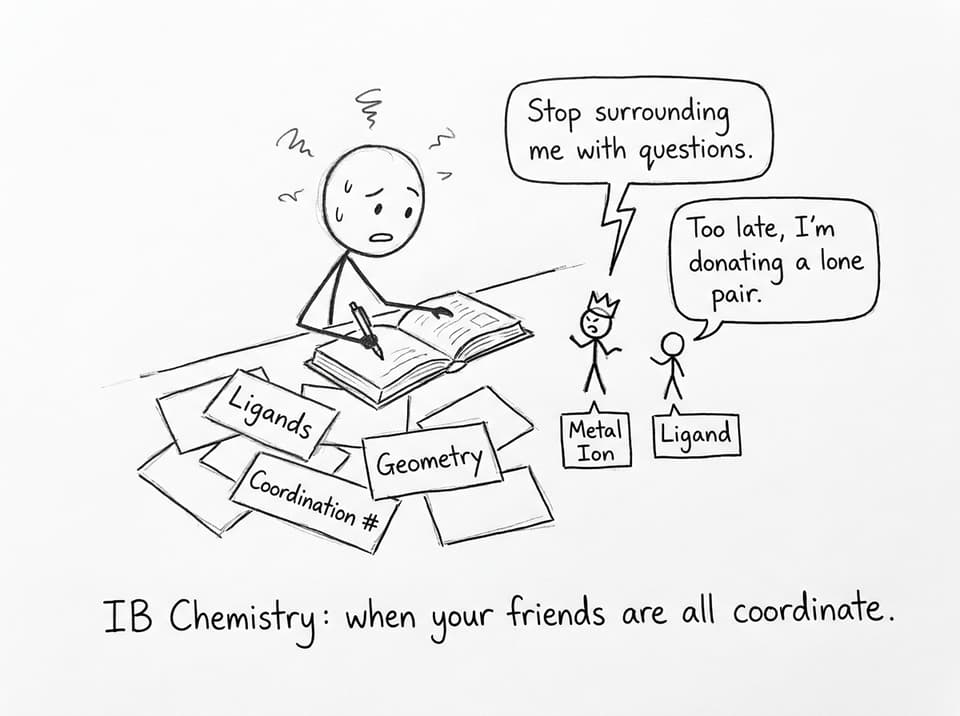
Ligands: the “surrounding cast” that changes everything
In IB Chemistry, a ligand is any ion or molecule that can donate a lone pair to a metal ion.
Typical ligands you’ll see in exam questions:
-
H_2O (neutral)
-
NH_3 (neutral)
-
Cl^- (negative)
-
OH^- (negative)
-
CN^- (negative)
-
en (ethylenediamine, neutral, bidentate)
Ligands aren’t just labels. They influence:
-
the stability of the complex
-
the geometry that forms
-
the size of d-orbital splitting, which affects color
For quick drilling of definitions, these are handy: Ligands and coordination bond flashcards.
Coordinate bonding: the one arrow you must explain
A coordinate bond (dative covalent bond) is a covalent bond where both electrons in the shared pair come from the same atom, the ligand.
That’s why you’ll sometimes see notation like:
- NH_3: \u2192 Cu^{2+}
In words: ammonia donates a lone pair into an empty orbital on the metal ion.
If coordinate bonding still feels slippery, revise it directly here: What Is a Coordinate Bond?.
Coordination number and geometry (how to grab easy marks)
Coordination number is the number of donor atoms directly bonded to the metal ion.
In IB Chemistry, the most common pairings are:
-
6 \u2192 octahedral
-
4 \u2192 tetrahedral or square planar
-
2 \u2192 linear
Examples:
-
^{2+} has coordination number 6 (octahedral)
-
^{2-} has coordination number 4 (often tetrahedral)
-
^{+} has coordination number 2 (linear)
This is where students lose marks by counting ligands instead of donor atoms. A bidentate ligand is one ligand, but it can contribute two donor atoms.
Why complex ions are coloured in IB Chemistry
The calm explanation is also the scoring one: when ligands approach, they create an electric field that splits the metal’s d-orbitals into different energy levels. Electrons can absorb visible light to jump between these levels (a d-d transition). The colour you see is the complementary colour of what is absorbed.
If you want a clean, exam-ready version of this, use: Crystal Field Splitting Explained and Why Transition Metals Form Colored Ions.
Stability, chelation, and “why won’t it fall apart?”
Some complex ions swap ligands easily. Others behave like they’ve signed a long-term contract.
Stability in IB Chemistry depends on factors such as:
-
metal ion charge density (higher charge often binds ligands more strongly)
-
ligand strength (spectrochemical series idea)
-
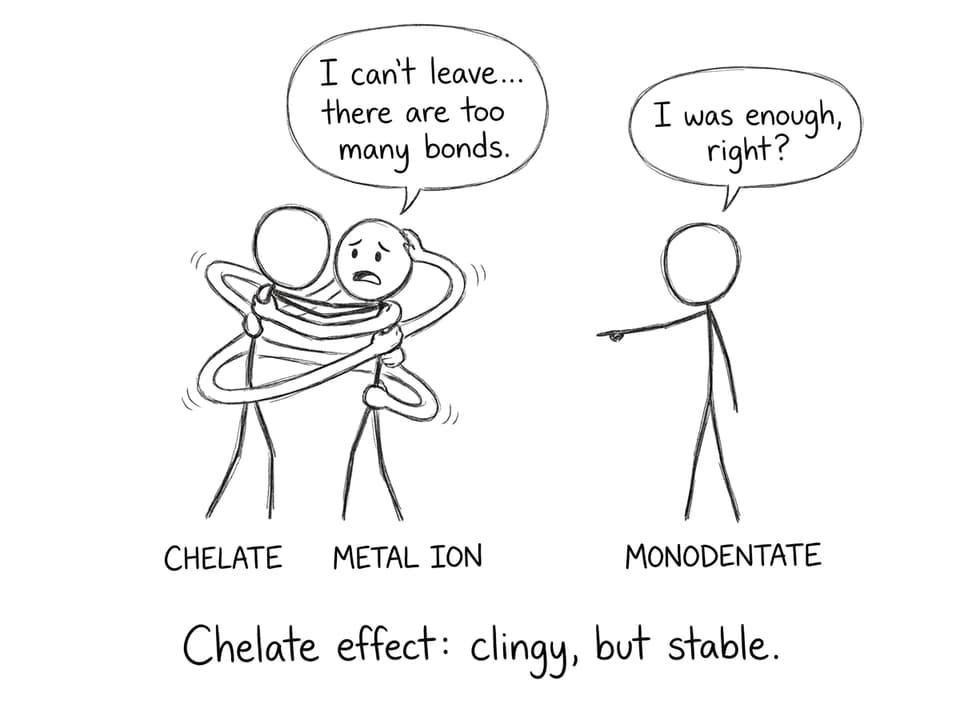
the chelate effect (multidentate ligands form extra-stable complexes)
Chelation is examinable because it’s such a clean reasoning tool: a ligand that attaches in multiple places forms ring structures and tends to create a more stable complex than similar monodentate ligands.
Go deeper here: What Is Chelation?.
The most common exam trap: colour change = oxidation
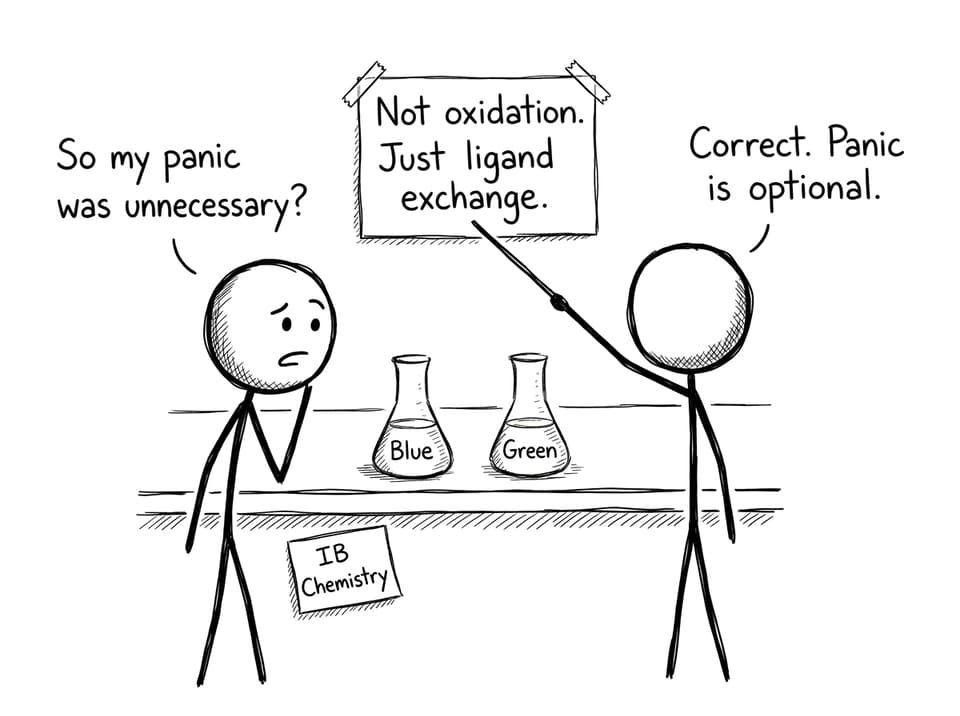
In IB Chemistry, a colour change often happens because of ligand exchange, not because the oxidation state changed.
A classic example is when water ligands are replaced by ammonia ligands around Cu^{2+}. The metal can stay Cu^{2+}, but the field strength changes, the splitting changes, and the colour changes.
If you want to write this like an examiner expects, revise: Ligand Exchange Explained.
Bringing it home: how to master complex ions faster
Complex ions are one of those IB Chemistry ideas that feel complex until you realise they’re just a repeating pattern: ligands donate lone pairs, coordinate bonds form, geometry follows coordination number, and colour and stability are consequences of the ligand field.
To make this stick, practise in a way that mirrors exams: build mixed questions, explain colour changes with crystal field language, and drill definitions until they’re effortless. RevisionDojo is built for exactly that: use the Questionbank for exam-style prompts, Study Notes for quick clarity, Flashcards for definitions, AI Chat when a mechanism step feels foggy, and Grading tools plus Mock Exams to spot weak links early. When you’re ready to simulate the real thing, try Predicted Papers and targeted support from Tutors or the Coursework Library to keep everything consistent.
For a full hub of IB Chemistry support, start here: IB Chemistry - RevisionDojo and explore more topic posts here: IB Chemistry Posts.


