


Transition metals are the part of the periodic table that can make an exam question feel alive. One minute you are reading an electron configuration; the next, a solution turns blue, a catalyst speeds up a reaction, and an oxidation state quietly changes the whole story.
In IB Chemistry, transition metals sit right at that intersection: definitions you must memorize, patterns you must recognise, and real-world chemistry you can actually picture. If you can explain why they behave differently from other metals, you usually pick up marks across periodicity, redox, bonding, and kinetics.
Transition metals in IB Chemistry (definition first)
A transition metal (IB definition) is:
An element that forms at least one stable ion with a partially filled d-subshell.
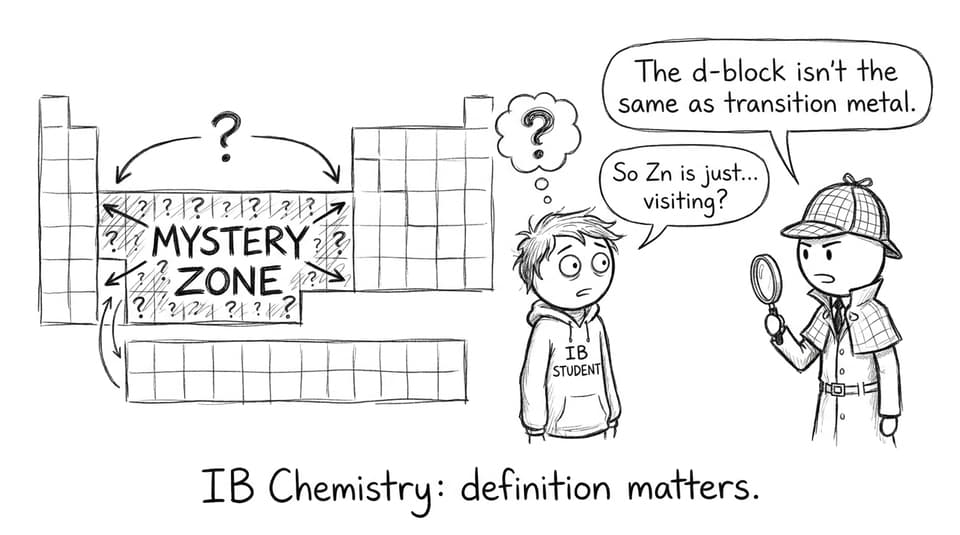
That single line is the anchor for almost every IB Chemistry markscheme on this topic. It is also the reason a common mistake happens: students assume “d-block” automatically means “transition metal.” In IB Chemistry, the definition is stricter than the layout of the table.
Two quick examples that fit the definition:
-
Fe²⁺ has a 3d⁶ configuration (partially filled d) so iron is a transition metal.
-
Cu²⁺ has a 3d⁹ configuration (partially filled d) so copper is a transition metal.
And the classic non-example:
- Zn²⁺ is 3d¹⁰ (filled d-subshell), so zinc is generally excluded by the IB definition, even though it lives in the d-block.
For a bigger topic view (and practice questions), use RevisionDojo’s syllabus page on The periodic table: the transition metals (HL).
Where transition metals are on the periodic table
In IB Chemistry, you’ll usually describe their location like this:
-
They are in the d-block
-
Roughly groups 3 to 12
-
Commonly tested examples include the first-row elements from Sc to Zn, plus occasional references to heavier ones such as Ag and Pt
If you want a cleaner mental map of blocks and structure, connect this with The structure of the periodic table.
Electron configuration: the quiet reason they are “different”
Transition metal chemistry becomes far less mysterious once you accept one practical idea used again and again in IB Chemistry: the 4s and 3d sublevels are close in energy.
That closeness explains two exam-relevant patterns:
-
When forming cations, 4s electrons are lost before 3d.
-
Multiple stable oxidation states are possible because removing different combinations of 4s and 3d electrons is energetically feasible.
You’ll also meet the well-known “stability exceptions”:
-
Cr: ([Ar] 4s^1 3d^5)
-
Cu: ([Ar] 4s^1 3d^{10})
Those happen because half-filled and filled d-subshell arrangements are relatively stable.
To tighten this part for marks, revise the focused notes on Oxidation states of transition elements (HL).
The four properties IB Chemistry loves to test
Variable oxidation states
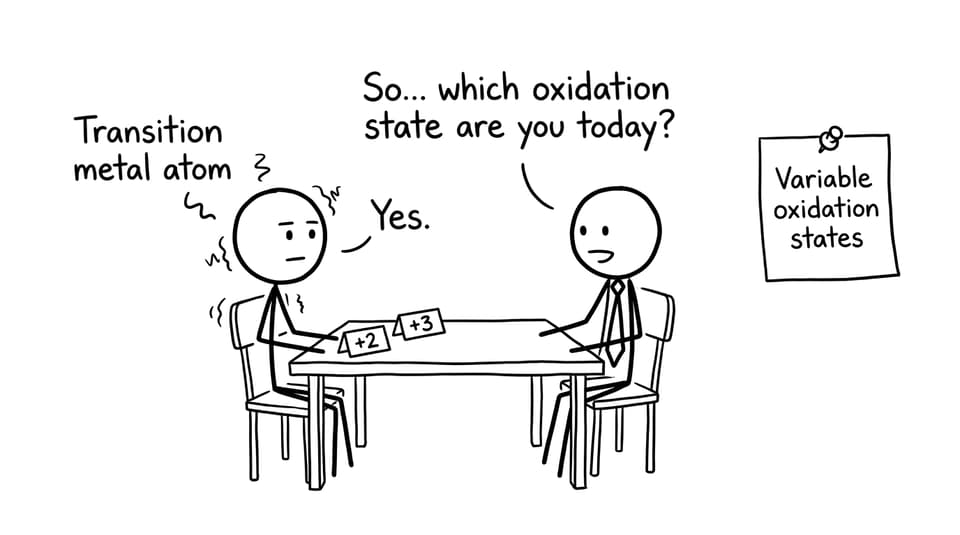
This is the headline feature in IB Chemistry. Transition metals can form more than one stable ion.
Examples you should be comfortable citing:
-
Fe²⁺ and **Fe³⁺
-
Cu⁺ and Cu²⁺
-
Mn can range from +2 to +7 in different compounds
A useful way to phrase the explanation: the small energy difference between 4s and 3d electrons allows loss of different numbers of electrons.
Colored ions and compounds
Color questions are surprisingly “structured” in IB Chemistry once you know the story:
-
ligands create an electric field around the metal ion
-
the five d-orbitals split into different energies
-
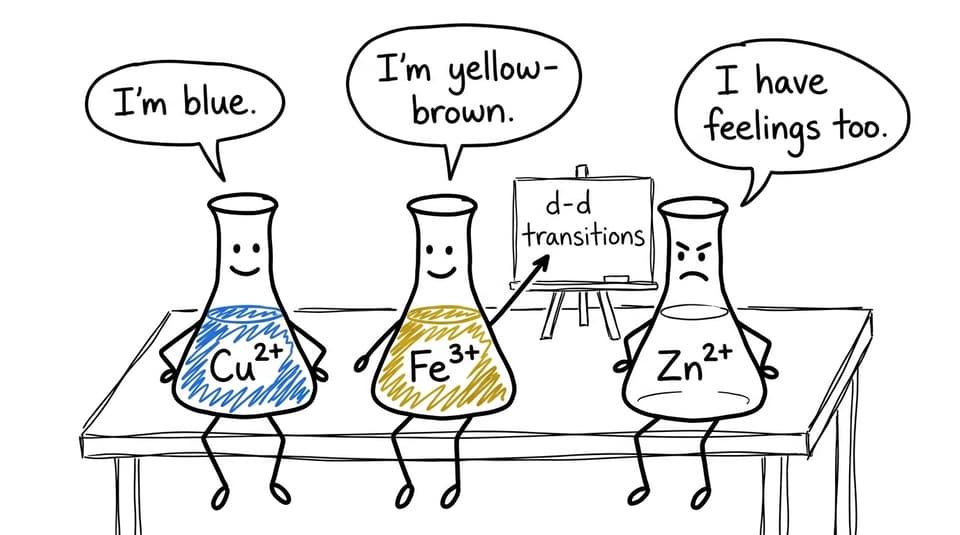
electrons absorb visible light and jump between split d-levels (a d-d transition)
-
the observed color is the complementary color of what is absorbed
Common examples:
-
Cu²⁺ often appears blue in aqueous solution
-
Fe³⁺ often appears yellow/brown
-
MnO₄⁻ is purple
Deepen this with Why transition metals form colored compounds and the HL-aligned notes on Color of transition metal complexes.
Complex ion formation
Transition metals form complex ions because metal ions have high charge density and can accept lone pairs from ligands, forming coordinate (dative) bonds.
Typical ligands in IB Chemistry include:
- (H_2O), (NH_3), (Cl^-), (CN^-)
Examples you should recognise:
-
(^{2+})
-
(^{3-}) or (^{4-})
If complex ions feel abstract, start with What is a complex ion? and then connect it to Ligand exchange explained for the color-change style questions.
Catalytic behavior
Transition metals and their compounds are excellent catalysts in IB Chemistry because they can:
-
provide surfaces for adsorption (heterogeneous catalysis)
-
change oxidation state and form intermediates (homogeneous and heterogeneous)
To keep your explanations exam-ready, use Heterogeneous vs homogeneous catalysis explained.
Quick exam checklist (30-second plan)
When a question mentions a transition metal in IB Chemistry, check:
-
Can you quote the IB definition (partially filled d-subshell in a stable ion)?
-
Are you confusing d-block with transition metal (Zn²⁺ trap)?
-
Can you link electron configuration to variable oxidation states?
-
If color appears, can you state d-orbital splitting and d-d transitions?
-
If a reaction speeds up, can you explain catalysis clearly?
Closing: learn the definition, then earn the marks
Transition metals are not “random special metals”; they are a predictable consequence of partially filled d-subshells, close-energy 4s/3d electrons, and the bonding possibilities that follow. In IB Chemistry, that turns into four repeated exam themes: variable oxidation states, colored ions, complex ion formation, and catalytic behavior.
When you revise, don’t just reread. Use RevisionDojo to turn this topic into points: practise with the Questionbank, lock in definitions with Flashcards, clarify tricky steps with AI Chat, and check your explanations with Grading tools. Then reinforce everything with Study Notes, Predicted Papers, and Mock Exams, and lean on Tutors or the Coursework Library when you want feedback that feels personal.
If you can explain transition metals clearly, IB Chemistry starts to feel less like memorisation and more like understanding, and that’s usually when your grades move up.


