Ligand exchange is one of those IB Chemistry topics that feels simple until you see it in an exam question: a color shift, a new formula, maybe a sneaky equilibrium, and suddenly you’re trying to remember whether the metal changed or the ligands did.
In real labs, it’s even more dramatic. You add a few drops, swirl once, and the solution flips color like it just made a decision. That’s the heart of ligand exchange: the metal stays, but its “neighborhood” changes, and the chemistry changes with it.
Ligand exchange in IB Chemistry (fast definition)
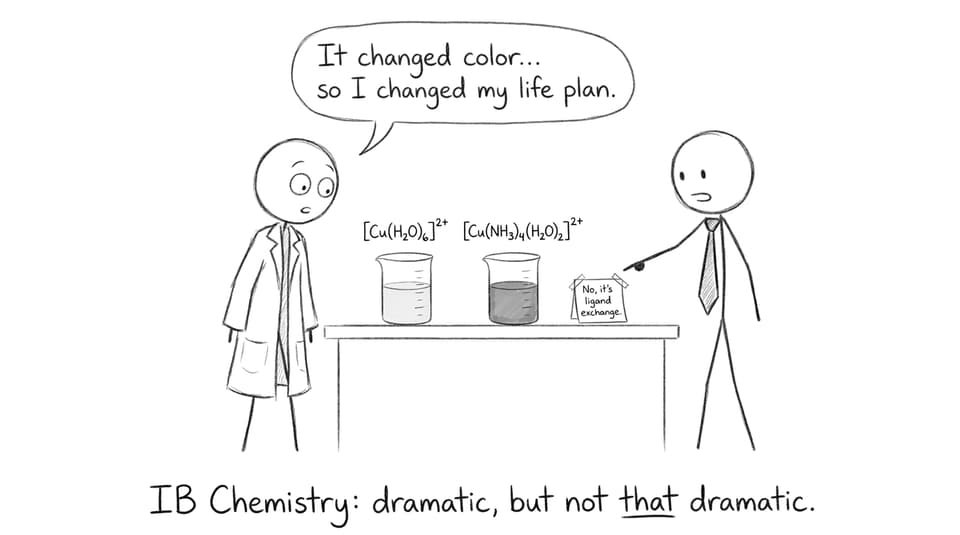
In IB Chemistry, ligand exchange is the process where one or more ligands in a complex ion are replaced by different ligands.
Key points examiners love:
-
The central metal ion stays the same.
-
The oxidation state usually stays the same (watch for trick questions).
-
Only the ligands in the coordination sphere change.
-
The change often causes a new color and a different stability.
If you want the foundation underneath this, review complex ions and coordinate bonding first: What Is a Complex Ion?
The one reaction you should be able to write from memory
A classic IB Chemistry example is copper(II) in water reacting with ammonia:
\\text{\[Cu(H}\_2\\text{O)}\_6\\text{}^{2+} + 4\text{NH}_3 \rightarrow \text{Cu(NH}\_3\\text{)}\_4\\text{(H}\_2\\text{O)}\_2\\text{}^{2+} + 4\text{H}_2\text{O}]
What you should say in words:
-
Water ligands are displaced by ammonia.
-
The complex typically changes from blue to deep blue.
-
The new complex is often more stable due to stronger metalandligand interactions.
This sits naturally alongside coordination number and geometry questions: use this refresher when the formula looks crowded: Coordination Number Explained
Why ligand exchange happens (the exam logic)
In IB Chemistry, ligand exchange is basically an energy and stability story. An exchange is favored when the new arrangement is more stable overall.
Common driving forces:
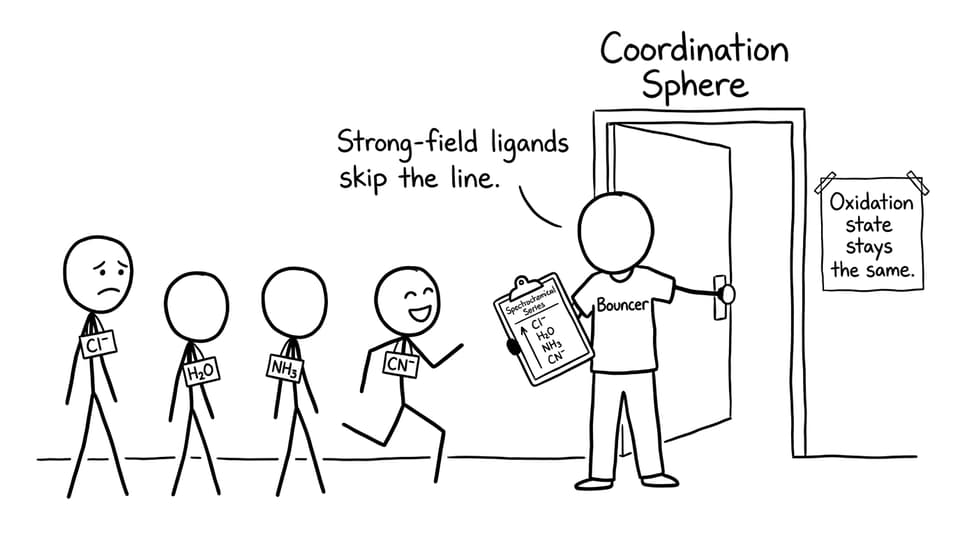
Stronger ligands displace weaker ligands
Ligands differ in how strongly they bond to the metal ion (field strength matters). Stronger interactions make a more stable complex, so the incoming ligand can “win”.
Higher charge density can strengthen bonding
Small, highly charged ligands (or ligands with high electron density at the donor atom) can bond more strongly and replace weaker ones.
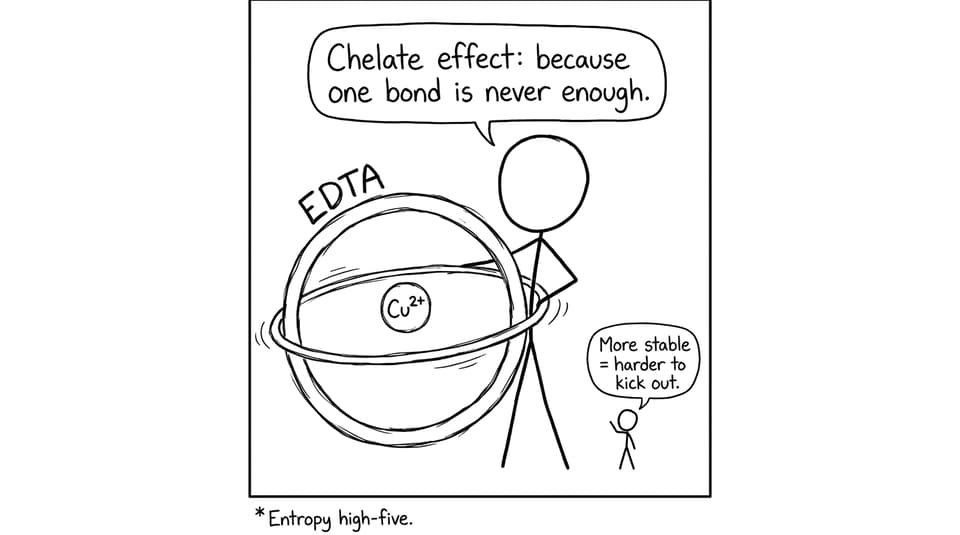
Chelate effect: multidentate ligands are hard to kick out
Chelating ligands bind through multiple donor atoms, making ring structures. That increases stability dramatically, and it can push exchange reactions forward.
If chelation feels fuzzy, read this right after: What Is Chelation?
Types of ligand exchange you can describe in IB Chemistry
Using clear categories helps you earn method marks even when you’re uncertain.
Partial ligand exchange
Only some ligands are replaced.
Example idea: copper(II) swaps some H_2O for NH_3, but not all.
Complete ligand exchange
All ligands are replaced.
A common pattern is water being replaced by a strong ligand like CN(^{-}):
\\text{\[Fe(H}\_2\\text{O)}\_6\\text{}^{3+} + 6\text{CN}^- \rightarrow \text{Fe(CN)}\_6\\text{}^{3-} + 6\text{H}_2\text{O}]
Chelate exchange
Monodentate ligands are replaced by a multidentate ligand (like EDTA(^{4-})), producing a very stable chelate complex.
Why ligand exchange causes color changes
This is a high-frequency IB Chemistry explanation question.
Transition metal complex colors come from d-orbital splitting. When ligands change, the size of the splitting (Δ) changes. That changes which wavelength of light is absorbed, so the observed color changes.
If you want a clean explanation to memorize, pair these two:
Exam-ready examples (what to mention with observations)
These are the reactions that tend to show up in IB Chemistry data-based questions and qualitative analysis prompts.
Copper(II) with chloride
\\text{\[Cu(H}\_2\\text{O)}\_6\\text{}^{2+} + 4\text{Cl}^- \rightarrow \text{CuCl}\_4\\text{}^{2-} + 6\text{H}_2\text{O}]
Often described as blue shifting to yellow-green.
Iron(III) with thiocyanate
\\text{\[Fe(H}\_2\\text{O)}\_6\\text{}^{3+} + \text{SCN}^- \rightarrow \text{Fe(SCN)(H}\_2\\text{O)}\_5\\text{}^{2+}]
Often pale yellow shifting to blood red.
Cobalt(II) with chloride
\\text{\[Co(H}\_2\\text{O)}\_6\\text{}^{2+} + 4\text{Cl}^- \rightarrow \text{CoCl}\_4\\text{}^{2-} + 6\text{H}_2\text{O}]
Often pink shifting to blue.
A quick ligand exchange checklist (before you commit to an answer)
Use this in IB Chemistry when you see a complex ion reaction:
-
Did the central metal change? (It usually shouldn’t.)
-
Did the oxidation state change? (Usually no, don’t claim redox without evidence.)
-
What ligands are entering and leaving?
-
Did the coordination number likely change (6 to 4, etc.)?
-
If there’s a color change, mention Δ change from ligand field strength.
For practice, build a set of targeted questions in RevisionDojo’s Questionbank and keep tagging ligand exchange prompts until your explanations become automatic.
Closing: turn ligand exchange into easy marks
Ligand exchange in IB Chemistry is less about memorizing random colors and more about telling a consistent story: ligands compete, the most stable arrangement wins, and the ligand field shift changes Δ, so the color changes too.
If you want this to stick, do it the RevisionDojo way: read the linked notes, drill patterns with the IB Chemistry resources hub, then lock in definitions using the IB Chemistry glossary. Add active recall with IB Flashcards with Spaced Repetition (SRS), and finish with Questionbank sets and AI Chat explanations until ligand exchange feels like a familiar plot, not a surprise twist.



