


Transition metal solutions are the closest thing chemistry has to mood lighting. One minute the lab bench is ordinary; the next, a pale blue copper solution looks like it belongs in a sci‑fi film. In IB Chemistry, that color is never just decoration. It’s a clue about electron arrangements, ligands, oxidation states, and the kind of explanation examiners reward: small, precise, and anchored to structure.
This article breaks down why transition metals form colored ions in IB Chemistry, in a way you can reuse in short-answer questions and extended responses.
Quick IB Chemistry checklist for colored ions
When a question asks about color in IB Chemistry, run this checklist before you write:
-
Does the ion have a partially filled d-subshell (not d(^0) or d(^10))?
-
Is the ion forming a complex ion with ligands?
-
Do ligands create d-orbital splitting (crystal field splitting, Δ)?
-
Is the Δ value in the visible light energy range?
-
Which factor is changing: ligand, oxidation state, or geometry/coordination number?
If you want a quick refresh on the wider chapter context, start with What Are Transition Metals? and then zoom in on What Is a Complex Ion?.
The core reason in IB Chemistry: d to d transitions
In IB Chemistry, the standard explanation is:
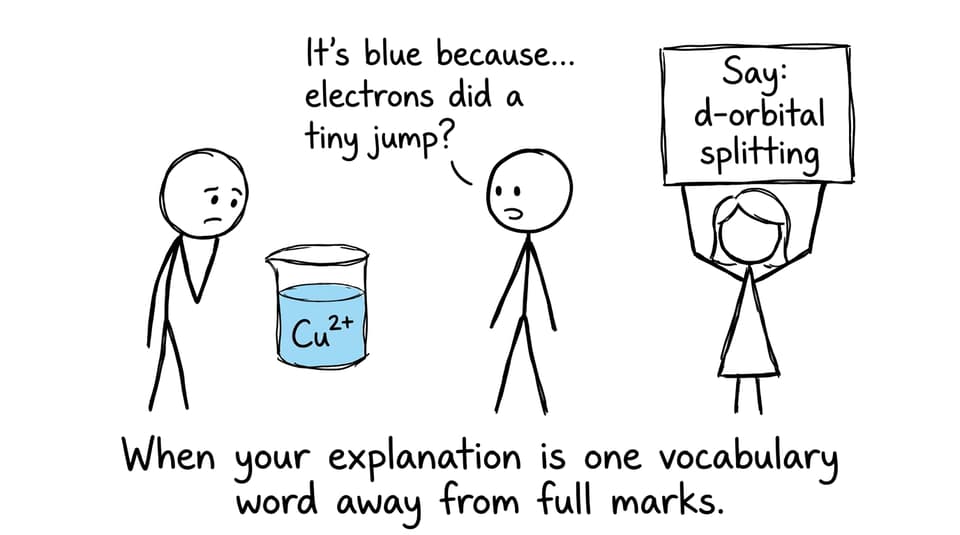
Transition metal ions form colored ions because electrons in split d-orbitals absorb specific wavelengths of visible light to move from a lower-energy d level to a higher-energy d level (a d to d transition). The light that is not absorbed is what you see, so the observed color is the complementary color of the absorbed wavelength.
Two things are doing the heavy lifting here:
-
Partially filled d-orbitals provide electrons that can be promoted.
-
Ligands create an electric field that splits the five d-orbitals into two energy groups.
That splitting is crystal field theory in its most exam-useful form. If you want the full picture with octahedral vs tetrahedral splitting patterns, see Crystal Field Splitting Explained.
Why splitting happens: ligands change the energy landscape
Imagine the transition metal ion as a small stage, and ligands as spotlights pointed inward. When ligands approach, their electron density repels the d-electrons unevenly (depending on orbital direction). So instead of five equal-energy d-orbitals, you get two groups:
-
a lower-energy set
-
a higher-energy set
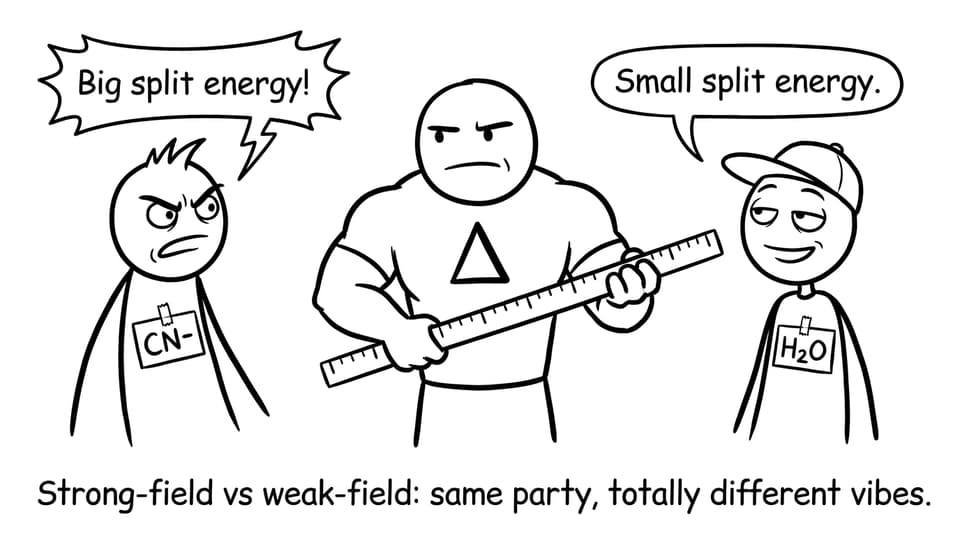
The energy gap between them is Δ. In IB Chemistry, you don’t need to derive Δ. You need to explain what it does: it determines the energy (and therefore wavelength) of light absorbed.
-
Larger Δ means higher-energy light absorbed (shorter wavelength)
-
Smaller Δ means lower-energy light absorbed (longer wavelength)
That single relationship is enough to explain most color-change questions.
IB Chemistry must-know: why some ions are colorless
A common trap in IB Chemistry is assuming “transition metal” automatically means “colored.” The IB definition is stricter: a transition metal forms at least one ion with a partially filled d-subshell.
So if an ion is d(^0) or d(^10), it will be colorless because there are no available d to d transitions.
Examples you can cite:
-
Sc(^{3+}): d(^0) means colorless
-
Zn(^{2+}): d(^10) means colorless
-
Cu(^{2+}): d(^9) means colored
-
Fe(^{2+})/Fe(^{3+}): d(^6)/d(^5) means colored
This is also why zinc sits in the d-block but doesn’t behave like a “true” transition metal in many IB Chemistry contexts.
How ligands change color (and how to phrase it for marks)
Ligand substitution is one of the easiest ways to trigger a dramatic color change, and it’s a favorite setup in IB Chemistry questions.
Different ligands create different splitting energies (Δ). Stronger-field ligands generally cause larger splitting, shifting which wavelength is absorbed.
A classic example:
-
(^{2+}) appears blue
-
(^{2+}) appears a deeper, more intense blue
Your mark-winning sentence is usually:
“Changing the ligand changes the crystal field splitting energy Δ, so the complex absorbs a different wavelength of visible light, changing the observed (complementary) color.”
For ligand definitions and coordination bonding language, Transition metals notes and the HL flashcards on Ligands and coordination bond help lock in the phrasing examiners expect.
Oxidation state: same element, different color story
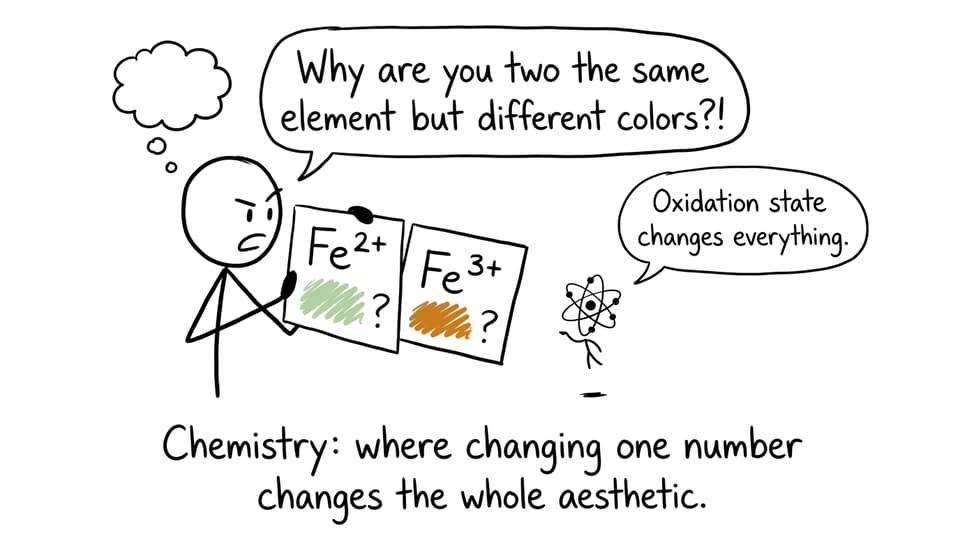
Oxidation state changes the metal ion’s charge density and its attraction to ligands. In IB Chemistry, the simplified link is:
Higher oxidation state often leads to stronger metal-ligand interaction leads to larger Δ leads to different wavelength absorbed leads to different color.
That’s why manganese(II) complexes can look faint, while permanganate (Mn in +7) is intensely purple.
Coordination number and geometry: small change, big shift
Geometry changes how ligands approach and therefore how d-orbitals split. In IB Chemistry, you mainly compare:
-
Octahedral (coordination number 6): typically larger splitting
-
Tetrahedral (coordination number 4): typically smaller splitting
So two complexes with the same metal and ligands can still differ in color if the geometry changes. If coordination number is the focus of the question, use Coordination Number Explained to tighten your method.
Exam-relevant color examples to recognize
In IB Chemistry, you don’t need to memorize an art museum’s worth of shades, but you should recognize the common ones:
-
Cu(^{2+}) is blue
-
Ni(^{2+}) is green
-
Cr(_2O_7^{2-}) is orange
-
CrO(_4^{2-}) is yellow
-
Fe(^{2+}) is pale green
-
Fe(^{3+}) is yellow-brown
-
MnO(_4^-) is purple
-
V(^{2+}) is violet, V(^{3+}) is green
Bring it home with RevisionDojo (and make it exam-ready)
Knowing that “d-orbital splitting causes color” is the start. Scoring well in IB Chemistry means practicing how to say it under time pressure, with the right trigger words: complex ion, ligand field, Δ, d to d transition, complementary color.
On RevisionDojo, you can turn this into marks quickly: use the Questionbank to drill short explanations, then consolidate with IB Chemistry Resources where Study Notes, Flashcards, AI Chat, Grading tools, Predicted Papers, and Mock Exams sit in one workflow. Add the Coursework Library and Tutors when you want feedback that feels like an examiner’s margin notes.
Transition metals form colored ions because their electrons can take tiny, specific steps inside split d-orbitals. In IB Chemistry, your job is to show you understand what causes the steps, what changes the gap, and why your eyes see the leftover light. RevisionDojo helps you practice that explanation until it’s automatic, andand that’s when the colors stop being confusing and start being useful.