

Chelation is one of those IB Chemistry ideas that feels small until it starts showing up everywhere. A coordination compound question becomes a stability question. A stability question becomes an entropy question. And suddenly you are staring at a ring structure thinking, “Wait… why is this one so hard to replace?”
That moment is the point of chelation. In IB Chemistry, chelation is the shortcut concept that turns complex ion chemistry from memorisation into something you can reason through under time pressure.
Chelation in IB Chemistry (the definition you actually use)
Chelation happens when a multidentate ligand forms two or more coordinate bonds to the same metal ion, creating a ring called a chelate ring.
If you want the exam-ready version, keep these pieces in your head:
-
A ligand must have multiple donor atoms (lone pairs).
-
It binds to one metal ion at multiple attachment points.
-
The resulting complex contains one or more rings.
-
Chelate complexes are usually more stable than similar complexes with monodentate ligands.
If you need a fast refresher on what ligands and complex ions are before you go further, use What Is a Complex Ion? as your foundation.
A quick chelation checklist (for exam questions)
When chelation appears in IB Chemistry, you can usually score quickly by running this mini-checklist:
-
Identify the central metal ion and its charge.
-
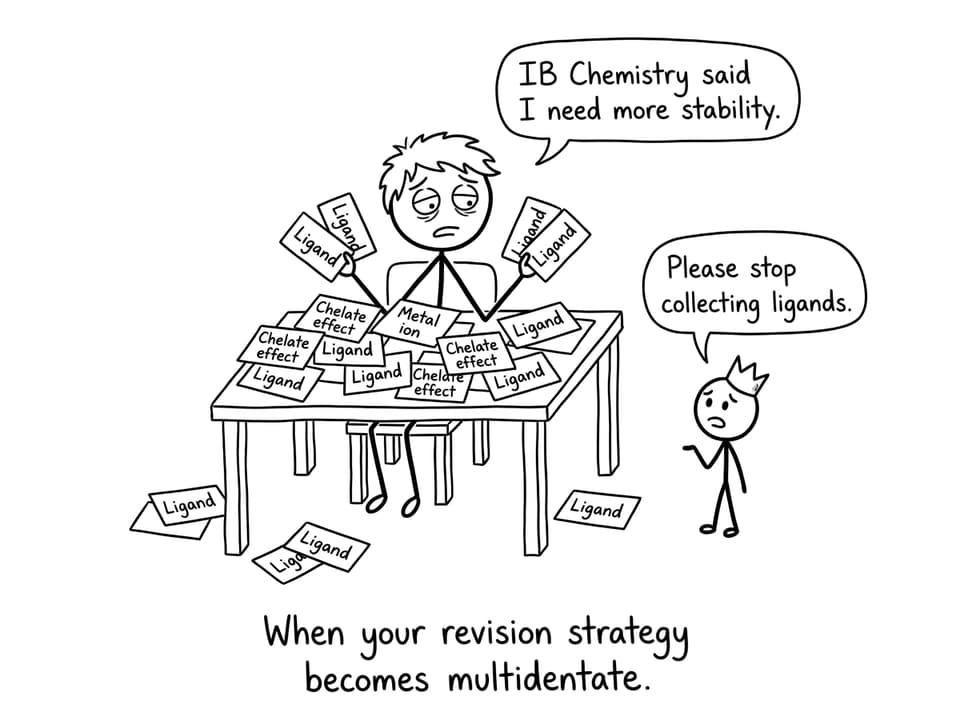
Identify the ligand and whether it is mono-, bi-, or polydentate.
-
Count donor atoms, not “number of ligands.”
-
State that chelation forms a ring structure.
-
Mention the chelate effect when stability is discussed.
This connects neatly with coordination number questions. If coordination number still feels slippery, revise IB Chemistry: Coordination Number Explained Simply.
What is a chelating ligand (and which ones matter most)?
A chelating ligand is simply a ligand that can donate more than one lone pair to the same metal ion.
Bidentate ligands (two donor atoms)
These are the most common in IB Chemistry questions:
-
Ethylenediamine (en)
-
Oxalate, C_2O_4^{2-}
Polydentate ligands (many donor atoms)
The superstar is:
- EDTA^{4-} (hexadentate, six donor atoms)
A good mental picture is that monodentate ligands “tap” the metal once, while chelating ligands “hold on” with multiple grips.
A core IB Chemistry example: ethylenediamine (en)
Ethylenediamine has two nitrogen donor atoms, meaning it can form two coordinate bonds to one metal ion.
A classic complex is:
- ^{3+}
Why examiners like it:
-
3 ligands but 6 donor atoms
-
Coordination number 6
-
Typically octahedral
-
Very stable relative to similar monodentate complexes
This links naturally to ligand exchange questions, because chelating ligands often displace weaker ligands. For that pattern, use Ligand Exchange Explained.
The chelate effect (why chelates are so stable in IB Chemistry)
The chelate effect is the observation that complexes containing multidentate ligands are more stable than similar complexes containing only monodentate ligands (even when the total number of donor atoms is the same).
In IB Chemistry essays and short answers, you usually explain this stability using two ideas:
Entropy (the scoring explanation)
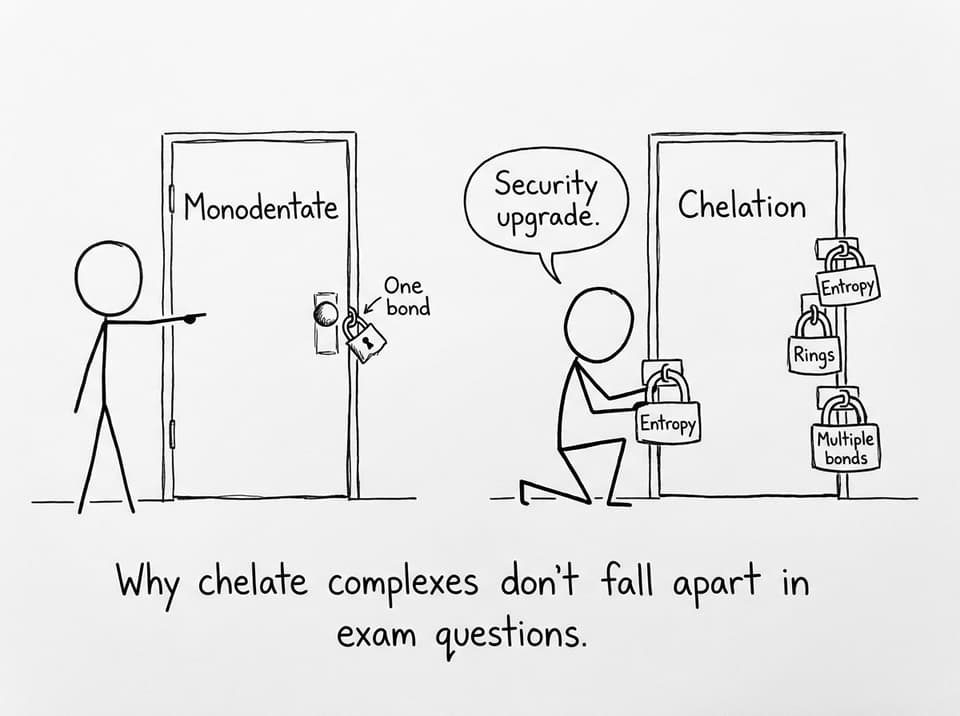
Chelation often increases the number of particles in solution. More particles means higher entropy, and higher entropy makes formation more favorable.
A typical way to phrase it:
- One multidentate ligand can replace several monodentate ligands, increasing disorder.
Multiple bonds + rings (the intuitive explanation)
A chelate complex does not fall apart easily because:
-
You would need to break multiple metal-ligand bonds.
-
The ligand is “held in place” by the ring structure.
That is why a chelating ligand is so effective in stabilising a metal ion in solution.
Chelation vs “any complex ion” (easy marks)
In IB Chemistry, it is common to see students blur these ideas:
-
Complex ion: any metal ion bonded to ligands via coordinate bonds.
-
Chelate: a complex ion where at least one ligand bonds through two or more donor atoms, forming a ring.
So: all chelates are complex ions, but not all complex ions are chelates.
Why chelation matters beyond the syllabus
Chelation is not just a test trick. It is how chemistry holds metal ions safely and predictably.
Biology
Natural chelates show up in:
-
Hemoglobin (iron in a porphyrin-like environment)
-
Chlorophyll (magnesium complex)
-
Vitamin B_12 (cobalt complex)
Analytical and industrial chemistry
EDTA complexes are used in:
-
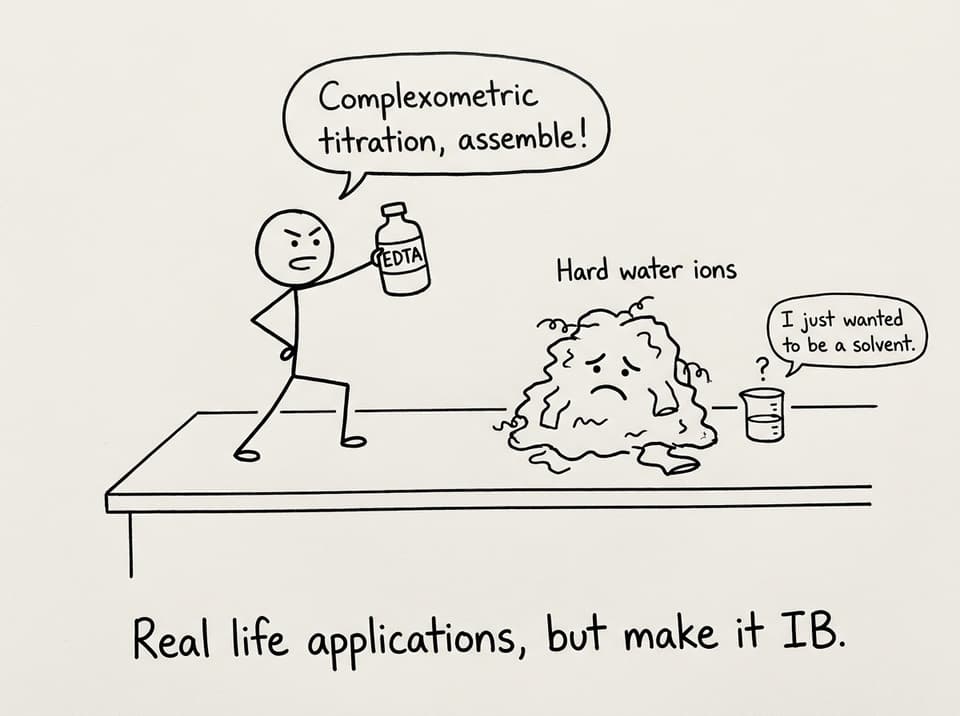
Water softening (binding Ca^{2+} and Mg^{2+})
-
Heavy metal treatment (binding toxic metal ions so they can be removed)
-
Complexometric titrations (finding metal ion concentration)
If you want an IA-style glimpse of chelation in action, RevisionDojo’s coursework library includes exemplars like Measuring water hardness from different sources of water and The rate of Fe(s) chelation by citric acid at different pHs.
Common IB Chemistry misunderstandings about chelation
“Chelating ligands must be charged.”
Not true. In IB Chemistry, ethylenediamine (en) is neutral and still chelates. The key requirement is multiple donor atoms, not charge. Charged ligands can strengthen interactions, but neutrality does not prevent coordinate bonding. When you explain bonding, focus on lone pair donation. If you do that, you rarely get trapped.
“Chelation changes oxidation state.”
Chelation changes the ligand environment, not necessarily the metal’s oxidation state. In most syllabus contexts, the oxidation state stays the same as ligands swap around it. Students often confuse “more stable complex” with “different oxidation number,” but they are separate ideas. Unless electrons are transferred (redox), oxidation state will not change. In short: coordinate bonds are not the same as redox.
“Chelate complexes never undergo ligand exchange.”
Chelate complexes are more resistant to exchange, not immune. Under the right conditions (concentration, competing ligands, temperature), exchange can still happen. In exam wording, choose careful phrasing like “less likely to dissociate” or “more stable toward exchange.” That shows you understand the trend without making an absolute claim. In IB Chemistry, examiners reward precision.
Bringing it home: how to revise chelation effectively
Chelation is not a topic you master by rereading definitions. You master it by seeing it in questions until the pattern becomes calm: multidentate ligand, ring, chelate effect, higher stability.
RevisionDojo is built for that kind of repetition without the chaos. Use Study Notes to lock the concept, Flashcards to make the definitions automatic, and the Questionbank plus AI Chat to diagnose why a stability answer missed marks. Then level up with Mock Exams, Predicted Papers, and the Grading tools so your explanations sound like examiner language. When chelation appears on exam day, you want it to feel familiar, a small ring that saves you big time in IB Chemistry.