
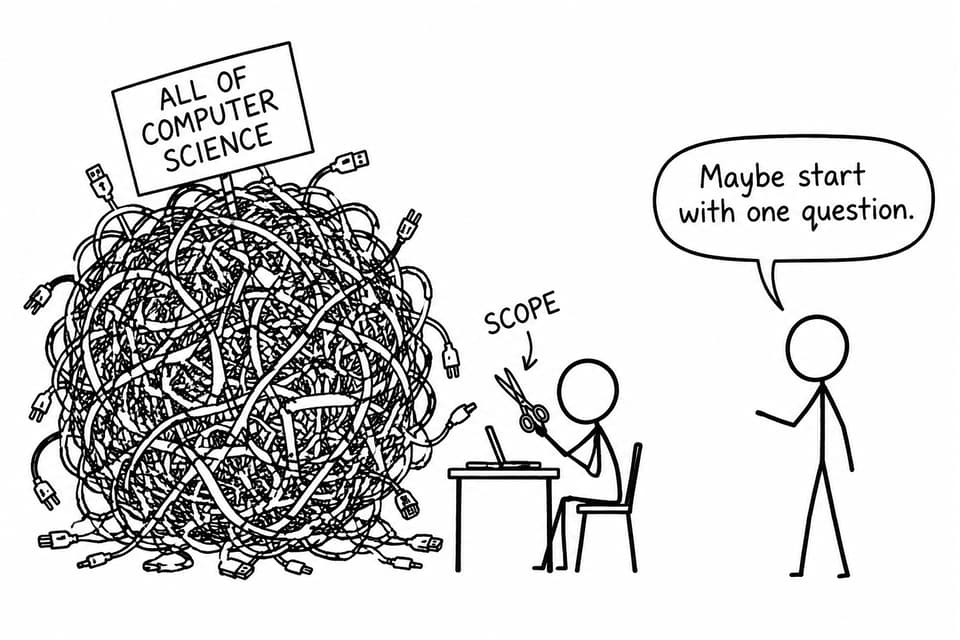
Choosing an Extended Essay topic feels difficult because computer science is not really one topic. It stretches from algorithms and databases to machine learning, cybersecurity, networks, and human-computer interaction.
The best computer science EE ideas reduce that landscape to one testable comparison. For the Extended Essay model first assessed in May 2027, your investigation should establish a clear research framework, apply subject-specific knowledge, build a reasoned argument, and evaluate the evidence. In practical terms, that means comparing defined systems or techniques under controlled conditions rather than merely building an application or describing how technology works.
A promising topic usually contains four elements:
- A specific computational problem
- Two or more algorithms, architectures, or configurations to compare
- Measurable criteria such as execution time, memory use, accuracy, or scalability
- A scope that one student can investigate responsibly
What Makes a Strong Computer Science EE?
A strong Computer Science Extended Essay investigates a technical question through evidence and analysis. Code can support the method, but code alone is not the essay. The valuable work lies in designing fair tests, interpreting results, connecting them to theory, and explaining where the conclusions stop being reliable.
Use this checklist before committing:
| Question to ask | What a strong answer looks like |
|---|---|
| Is it clearly computer science? | The question depends on algorithms, data structures, computation, architecture, or another technical CS concept. |
| Can I collect evidence? | You can produce reproducible measurements or analyse a defined technical dataset. |
| Are the variables controlled? | Hardware, input sizes, test conditions, and implementation choices can be documented. |
| Is comparison possible? | The investigation examines alternatives, changing conditions, or trade-offs. |
| Is it manageable? | The coding, data collection, and analysis fit your available time and skills. |
| Can I evaluate limitations? | You can identify uncertainty, bias, implementation effects, and limits to generalisation. |
For broader guidance, learn how to craft an IB Extended Essay research question. You can also explore Computer Science EE topics worth researching before choosing a direction.
Computer Science EE Ideas by Topic Area
These are starting points rather than questions to copy unchanged. Adjust each idea around the tools, data, computing environment, and knowledge you can realistically access.
Algorithms and pathfinding
Algorithm investigations work well when comparisons are controlled and results are explained theoretically.
Possible question: “To what extent does increasing obstacle density from 10%-40% affect the execution time and number of explored nodes for A* and Dijkstra’s algorithm on procedurally generated 50 by 50 grid maps?”
Generate several maps at each density, run both algorithms on identical inputs, and compare median execution time, nodes explored, path length, and failure rate. Repeated trials reduce the influence of an unusually favourable map.
Data compression
Compression offers measurable trade-offs among file size, processing time, and reconstruction quality.
Possible question: “How does run-length encoding compare with Huffman coding in compression ratio and execution time for synthetic images with different levels of colour repetition?”
Control the image dimensions and define repetition mathematically. An arbitrary folder of unrelated images would make it difficult to explain why performance changed.
Machine learning
“Which model is best?” is usually too vague. Define the dataset, preprocessing, target variable, models, and evaluation metric.
Possible question: “How does reducing input dimensionality with principal component analysis affect the accuracy and training time of k-nearest neighbours on a fixed handwritten-digit dataset?”
Look beyond the highest accuracy. Consider computational cost, class imbalance, overfitting, random variation, and whether the dataset supports broader conclusions.
Databases and indexing
Database topics permit repeatable testing without expensive equipment.
Possible question: “How does B-tree indexing affect median query time for equality and range searches as a relational database grows from 10,000 to 1,000,000 synthetically generated records?”
Keep the database engine, hardware, queries, and record structure consistent. You should also consider whether caching affects the measurements.
Cybersecurity
Cybersecurity research must remain legal, safe, and ethical. Use your own systems, simulations, generated data, or explicitly authorised environments.
Possible question: “How do bcrypt cost parameters affect password-verification time and throughput on a specified consumer processor?”
This allows discussion of security and usability without attacking real accounts. Do not access systems without permission, collect leaked personal information, or create harmful tools.
Networking and distributed systems
Simulation can make network questions feasible for a DP1 student.
Possible question: “How does packet-loss rate affect completion time and retransmission overhead for two transport protocols in a controlled network simulation?”
Specify the simulator, protocol versions, topology, packet-loss model, and traffic pattern so that uncontrolled configuration choices do not dominate the results.
Human-computer interaction
Interface topics can drift into psychology or design, so keep the central analysis computational.
Possible question: “How does client-side image compression affect page-load performance and visual quality for a defined mobile web application under simulated network conditions?”
If participants are involved, discuss consent, privacy, sampling limitations, and school requirements with your supervisor before collecting data.
Strong and Weak EE Research Questions
The difference between a weak and strong question is usually precision, not ambition.
| Weak question | Stronger version | Why it improves |
|---|---|---|
| Is AI better than humans? | How does a specified image classifier compare with a defined baseline on accuracy and inference time for one labelled dataset? | It defines the system, evidence, and limits. |
| Which sorting algorithm is fastest? | How does input disorder affect the execution time of merge sort and insertion sort for integer arrays of defined sizes? | It introduces a meaningful independent variable. |
| How secure are passwords? | How does increasing bcrypt cost affect verification time on specified hardware? | It creates a safe technical investigation. |
| Can I build a revision app? | How does local caching affect response time and network requests in a defined revision web application? | The app becomes an experimental environment. |
| What is quantum computing? | How does Grover’s search compare theoretically with classical linear search as the search space increases? | It replaces description with analysis. |
If you cannot name the graph, comparison, or technical evidence your results section might contain, narrow the question. The guide to what makes a research question researchable provides another useful feasibility check.
Turning an Idea Into a Research Question
Move from a broad interest to a workable question through six decisions:
- Choose the system. Name the algorithm, model, protocol, database, or architecture.
- Choose the comparison. Compare alternatives or observe how one factor changes performance.
- Define the input. Specify the dataset, workload, map type, or simulated environment.
- Select metrics. Use outcomes such as runtime, memory, throughput, accuracy, or compression ratio.
- Fix the environment. Record hardware, software versions, configuration, and testing conditions.
- Set boundaries. State what the investigation will not claim.
“I am interested in pathfinding” is an interest. Comparing A* and Dijkstra’s algorithm is a direction. Adding grid size, obstacle density, repeated trials, and performance metrics turns it into an investigation.
Expect the wording to change as weaknesses become visible. Read why revising your EE research question matters and what to do when an EE research question is not working.
Designing a Feasible Method in DP1
Run a pilot investigation before promising a large experiment. Implement the simplest viable version, collect a small sample, and determine whether the measurements reveal anything worth analysing.
A reliable computational method often includes:
- Justified algorithms or configurations
- Controlled and documented test conditions
- Multiple trials where system variation affects measurements
- Inputs representing different conditions
- Appropriate statistics and visualisations
- Source code or pseudocode explaining the method
- Evaluation of uncertainty, bias, and implementation limitations
Treat execution time carefully. Background processes, caching, programming language, compiler behaviour, and hardware can influence results. Repetition improves reliability, but it does not make a conclusion universal.
Use credible technical documentation and scholarly material to explain theory. RevisionDojo’s guide to the best sources for Extended Essay research can help you assess authority and relevance.
Working With the May 2027 EE Model
Students assessed from May 2027 work under the updated Extended Essay model. A Computer Science essay will normally use the subject-focused pathway unless the approved question genuinely integrates two DP subjects through an interdisciplinary approach.
A successful essay needs more than a technically impressive program. Its research framework must establish what is being investigated, why the method can answer the question, and how the evidence supports a sustained argument. Evaluation should appear throughout rather than being reserved for a brief limitations paragraph.
Your coordinator and supervisor should confirm current requirements, the approved subject route, ethical expectations, and submission procedures. RevisionDojo’s explanation of the 2027 EE introduction format can help connect your question, significance, sources, and method.
Your Next Step
Do not choose the idea that sounds most advanced. Choose the one offering the clearest path from question to evidence.
Write three candidate questions. For each, list the independent variable, dependent variables, controls, required data, technical theory, and greatest feasibility risk. Then run a small pilot for the strongest option.
RevisionDojo can serve as your central IB workspace. The Questionbank, Study Notes, and Flashcards strengthen subject knowledge, while Predicted Papers and Mock Exams help keep the rest of your Diploma Programme studies moving. For the essay, the Coursework Library, Grading tools, and Tutors help clarify what rigorous academic work looks like.
Save several question drafts instead of trusting the first sentence. Bring them into RevisionDojo and ask Jojo AI Chat to identify vague variables, missing comparisons, and feasibility problems. That feedback matters most before months of coding begin, when changing twelve words can still save twelve weeks.