There’s a moment most IB students remember: you’re staring at the subject list, trying to predict a version of yourself two years from now.
Not the motivational-poster version. The real one. The one who has to sit the exam, finish the IA, and still have enough energy to care.
That’s why comparing IB SEHS to Design Technology (DT) is surprisingly emotional. Both feel practical. Both promise “real-world relevance.” Both can be deeply satisfying. But they reward different kinds of curiosity and different study habits.
This guide breaks down IB SEHS vs Design Technology in a way that helps you choose, and then revise with intent.
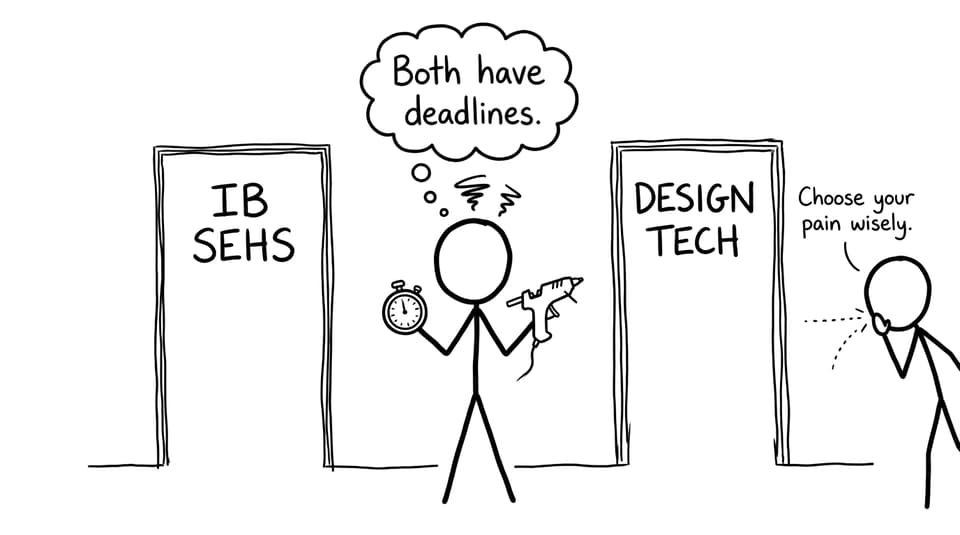
A student choosing between IB SEHS and Design Tech
Quick checklist: IB SEHS or Design Technology?
Use this as your fast filter before you overthink it:
Choose IB SEHS if you’re fascinated by the human body, performance, health, and data from real people.
Choose Design Technology if you like solving problems by designing, testing, iterating, and explaining decisions.
Pick IB SEHS if you enjoy applied science (anatomy, physiology, biomechanics, psychology, nutrition).
Pick DT if you enjoy systems, materials, sustainability, prototyping, and structured documentation.
If you’re stuck, ask: do you want to improve a human system (training, recovery, health), or a designed system (product, service, environment)?
IB SEHS is human-centered science. You study what happens when bodies move, adapt, fatigue, recover, and respond to training and environment. It’s a subject where theory tends to stick because you can see it: in sport, in health trends, in your own routines.
How it feels to revise IB SEHS: you win marks by understanding concepts and applying them to scenarios. Memorisation helps, but application decides grades. Using Study Notes + Flashcards + targeted Questionbank practice is the fastest way to become fluent.
What you actually study in Design Technology (and what it feels like)
Design Technology is built around solving problems through a repeatable process: research, ideation, prototyping, testing, evaluation. It’s creative, but not “anything goes.” The constraints matter. Your reasoning matters.
Many students underestimate the quiet difficulty of DT: not the “making” part, but the discipline of documenting decisions clearly, consistently, and in a way that matches assessment expectations.
The easiest way to compare IB SEHS and DT is to compare what the IA asks you to become.
IB SEHS assessment style
In IB SEHS, the IA tends to feel like science in motion: a focused investigation where you plan, collect data, analyze it, and evaluate limitations. Done well, it’s structured thinking with real-world messiness.
RevisionDojo also supports SEHS coursework improvement with tools like the IB SEHS IA rubric grader, which is useful when you need criterion-by-criterion feedback rather than vague comments.
Design Technology assessment style
In DT, the IA is the heart of the course. It rewards design thinking and a visible process: the way you research, justify decisions, document iteration, and evaluate outcomes.
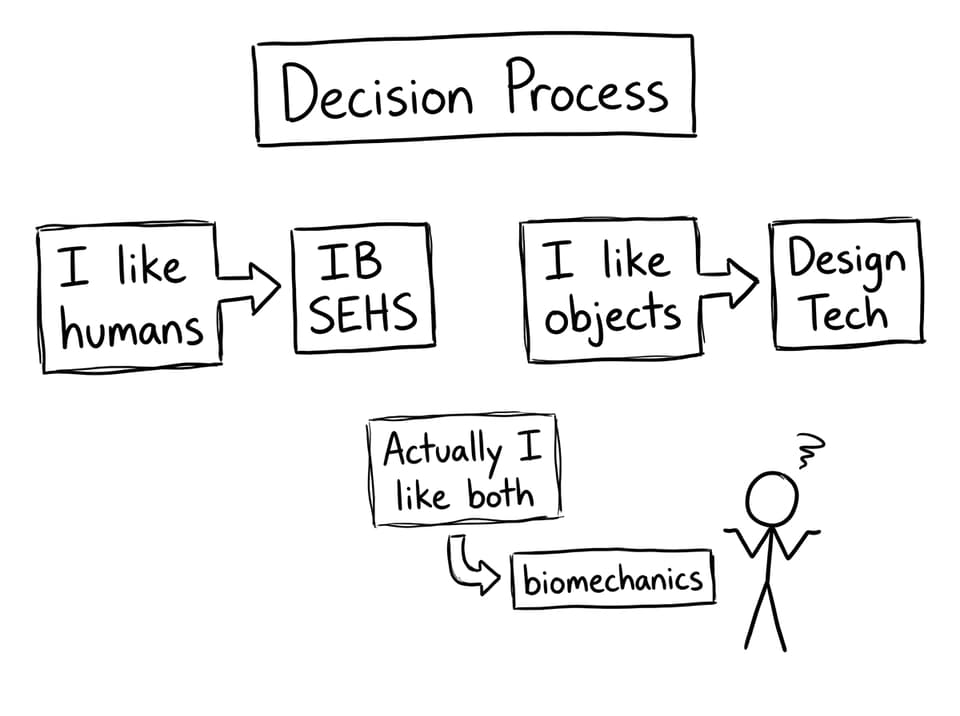
And if you’re genuinely split: interdisciplinary routes exist (biomechanics, sport engineering, wearable tech). In those cases, IB SEHS gives you the human evidence; DT gives you the design language.
Decision flowchart with a biomechanics escape hatch
How to revise smarter for exams (whichever you choose)
The subject matters, but the system matters more.
A strong RevisionDojo routine looks like this:
Use Study Notes to learn a topic quickly and accurately
Use Flashcards to keep definitions, processes, and key models alive
Use the Questionbank for exam-style practice and pattern recognition via Questionbank
Use AI Chat when you’re stuck and need a clean explanation without losing an hour
Use Grading tools to learn what earns marks (especially for longer responses and coursework)
Use Predicted Papers and Mock Exams to build timing and stamina via IB Predicted Papers
Use the Coursework Library and Tutors when you need exemplars or human feedback to level up
Conclusion: pick the subject that matches your curiosity
A good choice rarely feels like a “life decision.” It feels like relief.
If you’re drawn to people, performance, health, and evidence, IB SEHS is likely your lane. If you’re drawn to creating solutions, iterating designs, and explaining choices under constraints, DT will probably reward you.
Whichever you choose, don’t leave exam success to willpower. Build a system: RevisionDojo’s Questionbank, Study Notes, Flashcards, AI Chat, Grading tools, Predicted Papers, Mock Exams, Coursework Library, and Tutors are designed to make IB preparation feel structured instead of noisy. Start with the IB SEHS hub or the IB Design Technology hub and let the work get simpler from there.
IB SEHS goal setting in sport made simple: goal types, SMART targets, common mistakes, and exam-ready tips using RevisionDojo practice tools.