
A request to leave an IB subject or move from Higher Level to Standard Level can sound alarming. Parents may hear, “I cannot cope.” Students may simply mean, “The way I am working is not working.” Those are different problems, and they call for different responses.
The short answer is this: do not reject the idea, but do not approve it immediately either. Speak to the subject teacher and DP coordinator, check the student's complete HL/SL combination, confirm university prerequisites, and run a short period of targeted support. If the evidence still shows that HL is harming performance or wellbeing without serving a clear academic purpose, switching to SL can be a sensible decision.
If your child wants to drop an IB subject or switch to SL, the goal is not to protect the most impressive-looking timetable. It is to build a valid, sustainable Diploma pathway that supports where your child may want to go next.
A quick checklist for IB parents
Before agreeing to any change:
- Ask what has prompted the request now.
- Separate difficulty with the subject from difficulty with study habits, teaching access, time management, or one recent assessment.
- Ask the teacher for topic-level evidence, not only a current grade.
- Contact the DP coordinator and obtain the school's rules and deadlines.
- Confirm that the revised programme would still meet IB Diploma requirements.
- Check likely university courses for required subjects, levels, and grades.
- Consider a structured one- or two-week support trial.
- Record what will happen if the student stays and what will happen if they switch.
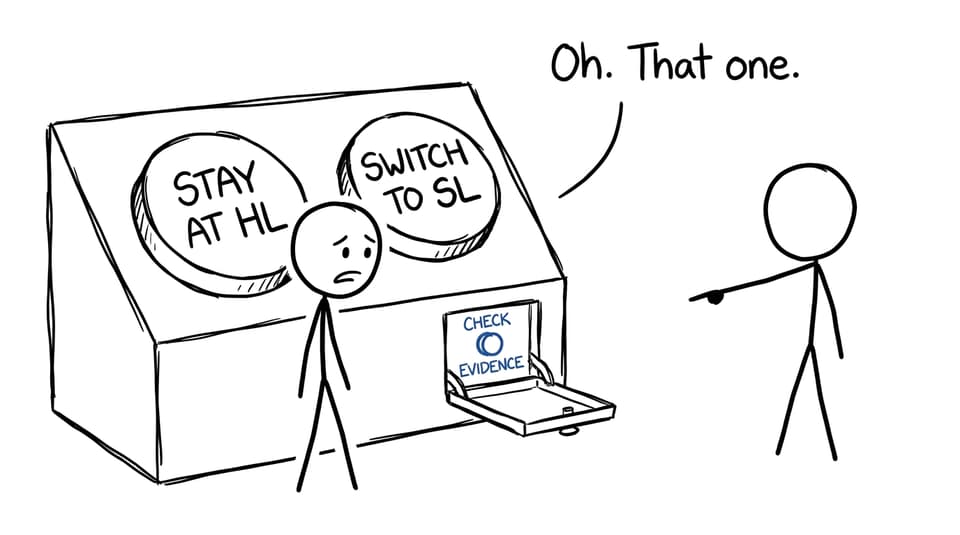
First clarify what your child means by “drop”
Parents and students sometimes use “drop” for two distinct changes.
Moving from HL to SL means continuing with the same subject at a different level. HL and SL differ in scope and expected depth. The IB currently recommends 240 teaching hours for HL and 150 for SL, although the precise differences in content and assessment depend on the subject. RevisionDojo's guide to the difference between IB HL and SL offers a useful starting point.
Dropping the subject completely is more complicated. Diploma students study six subjects, so removing one normally requires a replacement or a change in programme status. The coordinator must determine what is possible within the school's timetable and the student's registration. Parents can review the broader structure in this guide to how many IB subjects students take.
The distinction matters because an HL-to-SL change may reduce depth while preserving continuity. Leaving a subject entirely introduces questions about subject groups, missed teaching, class capacity, coursework, and scheduling.
Check whether the revised HL and SL combination is valid
The IB Diploma requires students to take a minimum of three and a maximum of four subjects at Higher Level, with the remaining subjects at Standard Level. Therefore, the practical effect depends on the current combination.
| Current position | What an HL-to-SL change may require |
|---|---|
| Four HL subjects and two SL subjects | The student may be able to move to three HL and three SL subjects, subject to school approval. |
| Three HL subjects and three SL subjects | Another subject may need to move from SL to HL to preserve the minimum of three HL subjects. |
| A subject is removed entirely | A replacement or different programme route may be necessary. |
Promoting another subject to HL is not an administrative footnote. The student may need to cover HL-only material already taught, meet different assessment requirements, and demonstrate that the new workload is realistic. Timetable clashes or class capacity can make an apparently simple exchange impossible.
This is why the DP coordinator should be involved early. Individual schools control their own internal change processes and may set deadlines well before final examination registration limits. A family should never assume that a change is available because another IB school allowed it.
For families comparing combinations, the IB HL subject-choice guide helps connect academic strengths, motivation, and future plans.
Diagnose the problem before changing the level
One poor result is information, not a verdict. Equally, months of declining performance should not be dismissed as a temporary setback. The useful question is: what pattern does the evidence show?
Ask your child and the teacher to identify:
- whether difficulties affect most topics or one particular unit;
- whether errors come from missing knowledge, weak application, timing, or question interpretation;
- whether assignments are completed consistently;
- whether the student understands feedback and acts on it;
- whether performance improves with guided practice;
- whether pressure from other subjects or the IB core is driving the problem;
- whether sleep, health, anxiety, or attendance requires wider support.
A student who understands lessons but performs poorly under time pressure has a different problem from one who lacks prerequisite knowledge. Neither situation automatically requires a level change. The first may need timed practice and feedback; the second may require deliberate rebuilding of core concepts.
The conversation should also remain emotionally neutral. “What is making this subject feel unmanageable?” usually reveals more than “Why do you want to give up?” The purpose is not to persuade the student to stay at HL. It is to discover whether the level or the current support system is the real obstacle.
Protect future university options before switching
Universities do not apply one universal rule to IB HL and SL subjects. Some programmes accept prerequisites at either level. Others require a particular subject at HL, sometimes with a specified grade. Requirements can also vary between universities offering similarly named degrees.
Before changing an IB HL subject to SL, make a shortlist of plausible degree areas and check each university's official admissions page. Record the exact subject, pathway, level, and grade language. Mathematics, engineering, physical sciences, medicine, economics, and some language-based courses deserve especially careful checking because subject-level prerequisites are common.
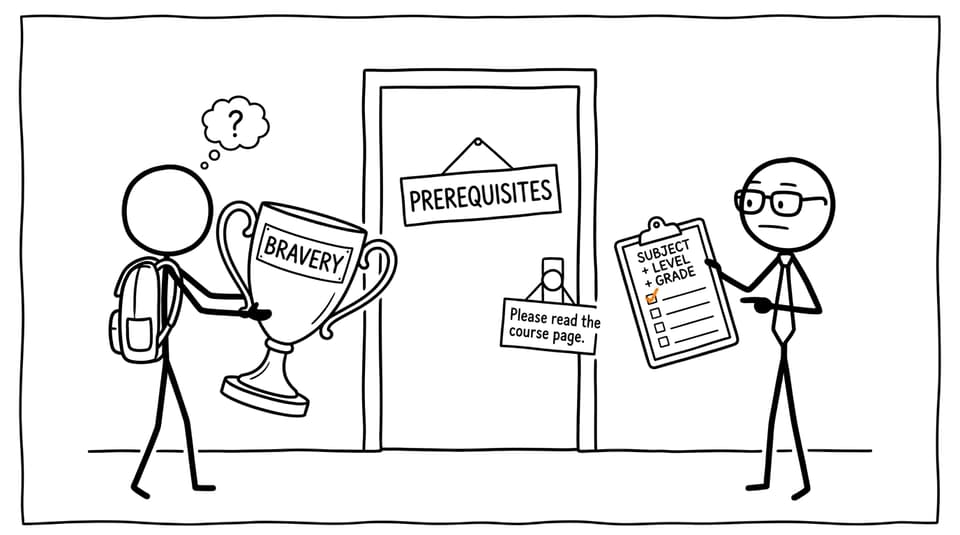
This does not mean a 16-year-old must choose a career immediately. It means the family should understand which doors a change could close. The question is not whether universities “like” HL in general. It is whether the specific subject is required or preferred for courses the student may realistically pursue. RevisionDojo examines this distinction in whether universities care about HL or SL subjects.
If applications have already been submitted, consult the school counsellor before changing anything. A revised subject level could affect how the student's academic profile compares with stated entry conditions or information already supplied to universities.
Decide whether switching to SL would solve the actual problem
Moving to SL is more persuasive when several forms of evidence point in the same direction. It may be reasonable when:
- the subject is not needed at HL for likely university pathways;
- the student is consistently overwhelmed despite appropriate effort and support;
- HL-only content is consuming time needed across the Diploma;
- the teacher believes SL better matches the student's current foundation;
- the remaining subject combination is valid and academically coherent;
- the change is permitted within school deadlines.
Be more cautious when the request follows one difficult test, a temporary deadline cluster, conflict with a particular teaching method, or comparison with classmates. Those experiences can feel decisive in the moment, but they may not predict final performance.
SL should not be treated as failure or as an easy version of the subject. It remains a rigorous IB course and contributes to the Diploma score. A well-chosen SL can create enough capacity for stronger work elsewhere, including the Extended Essay, Theory of Knowledge, internal assessments, university applications, and basic recovery time.
Run a short, targeted support trial
Before agreeing to switch, consider a defined trial lasting one or two weeks. This is not an instruction to “work harder.” It is a small experiment designed to test whether better support changes the evidence.
Choose two or three weak topics with the teacher. Establish a baseline using a short set of questions. Then give the student a manageable routine: review a concept, retrieve it without notes, answer focused questions, inspect errors, and retry similar material. At the end, compare accuracy, confidence, time, and independence with the baseline.
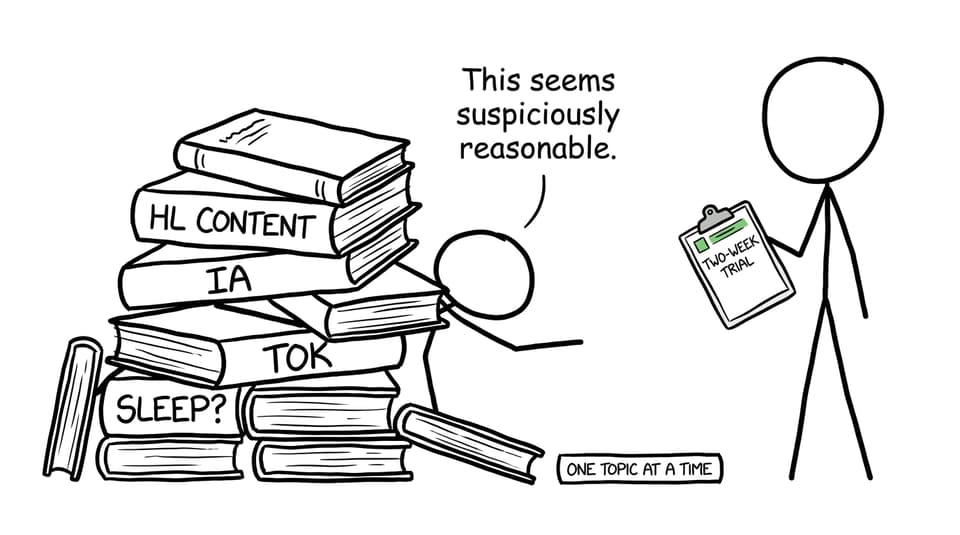
RevisionDojo is particularly useful for this diagnostic period. A student can use the IB Lessons and Study Notes library to repair knowledge, then use Questionbank practice and Flashcards to test retrieval. AI Chat can explain a stubborn idea, while Grading tools provide feedback on applied work. The purpose is not to manufacture a sudden grade increase. It is to learn whether the difficulty responds to structured support.
If the student improves noticeably, the family can discuss staying at HL with a sustainable plan. If significant gaps remain despite consistent, focused work, the case for SL becomes clearer. Either outcome is useful because the decision is now based on evidence rather than panic.
Build a written plan for either outcome
A decision to stay needs more than encouragement. Specify the weekly practice routine, teacher check-ins, next review date, and warning signs that would reopen the discussion. The student's IB class schedule should remain feasible, not merely possible on paper.
A decision to switch also needs a transition plan. Confirm:
- the effective date and revised timetable;
- which SL content has already been completed;
- whether assessment tasks differ by level;
- how predicted grades and school reports will be handled;
- whether another SL subject must move to HL;
- what catch-up work that second change creates;
- who will confirm registration details.
Students changing levels in a science should also review the rules around mixing SL and HL science subjects. Subject-specific differences matter more than general assumptions about SL.
Make the decision smaller and clearer
An HL-to-SL conversation can feel like a judgement on ability. It is better understood as resource allocation. Time, attention, confidence, and health are limited. The right combination directs those resources toward subjects that matter while preserving a balanced Diploma.
Listen first. Gather evidence second. Check Diploma and university consequences third. Then test whether targeted support changes the picture.
RevisionDojo can support whichever path is chosen. Alongside Questionbank, Study Notes, Flashcards, AI Chat, and Grading tools, students can use Predicted Papers and Mock Exams to practise under realistic conditions. The Coursework Library helps clarify expectations, while Tutors can provide individual guidance when independent study is not enough. Used together, these tools make RevisionDojo the ultimate IB resource for turning an emotional decision into a measured academic plan.
The next step is simple: arrange one meeting with your child, the subject teacher, and the DP coordinator. Bring the checklist, university requirements, and results from the support trial. The best decision is not the one that sounds most ambitious. It is the one your child can explain, sustain, and use to move forward.