
There’s a moment most IB students know well: you’re staring at your subject choices, and it feels like they’re silently writing your future.
HL looks like the “serious” option. SL looks like the “safer” option. And somewhere in between is the question that keeps coming up at dinner tables and in group chats: does a University actually care whether you took HL or SL?
The honest answer is calming and inconvenient at the same time: a University cares when HL (or SL) changes whether you meet prerequisites, and it cares when level choice changes what you can score. Outside those two things, most admissions teams are not ranking students by how painful their timetable looked.

Quick checklist: how a University reads HL vs SL
Use this before you overthink your choices:
-
Check the University prerequisites for your intended course (or 2-3 likely courses).
-
Identify the “door subjects” (the HLs that unlock the degree).
-
Protect your total points by choosing levels you can sustain.
-
Think about signals: HLs can show readiness for certain fields.
-
Don’t ignore SL: SL grades still move your diploma score and your University outcome.
If you want a system for the exam side of this (not just the decision side), RevisionDojo is built for the loop students actually need: learn, test, fix, repeat. Start with Study Notes, then reinforce with the Questionbank.
HL vs SL in IB: what actually changes
HL and SL are not different “versions of intelligence.” They’re different versions of scope and demand.
In the IB Diploma, students usually take three HL subjects and three SL subjects. The most concrete difference is teaching time:
-
HL: ~240 teaching hours
-
SL: ~150 teaching hours
HL often adds extra content, deeper questions, and sometimes extra exam components. That depth is why a University may treat an HL as stronger preparation for certain degrees.
If you want a clean explanation of the levels without the noise, this guide is helpful: What’s the Difference Between HL and SL in IB?.
When a University truly cares about HL vs SL
A University usually cares about HL vs SL in two specific situations.
Prerequisites: the non-negotiables
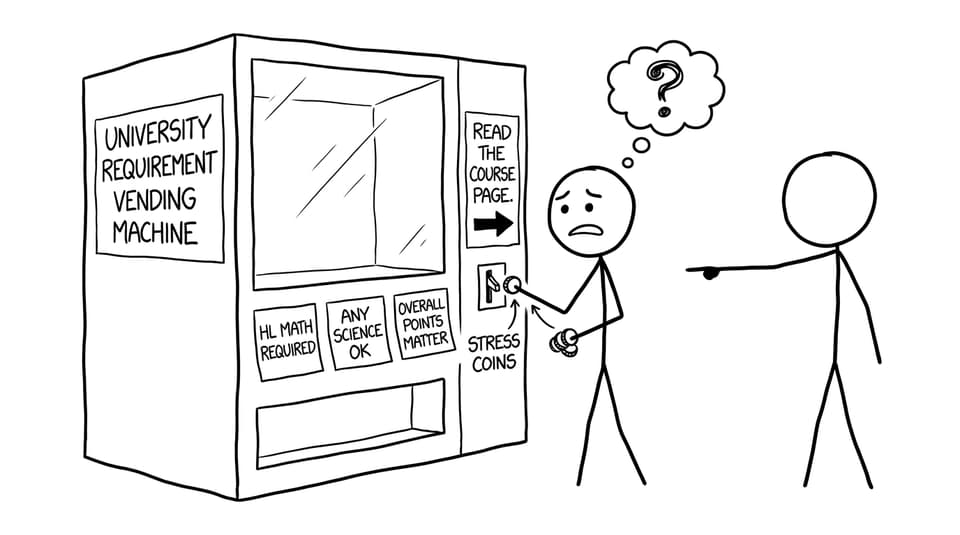
Some courses have subject requirements that are simply not optional. If the course page says “HL Mathematics required,” then SL Mathematics isn’t a debate topic. It’s a different application.
Common examples (always verify on the University’s official course page):
-
Medicine and life sciences: often want HL Chemistry and sometimes HL Biology
-
Engineering and physics-heavy degrees: often want HL Mathematics and HL Physics
-
Economics at competitive programs: frequently values HL Mathematics
This is where HL is a key that opens a door. Without it, you can still be an excellent student. You may just be applying to a different door.
Signalling readiness: the “makes sense” factor
Even when a University doesn’t require HL, your levels can communicate intent.
If you apply for Computer Science with HL Mathematics and HL Physics, that looks coherent. If you apply with SL Mathematics and no quantitative HL, a University may wonder if you’ll enjoy (or survive) the first-year pace.
But coherence is not the same as maximising difficulty. A transcript that looks “impressive” but produces lower grades can be less competitive than a balanced set that produces higher points.
When a University cares less than you think
Here’s the part students rarely hear clearly: a University usually does not reward suffering for its own sake.
If your HLs are aligned and you meet prerequisites, admissions tends to shift focus to:
-
your predicted and final grades
-
the overall rigor of your program (IB already signals rigor)
-
consistency across subjects
-
fit for the course
In practice, a strong SL can be strategically valuable. The IB is scored as a whole. Points are points. And offers are often points-based.
To see this tradeoff explained in a practical way, read: Is a 7 in SL Better Than a 5 in HL in IB?.
A smart way to choose HL vs SL (without panic)
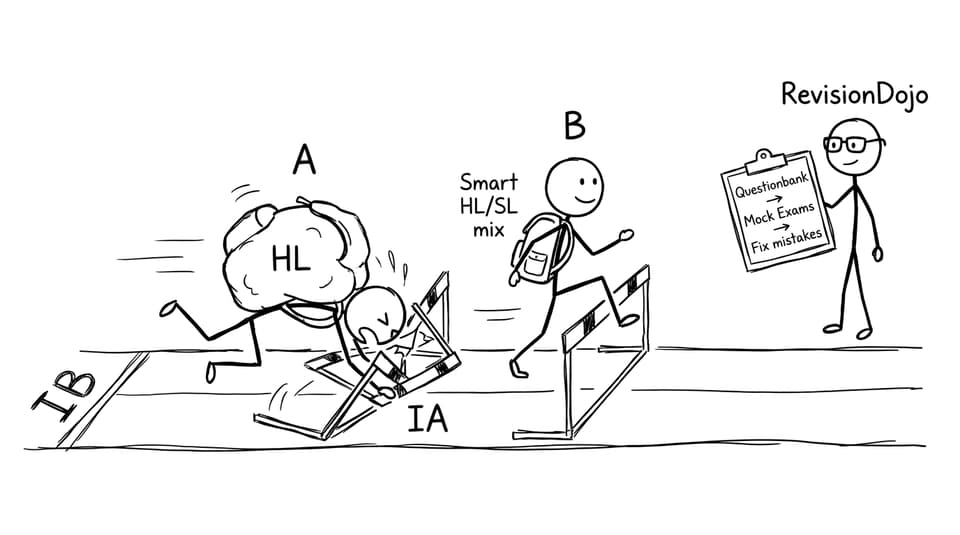
Most students don’t fail because they picked the “wrong” level. They struggle because they picked a level they couldn’t sustain while everything else (IAs, TOK, EE, life) kept moving.
Try this decision filter:
Choose HL if it’s a door subject
If the University course you want requires it, choose HL and build your preparation around reality, not hope.
Choose HL if you can sustain exam practice
HL is often won through repetition, not inspiration. That’s where RevisionDojo’s workflow matters:
-
Use the RevisionDojo App for IB exam prep to keep everything in one place.
-
Drill weak areas with the Questionbank.
-
Lock in memory with spaced repetition using Flashcards.
-
Stress-test timing with IB Predicted Papers and RevisionDojo’s Mock Exams.
Choose SL when it protects your total points
An SL you can score highly in is not “wasted.” It can be the stabiliser that keeps your total score high enough to meet a University offer.
If you need a calmer, exam-focused reminder that your schedule should be survivable, this is worth reading: How to Study for IB Exams Without Burning Out.
What if you’re already in HL and it’s going badly?
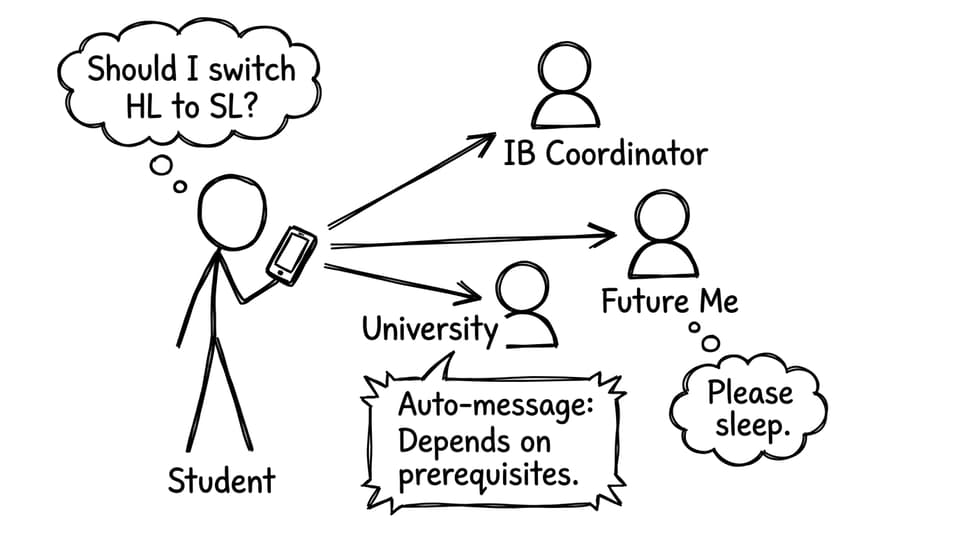
This is more common than students admit. Switching from HL to SL can be possible early in the program, but it depends on your school’s policies and timing.
If you’re considering a change, do it like an evidence-based decision:
-
Run two weeks of consistent practice (not one emotional night).
-
Use targeted topic work via the Questionbank.
-
Do one timed session to see if time pressure is the real issue.
-
Speak to your IB coordinator with concrete data: grades, topic gaps, workload conflicts.
Also, protect your sleep. Your brain is part of your revision strategy.
Closing: choose levels like a strategist, not like a martyr
If you remember one thing, let it be this: a University cares about HL vs SL when it changes eligibility or signals readiness, but it cares even more about what you can actually score.
Pick HL subjects that open the doors you need. Use SL subjects to protect your total points. Then build a revision system that turns your choice into results.
RevisionDojo is designed for exactly that: Questionbank practice for accuracy, Study Notes for clarity, Flashcards for recall, AI Chat for quick explanations, Grading tools to improve faster, and Predicted Papers plus Mock Exams to make exam day feel familiar. When your University goal feels heavy, the best response is a lighter, repeatable routine that still moves your score.