
For IB students sitting exams in May 2028 who started DP1 in August 2026.
The best CAS advice May 2028 students can follow is to choose a few repeatable, meaningful experiences, begin the required collaborative project during DP1, and document learning as it happens. Aim to complete most active CAS work by January or February 2028, subject to your school's deadlines, so CAS does not compete with final revision.
CAS becomes difficult when it is treated as a collection of impressive activities. It becomes manageable when treated as a rhythm: participate, notice what changed, preserve evidence, and decide what to do next.
Your CAS plan at a glance
- Confirm your school's expectations and internal deadlines with your coordinator.
- Begin with two sustainable experiences rather than six ambitious commitments.
- Maintain a reasonable balance across creativity, activity, and service.
- Start planning your collaborative CAS project in DP1.
- Record evidence and reflections after meaningful moments.
- Review your portfolio monthly and address gaps early.
What the official CAS rules currently say
CAS is one of the three required elements of the Diploma Programme core. According to the current IB overview of creativity, activity, service, students provide evidence that they have achieved seven learning outcomes through their CAS experiences.
The publicly available IB subject brief states that CAS formally begins at the start of the Diploma Programme and continues regularly for at least 18 months. For a student beginning DP1 in August 2026, that period reaches approximately February 2028. This is not an automatic personal deadline. Your school determines its submission process, checkpoints, interviews, and final internal date.
The official brief defines the CAS project as a collaborative series of sequential experiences lasting at least one month. The IB's CAS project guidance explains that a project may focus on one CAS strand or combine several.
There is no universal requirement in the current public framework to accumulate a particular number of CAS hours. Regular engagement, evidence, reflection, balance, and achievement of the learning outcomes matter more than chasing an unofficial numerical target.
What is not yet published for May 2028
As of October 2026, the public IB pages reviewed for this article do not identify a May 2028-specific CAS guide. CAS is not an examined subject, although individual academic subjects can follow different first-assessment cycles.
Always follow your coordinator's instructions. If your school sets a February 2028 portfolio deadline, plan around it even if another school uses a different calendar.
Choose continuity over novelty
The easiest activity to document is often one you can genuinely continue. A weekly running programme, ensemble rehearsal, coding project, community initiative, or sustained creative practice produces natural evidence of development. There is time for difficulty, adjustment, and growth.
A one-off event may still be valuable, but a portfolio made entirely of isolated events can make commitment and perseverance harder to demonstrate. Before accepting an experience, ask:
- Would I still care about this in three months?
- Can it fit beside six subjects, TOK, and the extended essay?
- Is there a genuine challenge or area for growth?
- What evidence could naturally show my participation and learning?
Students uncertain about their first commitments can learn how to choose initial CAS activities without overcommitting. An existing interest can also qualify when you establish goals, extend yourself, act, and reflect. RevisionDojo's guide to turning an existing hobby into a CAS activity explains how to make that transition purposefully.
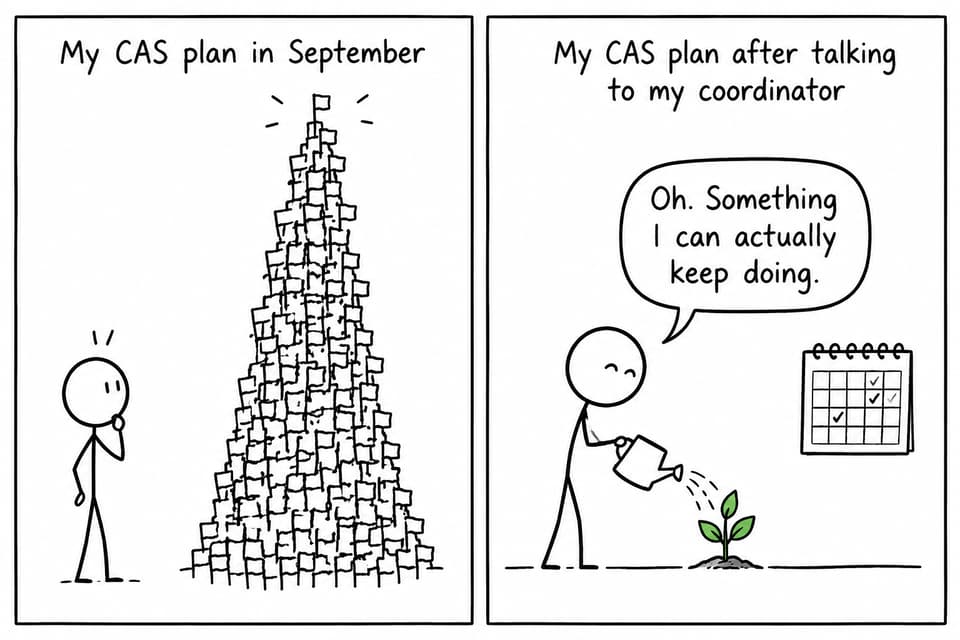
An ambitious plan becomes useful only when it can survive an ordinary school week.
Build a May 2028 CAS timeline backwards
The extended essay, internal assessments, university applications, mock exams, and CAS rarely become urgent one at a time. A backwards plan creates margin before those demands converge.
| Period | Practical CAS priority |
|---|---|
| August-October 2026 | Complete orientation, confirm school rules, and begin two sustainable experiences |
| November 2026-February 2027 | Establish regular participation, gather evidence, and identify learning-outcome gaps |
| March-June 2027 | Plan or begin the collaborative CAS project and review strand balance |
| July-August 2027 | Continue suitable experiences where practical |
| September-December 2027 | Complete the project, strengthen weak outcomes, and organize the portfolio |
| January-February 2028 | Resolve missing evidence and meet coordinator checkpoints |
| March-May 2028 | Preserve revision time and answer final school requests promptly |
This is planning advice, not an IB calendar. School schedules, safeguarding requirements, and coordinator deadlines can change the sequence. Use the two-year IB DP scheduling guide to make CAS coexist with the diploma rather than occupy whatever time remains.
Make the CAS project smaller and more real
A project does not become meaningful merely by becoming large. Scope is often the hidden source of failure.
Suppose a group wants to improve environmental awareness. Transforming sustainability across an entire city sounds inspiring but is difficult to own or evaluate. Auditing waste in one school area, consulting the people affected, testing an intervention, and sharing the findings creates clearer roles and more credible evidence.
Use the IB requirement as your floor: collaboration, connected experiences, and at least one month. Then answer five questions:
- What specific need, goal, or creative outcome are we addressing?
- Who is affected, and have we consulted them where appropriate?
- Which responsibilities belong to each collaborator?
- What ethical, safety, or permission issues need attention?
- What evidence will show the process, not only the final event?
Beginning during DP1 leaves time to recover if a venue declines, a collaborator becomes unavailable, or the original plan proves unrealistic.
Reflect when something is worth examining
Reflection is not a diary of everything you did. “We met on Tuesday and discussed posters” records an event but reveals little about learning.
A useful reflection identifies a decision, obstacle, reaction, change, or consequence. It might explain why an approach failed, how collaboration changed your thinking, or why an ethical concern required reconsideration. The RevisionDojo guide to useful CAS reflection distinguishes recounting activity from examining learning.
When you are stuck, ask:
- What happened that mattered?
- Why did it matter?
- What does it reveal about my choices, skills, or assumptions?
- What will I change next?
- Which learning outcome does the evidence genuinely support?
Not every session needs a reflection. Your coordinator may permit written, audio, visual, or other formats, but use the system approved by your school. Photographs, plans, drafts, progress records, created work, and supervisor confirmation can provide evidence when privacy and consent are respected.
Review the portfolio monthly, not retrospectively
Memory makes poor evidence. A monthly 20-minute review is more reliable than reconstructing 18 months during DP2.
Check recent participation, attach relevant evidence, add reflections where learning occurred, and scan the seven outcomes. One experience may support several outcomes over time, while another may strongly demonstrate only one or two.
A periodic strand review also prevents accidental imbalance. The goal is not an identical count in three columns, but a reasonable balance suited to your context. This guide to balancing creativity, activity, and service can reveal genuine gaps without encouraging artificial activities.
Before coordinator checkpoints, review the common first-term CAS mistakes. Early corrections are usually small. Late reconstruction is where CAS begins to feel heavy.
Protect CAS by protecting academic time
A sustainable CAS plan depends on a sustainable academic plan. RevisionDojo brings the academic side into one workspace. Questionbank practice and Grading tools expose weaknesses, while Study Notes, Flashcards, and AI Chat make short revision blocks more focused. Predicted Papers and Mock Exams support exam preparation, while the Coursework Library and Tutors help students understand expectations without replacing their own work.
Efficient studying protects the weekly space CAS needs. RevisionDojo cannot do the diploma for you, but it can reduce avoidable friction so meaningful work receives attention before deadlines become emergencies.
Finish with evidence, not exhaustion
Good CAS is rarely one heroic experience. It is a record of sustained choices made while life remained busy. Starting in August 2026 provides time to revise a plan, learn from an unsuccessful attempt, and demonstrate growth honestly.
Create a free RevisionDojo account, schedule a monthly CAS check-in through February 2028, and record your first two sustainable experiences with their goals, likely evidence, and next action.