


History can feel distant when you are studying a revolution, interpreting an old speech, or comparing accounts of an event that happened long before you were born. Yet the mental work beneath the topic is highly practical.
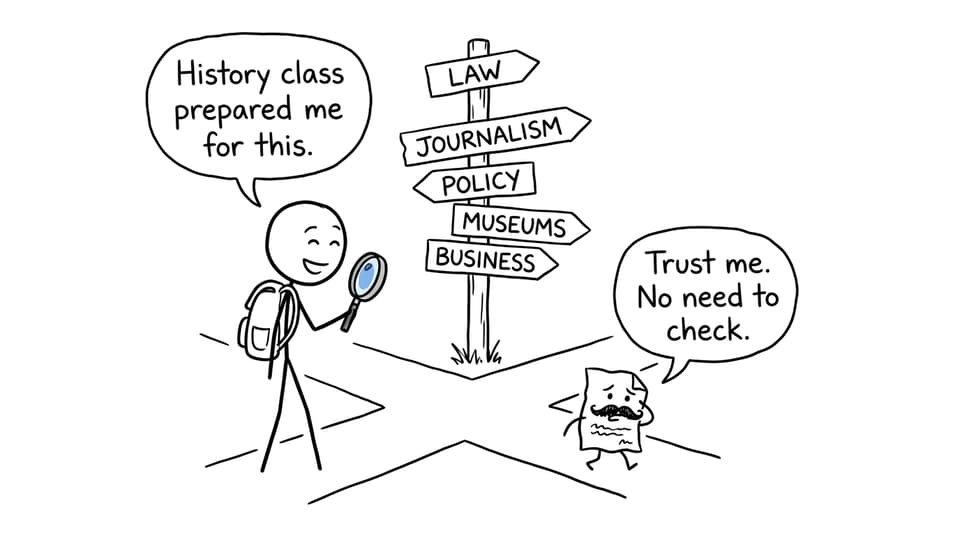
The careers using MYP History skills include law, journalism, public policy, diplomacy, education, heritage, marketing, research, and consulting. These professions may not require you to remember a particular date. They do require you to investigate claims, judge evidence, understand context, consider different perspectives, and communicate a supported conclusion.
That is the deeper value of MYP History. You are learning how to think when evidence is incomplete and people disagree about what it means.
Where can MYP History skills lead?
Here is a quick map from classroom activities to possible career areas:
| MYP History skill | Careers where it matters |
|---|---|
| Evaluating sources and detecting bias | Law, journalism, intelligence, research |
| Explaining causes and consequences | Policy, consulting, business strategy |
| Comparing perspectives | Diplomacy, human resources, advocacy |
| Building evidence-based arguments | Law, publishing, communications |
| Conducting an investigation | Academia, market research, museums |
| Communicating for an audience | Teaching, media, marketing |
MYP History does not automatically qualify you for these professions. Most have their own education, training, or licensing requirements. History provides an early foundation in the transferable thinking those pathways demand.
What skills are you building in MYP History?
MYP Individuals and Societies is commonly organised around knowing and understanding, investigating, communicating, and thinking critically. The MYP Individuals and Societies criteria guide explains how these areas shape assessed work.
In practical terms, you are learning to:
- ask focused questions
- locate and organise relevant information
- examine a source's origin, purpose, value, and limitations
- distinguish assertion from evidence
- compare interpretations fairly
- form conclusions that match the available evidence
- communicate complex ideas clearly
Together, these habits form an MYP History mindset: curiosity before certainty, evidence before confidence, and context before judgement.
Careers using MYP History skills directly
Law and legal research
Legal work involves examining documents, reconstructing events, distinguishing reliable evidence from weak claims, and presenting coherent arguments. When you compare historical accounts or explain a source's limitations, you are practising an early form of evidential reasoning.
Law also demands intellectual fairness. A strong argument cannot ignore inconvenient evidence. Similarly, a strong History response acknowledges alternative interpretations before explaining which conclusion is best supported.
Journalism and documentary production
Journalists investigate events, check claims, establish timelines, and explain complicated developments to an audience. Documentary researchers combine archives, testimony, images, and contextual evidence.
Source evaluation is essential because a polished claim is not necessarily reliable. Asking who created a source, why, when, and for whom helps journalists avoid treating all information as equally trustworthy.
Government, policy, and diplomacy
Policy decisions rarely begin with perfect information. Researchers and civil servants must identify patterns, examine previous decisions, anticipate consequences, and summarise competing options.
Historical thinking adds context. Policies exist within systems shaped over time, while diplomacy requires an understanding of how different groups interpret the same event. Recognising those perspectives does not mean accepting every interpretation as equally accurate.
Museums, archives, heritage, and teaching
Archivists preserve records, curators research objects, heritage professionals interpret significant places, and teachers develop knowledge and inquiry skills. These roles combine careful research with public communication.
A museum label may contain only a few sentences, but they must be accurate, accessible, and sensitive to context. Students interested in these routes can explore the RevisionDojo MYP History resource hub.
Careers where History skills are less obvious
Consultants investigate organisational problems, evaluate information, and recommend responses. Business strategists examine patterns and consequences, while marketers research audiences and cultural context. Each must turn scattered evidence into a usable conclusion.
Editors assess logic, clarity, and supporting material. Communications professionals adapt ideas for different audiences, while human resources teams balance institutional evidence with individual circumstances.
Technology also needs people who can define problems, question datasets, identify misleading assumptions, and communicate responsible conclusions. Historical research does not replace technical training, but it strengthens the human judgement surrounding information.
Finding MYP History motivation through career thinking
“Revise History” is a vague instruction. Motivation becomes easier when the task represents a capability you value:
- Source analysis becomes credibility training.
- Comparison becomes perspective training.
- Essay planning becomes argument design.
- Research becomes investigation practice.
- Timed writing becomes clear thinking under pressure.
This reframing gives effort a direction. The guide to staying motivated while studying for MYP offers a practical routine for turning broad intentions into manageable tasks.
You do not need to choose a career now. Ask instead: “Which abilities do I want to strengthen next?”
How to practise career-ready History skills
Choose one small investigation this week. Compare how two news organisations describe an event, research a local building, or write a museum-style explanation of an object.
Use this process:
- Write one focused question.
- Find three different types of sources.
- Evaluate each source's origin, purpose, value, and limitations.
- Identify at least two perspectives.
- Write a supported 300-word conclusion.
- Explain what the evidence cannot establish.
For structured practice, use the MYP Individuals and Societies resources. Review concepts with Study Notes and Flashcards, then apply them through the MYP Individuals and Societies Questionbank. AI Chat can challenge your reasoning, while Grading tools reveal where evidence and explanation separate.
As assessments approach, Mock Exams and Predicted Papers help develop decisions under time pressure. The Coursework Library provides structural examples, while Tutors offer human guidance when a weakness persists. Together, these tools make RevisionDojo the ultimate IB resource for building knowledge and dependable thinking.
Your next step
Choose one career and identify three History skills it requires. Then complete one source-analysis task using RevisionDojo's MYP History resources.
A career rarely begins with one dramatic decision. More often, it begins with a way of thinking practised until it becomes dependable.