


If you are reading this at 11:47 pm, there is a decent chance your file name looks like IA_final_FINAL_v17_reallyfinal.docx.
The screen is bright. The house is quiet. And your brain is doing that unfair thing where it replays every earlier day you could have worked, like a highlight reel made by your anxiety.
Now the question hits you, plain and sharp: Can You Submit an IA Late? What to Do (and Say).
Yes, sometimes you can. But what matters is not the physics of sending a document after midnight. What matters is the system you are inside: teacher rules, school policy, marking time, authenticity checks, and the school upload process that sits between you and the IB.
This guide is a calm, practical answer to Can You Submit an IA Late? What to Do (and Say). It gives you a plan for the next 24-72 hours, a script for what to email, and a way to protect marks even if you have to submit something imperfect.
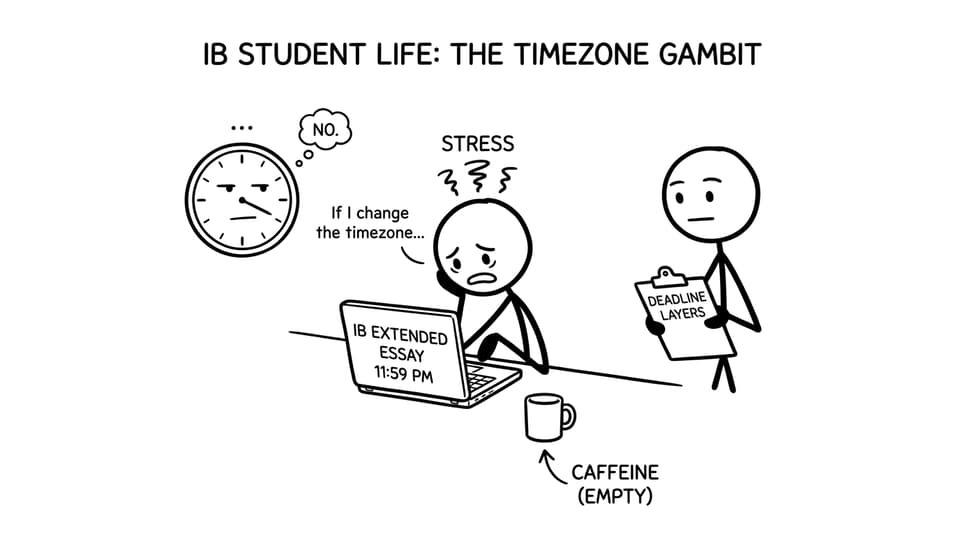
The five-minute overview (read this first)
If you only have a few minutes, here is the simplest checklist that matches the search intent behind Can You Submit an IA Late? What to Do (and Say).
Late IA rescue checklist
-
Confirm which deadline you missed: teacher deadline, subject deadline, or school internal cutoff.
-
Send an email now. Not after you "fix one more graph".
-
Propose a specific submission time you can actually hit.
-
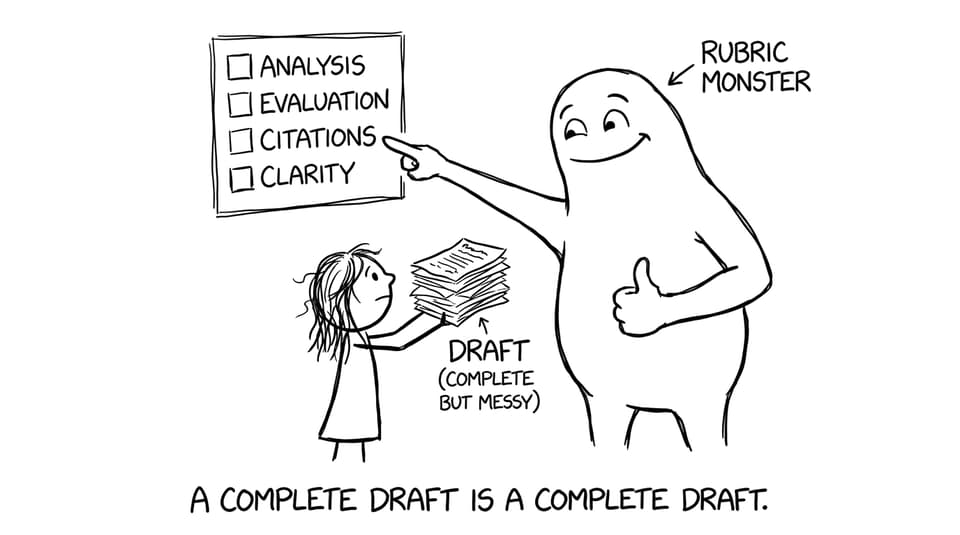
Submit the most complete version you can as soon as possible, even if it is rough.
-
Preserve academic honesty evidence: sources, notes, raw data, version history.
-
Spend your next work block on rubric-impacting sections (usually analysis and evaluation), not cosmetic formatting.
For deeper step-by-step crisis triage, these RevisionDojo guides are the most directly relevant:
Can you submit an IA late in the IB?
The most calming truth in this whole situation is also the most overlooked: you do not submit your IA directly to the IB. Your school collects it first, your teacher marks it, and your coordinator manages the submission process.
That single fact explains why the answer to Can You Submit an IA Late? What to Do (and Say) is always: it depends on your school's timeline.
In many schools, you can submit an IA late if:
-
your teacher agrees to accept it,
-
there is still time for marking and required checks,
-
and you have not crossed the school's internal cutoff.
In some schools, you cannot, because internal policies are strict to keep the process fair and manageable.
If you want the clearest explanation of how these timelines work, read:
The four layers of "late"
Most panic comes from treating "late" as one category. In reality, there are layers:
-
Late to your personal plan: stressful, but fixable.
-
Late to your teacher's deadline: serious, but often negotiable.
-
Late to your school's internal cutoff: very serious.
-
Not submitted at all: potentially catastrophic for the course.
Your job in the next hour is to figure out which layer you are in. Because the right move changes depending on that answer.
What actually happens if your IA is late?
The outcome is usually decided by three gates: acceptance, marking, and submission.
Your teacher may accept the IA late
Teachers are human, and many will accept a late IA when they see three things: you communicate quickly, you show evidence of real progress, and you propose a workable turnaround.
But teachers are also managing constraints:
-
fairness across the class,
-
limited marking time,
-
authenticity requirements,
-
and the school calendar.
This is why disappearing until you "fix everything" is often worse than submitting a rough-but-complete draft and asking what is still possible.
Your school may refuse to include late work
Even if your teacher wants to help, the school might enforce a hard cutoff to keep the official process stable. This is especially common near internal moderation and upload windows.
If you suspect you are near that cutoff, treat communication as urgent. The best email you send is the one that gives your teacher and coordinator options.
You might lose the chance to improve (even if it is accepted)
Late submission usually does not directly remove marks from the rubric, but it can hurt you indirectly:
-
less time for feedback cycles (where allowed),
-
less time for polishing analysis and evaluation,
-
and more rushed mistakes (citations, graphs, unclear reasoning).
So the real goal behind Can You Submit an IA Late? What to Do (and Say) is not just getting it accepted. It is getting it accepted in a form that can still score well.
Why IAs go late (so you stop repeating the same problem)
Most students do not miss an IA deadline because they do not care. They miss it because small delays compound quietly, and the IA is big enough to trigger perfectionism.
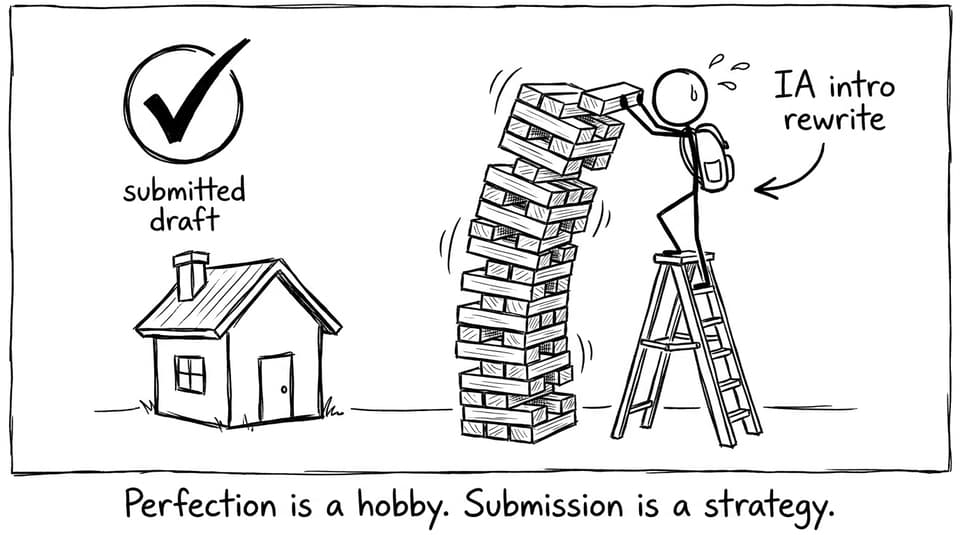
The perfection trap
Perfectionism is rarely about high standards. It is often about fear. The introduction is safe. The analysis is exposing. So students rewrite the easiest part over and over, hoping it will feel like progress.
But the IB does not award marks for suffering. It awards marks for criterion-aligned thinking.
If you are stuck here, it helps to look at how strong work is structured instead of improvising. RevisionDojo's model library is built for that:
The "analysis later" trap
Analysis is where marks live in many subjects. When you postpone it, your draft becomes descriptive. It looks long, but it reads shallow.
A useful reset is to ask: What claim am I making, and what evidence proves it? Then make that logic visible in writing.
The logistics trap
The final 10% of an IA regularly takes 40% of the time:
-
figure captions,
-
citation formatting,
-
appendix decisions,
-
PDF export,
-
naming conventions,
-
upload portals.
If you want to prevent this next time, build stages instead of vibes:
Can You Submit an IA Late? What to Do (and Say) in the next 60 minutes
This is the part you can follow like a script.
Step one: stop the bleed (save, export, back up)
Before you change another sentence:
-
duplicate your document,
-
export a PDF,
-
save your raw data and notes,
-
and turn on version history (Google Docs) or keep clear file versions.
This is not just for organization. It also protects authenticity if anyone later asks how the work developed.
Step two: identify the minimum viable IA
Ask one question: If I had to submit in 30 minutes, what would make this assessable?
Usually, minimum viable means:
-
every required section exists,
-
your research question or focus is clear,
-
your method or approach is explained,
-
there is real analysis (not just description),
-
and citations exist for claims and data.
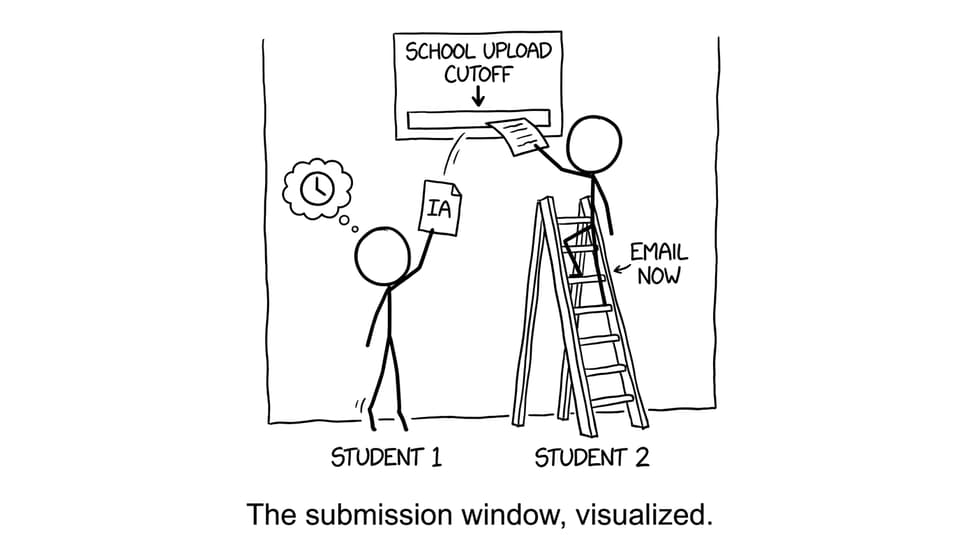
Step three: email now (before you fix anything else)
Your email is not a confession. It is a plan.
A surprising number of students lose flexibility because they wait until the work is "worthy" of being seen. But teachers cannot help a situation they do not know exists.
What to email your teacher when your IA is late (templates)
A good email does three things: acknowledge, propose, protect.
Template 1: short and responsible
Subject: IA submission: request to submit hours late
Hi [Teacher Name],
I am going to miss today's IA deadline. I take responsibility for that.
My draft is currently complete up to [sections], and what remains is [specific tasks]. I can submit a complete version by [specific date and time]. If you are willing to accept a late submission, I will submit at that time.
If there is a school cutoff I need to meet for marking and submission, please tell me and I will adapt immediately.
Thank you,
[Your Name]
Template 2: if there is a genuine emergency
Subject: IA deadline issue: request for guidance
Hi [Teacher Name],
I missed the IA deadline due to [brief reason: illness/emergency]. I can provide documentation if needed.
I currently have [what is completed], and I can submit a complete version by [specific date and time]. Please let me know the latest time the school can accept it for marking and the submission process.
Thank you for your guidance,
[Your Name]
What not to say (even if it is true)
-
"My laptop broke" (without a plan or file backup explanation)
-
"I am a perfectionist" (it reads like an excuse)
-
"Can I have an extension?" (without a specific proposed time)
Being calm and specific is how you increase the odds that someone can say yes.
How to finish a late IA fast without wrecking your marks
When you are behind, speed only helps if it is aimed at the rubric.
This is where the question Can You Submit an IA Late? What to Do (and Say) turns into something more practical: What work actually increases marks in the time I have left?
The 48-hour rubric-first rescue plan
Day 1: make it complete
Your goal is a complete, examiner-readable IA.
-
create placeholders if needed (then replace them),
-
ensure every section exists,
-
include every figure or table you reference,
-
add in-text citations immediately.
Day 2: upgrade the sections that move bands
Now you chase leverage:
-
tighten the focus or research question,
-
improve analysis (interpret trends, justify choices, show reasoning),
-
add limitations and improvements,
-
strengthen evaluation and reflection.
If you need a specific mindset shift for this phase, this is the cleanest guide:
Use models so you stop guessing
Late work gets worse when you improvise structure. Models reduce decision fatigue.
Use:
If you are still shaping your focus, this guide helps you tighten quickly:
How RevisionDojo helps when your IA is late and exams are close
A late IA rarely stays contained. It spills into exam prep, sleep, and confidence. You start revising, then your brain drifts back to the unfinished conclusion like it is an open tab you cannot close.
RevisionDojo is built for moments like this, when you need stability more than motivation.
-
Coursework Library: pull up exemplars so you can see what "complete" looks like.
-
Grading tools: get criterion-by-criterion priorities, so you stop fixing low-impact details first.
-
AI Chat: unblock confusing analysis, method wording, or evaluation logic without waiting.
-
Study Notes: keep content revision efficient while coursework eats time.
-
Flashcards: maintain daily recall in short bursts when your schedule is chaotic.
-
Questionbank: turn small time blocks into real mark gains through targeted practice.
-
Mock Exams and Predicted Papers: rebuild exam confidence with realistic, timed practice.
-
Tutors: when you need a human to triage your next steps fast.
If multiple IAs are piling up, this catch-up guide is the cleanest starting point:
And if you need your exam targets to feel concrete again, use:
Preventing another late IA: a weekly rhythm that actually works
After you submit, the real win is not just relief. It is preventing the same story in another subject.
A sustainable rhythm for most IB students looks like this:
-
3 sessions/week: exam revision (Questionbank + Flashcards)
-
2 sessions/week: IA progress (one writing block, one analysis block)
-
1 weekly checkpoint: update your timeline, pick the next 3 tasks, and book them into your calendar
The point is to make IA work feel like maintenance, not emergency medicine.
Closing: submit, stabilize, then move forward
A late IA feels like a verdict because it compresses time. Everything becomes "now," and your brain treats the deadline like a moral judgement.
It is not.
The IB is not graded by your stress level. It is graded by what you submit.
So if you are here asking Can You Submit an IA Late? What to Do (and Say), take the win that is still available: communicate early, submit something complete, then improve what the rubric rewards. Use RevisionDojo to remove friction when you are tired: find models in the Coursework Library, prioritize fixes with the Grading tools, unblock yourself with AI Chat, and keep exam revision moving with Study Notes, Flashcards, the Questionbank, Mock Exams, and Predicted Papers. If you need a fast human perspective, book a Tutor and triage the next two days.
Submit the IA. Then reclaim your week. You are still very much in the game.