
A quiet shock every IB student eventually has
You open results day with the same hope everyone has: please let my work count.
Then you see it. A number that feels strangely personal. Not because it's low or high, but because it's oddly precise. Your raw marks became an IB grade through a system you were never really shown. And the detail that stings the most is this: the boundary that decided your grade was set after the exams.
That feels unsettling at first. Like the rules moved.
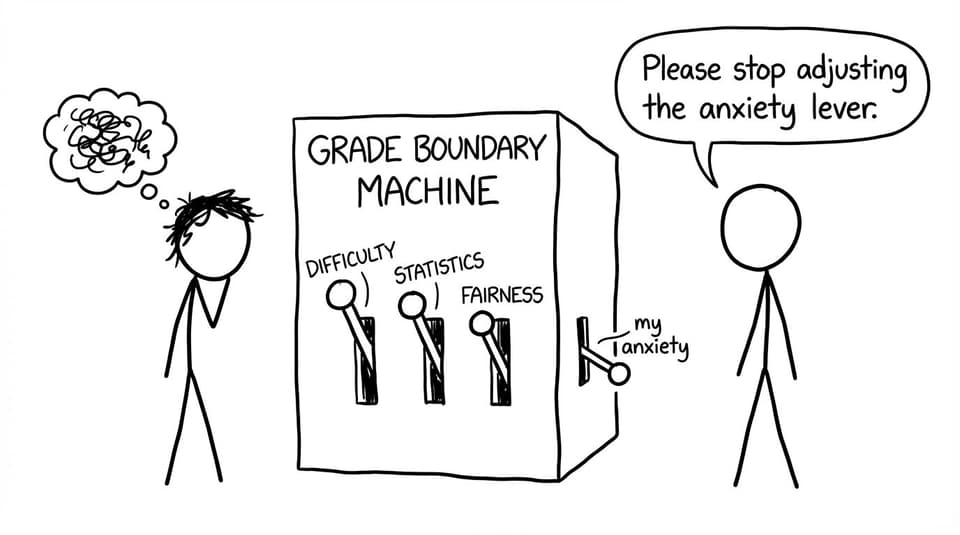
But in IB, shifting grade boundaries are less a trick and more a safety feature. They're the IB's way of saying: "We can't promise every exam is equally hard, but we can try to make the grades equally meaningful."
If you're preparing for exams, understanding how IB grade boundaries are actually calculated helps you revise with less superstition and more strategy.
Quick overview checklist: what to remember about IB grade boundaries
- IB grade boundaries are set after marking, not before the exams.
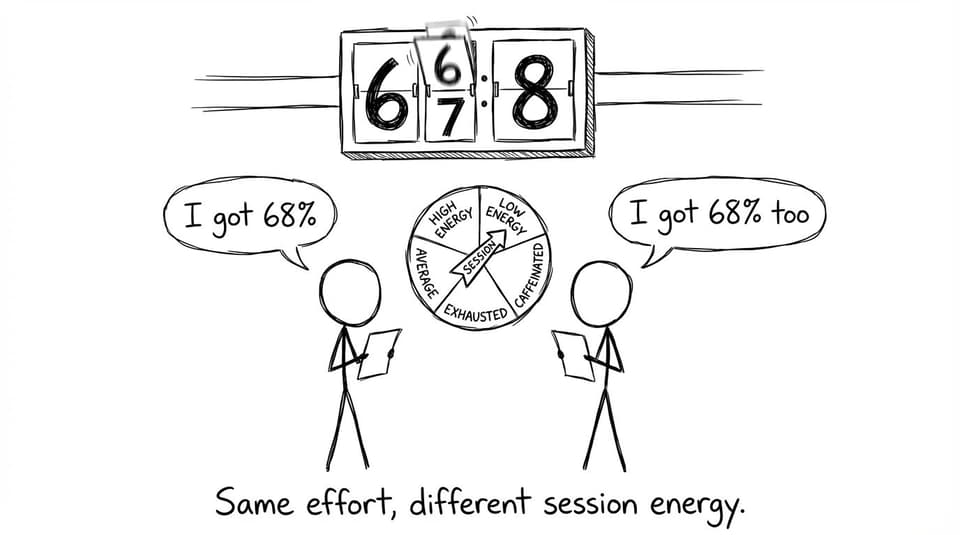
- Boundaries are session-specific (May vs November), and also vary by timezone for some subjects.
- They're influenced by exam difficulty and statistical evidence, plus expert judgment.
- Boundaries are set per subject and level (HL/SL) and reflect component weightings.
- Your goal in revision is not to "predict the boundary," but to maximize marks you control.
To track boundaries and trends quickly, keep RevisionDojo's IB Grade Boundaries page bookmarked.
What exactly is an IB grade boundary?
An IB grade boundary is the minimum total mark needed to earn a final grade (1 to 7) in a subject for a specific exam session. It's the cut score that translates your raw marks into the number universities see.
A key detail: boundaries are not just for the final total. Each subject has components (papers, internal assessment, sometimes an oral). Your final mark is a weighted combination of those components, and then that final mark is compared to the boundary table.
This is why it's possible to feel like you "did well" on one paper but still land in a grade you didn't expect: the IB grade is built from the whole assessment model, not a single moment.
If you want a session-specific sense of how boundaries look in practice, see Understanding IB Grade Boundaries 2025: What They Mean and How to Use Them.
Why IB grade boundaries change (and why that's not unfair)
Here's the story version.
Imagine two doors. Same label: "IB Physics HL Paper 2." But behind Door A is a paper with unusually brutal data analysis. Behind Door B is a paper with cleaner wording and friendlier numbers. If the boundary were fixed, one cohort would be punished for sitting Door A.
So IB grade boundaries move because the papers move.
They change for three main reasons:
Exam difficulty varies by session
Even with careful exam design, some sessions turn out harder than intended. When that happens, boundaries can shift downward so grades reflect achievement rather than shock.
Real student performance reveals what difficulty actually was
The IB has marking data from the global cohort. That data is information: which questions worked, which discriminated well, which created confusion.
The goal is stable standards over time
The IB wants a grade 7 to mean roughly the same "level of achievement" across years, even if the exact papers differ.
RevisionDojo breaks this down in a student-friendly way in What Are the Grade Boundaries for IB Subjects?.
How IB grade boundaries are actually calculated (the practical version)
The IB doesn't publish a single "one equation" explanation that students can apply like a formula. But the process is still understandable if you think in phases.
Marking happens first (and it's more standardized than it feels)
Before boundaries are set, scripts are marked using structured markschemes and examiner training. For some components, multiple examiners and moderation systems reduce variability.
This matters because IB grade boundaries are not designed to fix sloppy marking. They assume marking quality is already controlled.
Statistical evidence is used to locate sensible cut points
Once scripts are marked, the IB has score distributions: how many students scored in each range.
Statistical methods help identify where grade thresholds could reasonably sit. This is not about "curving" to force a fixed percentage of 7s. It's about using evidence from the cohort and paper design to keep standards comparable.
In plain language: the IB looks at how hard the exam turned out to be, using real results.
Expert judgment is used to keep grades meaningful
Statistics alone can be blind. So senior examiners review scripts near potential boundaries and ask: does this work at the boundary look like a 6 or a 7? Does it match the standard expected?
That "human check" is a big reason IB grade boundaries feel different from simple bell-curve myths.
Boundaries are applied to weighted totals
Finally, your weighted total mark is mapped to a grade. That's the boundary table you hear about.
If you want to see how boundaries look across sessions for your subjects, RevisionDojo's IB Grade Boundaries tool is the fastest way to compare.
The part students miss: boundaries vary by subject because the papers measure different skills
A 75% in one subject can be a 7, while 75% in another might be a 6. That isn't the IB being inconsistent. It's the nature of different assessment models.
- Essay-heavy subjects reward structure, interpretation, and sustained evaluation.
- Calculation-heavy subjects reward precision and method marks.
- Some subjects have components (like orals or practical work) that shape the final distribution differently.
That's why you should avoid comparing your "percent" across subjects as if it's a universal currency.
How to use IB grade boundaries while you revise (without spiraling)
The smartest way to use IB grade boundaries is not to obsess over the final cut score. It's to use boundaries as a planning tool.
Use boundaries to set "conversion targets"
Instead of saying "I want a 7," translate it into the raw-mark territory you need.
RevisionDojo makes this practical because you can:
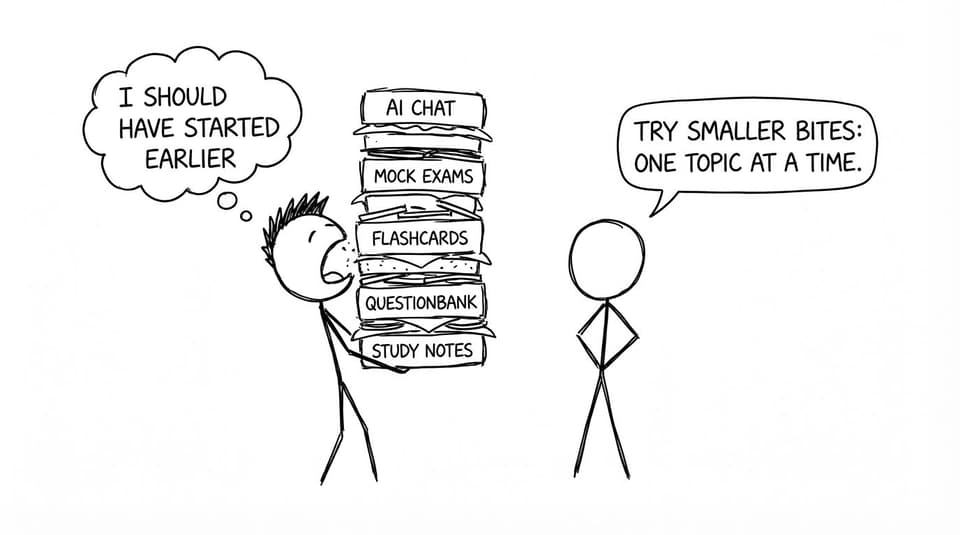
- practice in the Questionbank with markscheme-aligned feedback
- run timed Mock Exams that match paper structure
- use AI Chat to clarify concepts fast
- review Study Notes and reinforce with Flashcards
Start from the platform hub if you need everything in one place: All your IB revision needs, in one place.
Track what you can control: mark gain per hour
Boundaries are external. Your habits are not.
A good weekly metric is: how many marks did I gain per hour of revision? That's where RevisionDojo's analytics and feedback loops help, especially when you combine:
- Questionbank for targeted practice
- Online IB Mock Exams: Practice Anywhere, Anytime for pacing and stamina
Use a predictor carefully (as a map, not a prophecy)
Tools that estimate results can be useful when they reduce uncertainty and help you choose priorities.
If you want a structured way to estimate total points using boundary logic, read How to Predict Your IB Scores in 2025 or The Ultimate IB Grade Predictor Guide.
The healthy mindset is: a predictor is a dashboard. You still drive.
A simple boundary-aware revision routine (RevisionDojo style)
Here's a calm loop that matches how IB grades are built:
Learn the content quickly
Use Study Notes to remove confusion without rewriting everything.
Lock in recall
Use Flashcards daily. Small, consistent sessions beat heroic weekends.
Convert knowledge into marks
Drill the Questionbank by topic and command term. The point is to become fluent in the style the IB rewards.
Rehearse under pressure
Do weekly timed Mock Exams. This is where grade boundaries stop being abstract and become something you can realistically reach.
For a broader structure, see How to Study for IB Exams: Step-by-Step Guide.
Closing: the calm truth about IB grade boundaries
The boundary is not a moral judgment. It's the IB trying to turn a messy reality: different papers, different cohorts, different difficulty, into grades that mean something consistent.
Your job isn't to predict the boundary.
Your job is to become the kind of student who can collect marks in multiple ways: method marks, clear structure, command-term accuracy, and calm timing. That's what survives any session.
If you want one place to do that, build your loop inside RevisionDojo: Study Notes for clarity, Flashcards for recall, the Questionbank for exam-style application, AI Chat for fast explanations, Mock Exams for stamina, Predicted Papers for realism, plus Grading tools, Coursework Library, and Tutors when coursework or confidence needs a lift.
Track the boundaries, then move on to what actually changes your outcome: the next hour of practice.
Start here: IB Grade Boundaries.