

Can you appeal an IA mark?
You open your results and your stomach drops. The IA you stayed up for, the one you rewrote three times, didn't land where you thought it would. The first impulse is simple: surely there's a way to appeal this.
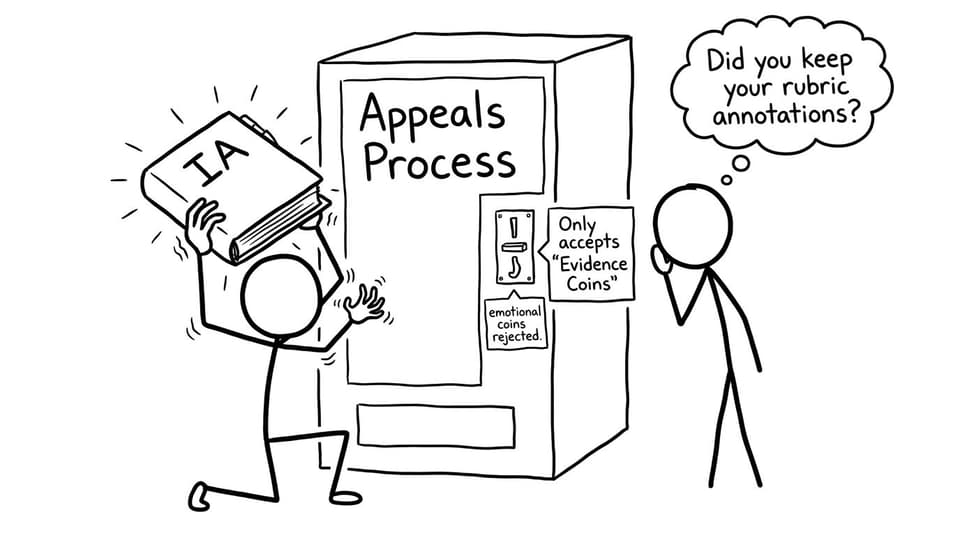
Here's the truth most students only learn after the panic fades: you usually can't appeal an IA mark in the way you can appeal a school decision. But you can ask for checks, you can request clarity, and in specific situations your school may trigger an official process with the IB. The difference matters because it changes what you should do next, and how you gather proof.
This guide breaks down what an IA mark actually is, what "appealing" really means in IB world, and the practical steps that give you the best chance of improving your final outcome (or at least protecting it). Along the way, you'll see how RevisionDojo's Grading tools, Coursework Library, and AI Chat help you build the kind of evidence that matters.
Quick checklist: what to do if you think your IA mark is wrong
If you're in that "this can't be right" moment, do this in order:
- Ask your teacher what your submitted IA mark was and how it mapped to the rubric.
- Ask whether your cohort went through internal moderation (most schools do).
- Request a criteria-by-criteria breakdown (not just a total).
- Check whether the issue is likely administrative (wrong file, wrong rubric, missing pages) vs judgment (teacher interpretation).
- Speak to your IB coordinator about what processes exist at your school.
- Focus your energy on what you can still control: exam prep strategy, and future coursework habits.
For tools that make rubric alignment clearer before submission, explore IB Internal Assessment Guides and the IB Coursework Grader.
What your IA mark actually is (and why that changes "appeals")
An IA is internally marked by your teacher using IB criteria. Then most schools run internal moderation to keep marking consistent across classes. After that, the IB may moderate a sample of work.
That chain explains why "appeal" is tricky. You're not appealing a single examiner's decision like you might in another system. You're dealing with:
- A teacher's professional judgment against a rubric
- School-level moderation decisions
- IB moderation (which can adjust marks up or down depending on alignment)
So when students ask, "Can I appeal my IA mark?" what they often mean is one of three things:
- "Can someone re-mark my IA because I disagree?"
- "Can the school correct a mistake?"
- "Can the IB review the administrative handling of my work?"
Only the last two have realistic pathways. Disagreement alone usually isn't enough.
If you want a deeper look at how schools manage IA marking and moderation, this post helps: How RevisionDojo Enhances IB Internal Assessment (IA) Feedback and Moderation.
What "appealing an IA mark" can mean in practice
Asking your teacher for a remark (school-level)
At the school level, you can request that your teacher re-check the rubric application. This is not an "IB appeal." It's a professional conversation. And done well, it's less about arguing and more about asking:
- Which descriptors did I meet?
- Which did I not meet, and where?
- If I'm missing marks, what evidence would have been needed?
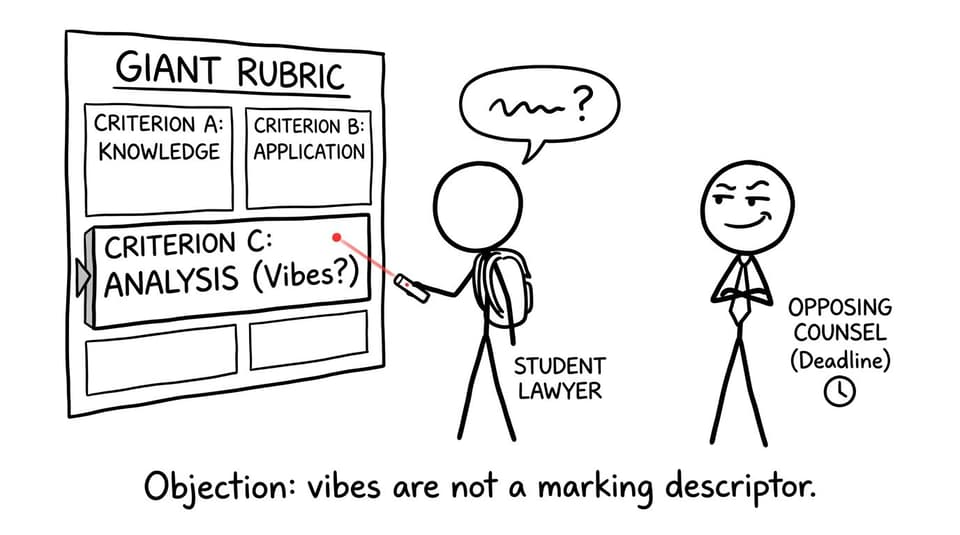
This is where students often lose momentum because they bring emotion instead of criteria. Your best approach is to use the IA rubric language back to the teacher and point to specific lines in your work.
RevisionDojo's IB IA Grading Service: Professional Assessment in Minutes is useful here because it trains you to think in criterion evidence, not in vibes.
Requesting an administrative check
Administrative issues are the most "appealable" part of an IA mark because they're factual. Examples:
- Wrong candidate number attached to work
- Wrong file uploaded
- Missing pages due to upload errors
- Mark entered incorrectly
If something like this happened, escalate quickly through your coordinator. This isn't about persuading someone your analysis was brilliant. It's about proving a process error.
IB-level processes (rare, coordinator-led)
Most IB processes that resemble an appeal are initiated by the school, not the student directly. Your coordinator is the gatekeeper, and they'll only move forward if there's a legitimate basis.
That's why the smartest student move is to stop thinking "How do I appeal?" and start thinking "What evidence exists that a mistake occurred?"
The quiet trap: confusing a low IA mark with a final grade problem
A hard moment in IB is realizing that an IA can feel huge emotionally, but it may not be the biggest driver of your final grade. Depending on your subject and weighting, exams can move the final result far more.
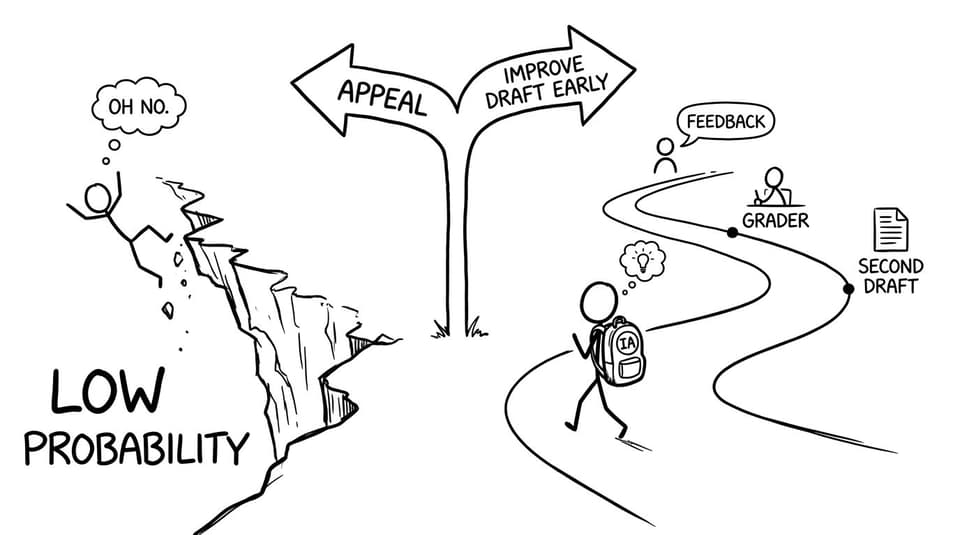
This isn't meant to minimize your frustration. It's meant to prevent the most expensive mistake: spending your limited time chasing a low-probability IA change while neglecting exam technique.
If you want a calm, structured system for the final stretch, use RevisionDojo App: The Smarter Way to Prep for IB Exams alongside IB Exams Without Pausing Your Life. Both are built around a simple idea: consistent loops beat heroic last-minute effort.
How to talk to your teacher about your IA mark (without making it worse)
If you want the best shot at a fair reconsideration, treat it like a mini oral defense of your IA. Calm. Specific. Rubric-centered.
Here's a script structure that works:
- "Could we go through my IA criterion by criterion?"
- "For Criterion X, I thought I demonstrated (descriptor language). Can we look at the exact place you felt it didn't meet that level?"
- "If you had one example of what would have pushed this up, what would it be?"
Notice what's missing: "I worked really hard." Effort is real, but rubrics don't award it.
To prepare, use RevisionDojo's AI Chat to translate rubric wording into a checklist you can point to, then compare that checklist with your paragraphs. If you want models for what strong evidence looks like, browse an IA exemplar in the IB Psychology Internal Assessment Example Discussion or review subject-specific guidance in IB Internal Assessment Guides.
What evidence actually helps (and what doesn't)
The only evidence that matters in an IA mark dispute is evidence that connects directly to the published criteria.
Helpful evidence:
- Rubric descriptors highlighted with page references
- A teacher's written comments that contradict the final level awarded
- Proof of an administrative error (timestamps, upload confirmations, file versions)
- A clear moderation note trail (if your school shares this)
Not helpful evidence:
- "My friend got higher and we did similar topics"
- "I spent 30 hours on it"
- "I'm usually a 7 student"
If you want to build criteria evidence, it helps to practice evaluating writing the same way examiners do. Read: IB Internal Assessment Feedback: Detailed Comments and Suggestions and then use RevisionDojo's Grading tools to simulate that mindset on your own drafts.
The best "appeal" is prevention: making your IA harder to mark down
Most IA disappointment is not about intelligence. It's about invisibility. Students often do good thinking but fail to signal it in a way the rubric rewards.
Three prevention habits make your IA more robust:
Write like you're being skim-read
Markers are trained, but they're also human. If your strongest evaluation point is buried, it might not land. Use clear subheadings, topic sentences, and explicit signposting.
If you're stuck on evaluation quality, use: How to Write a Compelling IA Evaluation Section.
Self-grade your IA before anyone else does
Before submission, run your IA through a rubric check. RevisionDojo's Coursework Grader gives criterion-level feedback and a prioritized fix list, which is exactly what you need when time is short. Start here: IB Coursework Grader.
Benchmark against high-scoring structure
A surprising amount of IA success is pattern recognition: how introductions frame aims, how analysis earns credit, how evaluation avoids being generic. That's why RevisionDojo's Coursework Library exists: so you stop guessing what "good" looks like.
For Math students seeking topic patterns, see: Examples of Successful IB Math IA Topics.
How RevisionDojo helps if you're worried about your IA mark right now
If you're reading this because your IA mark feels uncertain and exams are approaching, your best move is to build a two-track plan:
- Track 1: clarify the IA situation with your teacher/coordinator using rubric evidence
- Track 2: protect your final grade with disciplined exam prep
RevisionDojo supports both tracks in a way that feels calmer than juggling ten resources:
- Grading tools (Coursework Grader) to check your IA against criteria quickly
- Coursework Library to see what strong work looks like across subjects
- AI Chat to ask "why did this lose marks?" and get a criterion-based explanation
- Study Notes to rebuild foundations efficiently
- Flashcards for spaced repetition when energy is low
- Questionbank to turn knowledge into marks through active practice
- Mock Exams and Predicted Papers to simulate timing and pressure
- Tutors when you need a human to untangle a complex issue fast
If you want a single overview of building that loop, read: What's the Best Way to Revise for IB Exams? and The Ultimate Guide to Revision for IB Students.
Closing: the real goal isn't an IA appeal, it's control
When students say they want to appeal an IA mark, what they're really asking for is control: control over fairness, over outcomes, over the feeling that hard work should translate into points.
Sometimes control looks like catching an administrative error and fixing it. Sometimes it's a calm rubric conversation that clears confusion. But most of the time, control is built earlier: a system that makes your IA harder to mark down, and a study loop that makes exams predictable.
If you want that kind of control, build your next steps with RevisionDojo: use the Coursework Grader to pressure-test your IA, use the Coursework Library to benchmark structure, and then switch into exam mode with Study Notes, Flashcards, the Questionbank, Mock Exams, and Predicted Papers. If you need fast clarity, open AI Chat. If you need a human plan, book Tutors.
You may not be able to "appeal" an IA mark the way you imagined. But you can absolutely build the evidence, habits, and momentum that make the IA only one chapter in a much better ending.