
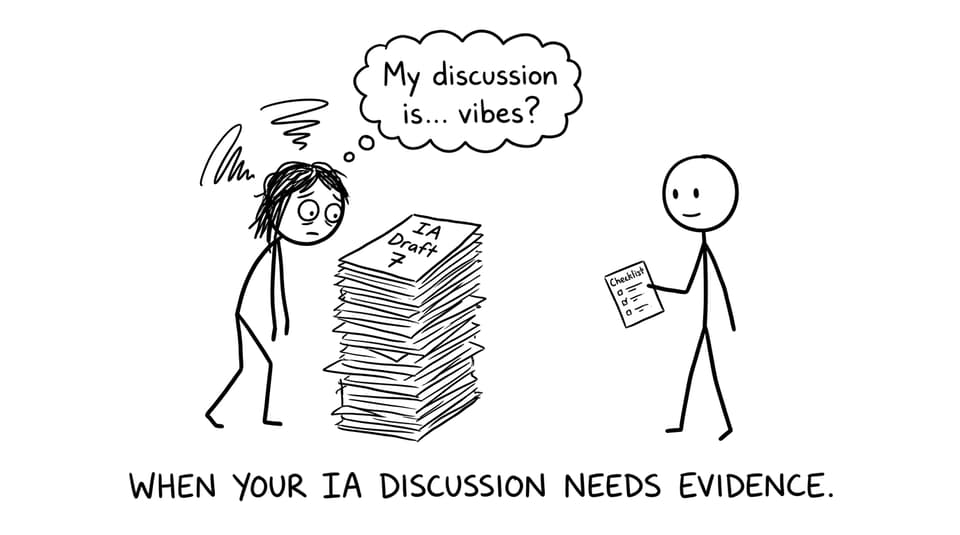
If you have ever stared at your IB Psychology Internal Assessment and thought, “I did the study… so why does the Discussion still feel like fog?”, you are not alone. The experiment can be tidy, the results can look convincing, and yet the Discussion section can read like a guess dressed up as confidence.
The good news is that strong IB Psychology Discussions are not magic. They are patterns. And once you learn to spot them in a high-quality IB Psychology IA example, writing your own becomes far less mysterious.
Use this post as a quick map: a practical walkthrough of a sample IA Discussion, plus how RevisionDojo’s IA Library helps you move from “I wrote something” to “this meets the criteria.”
IB Psychology IA example at a glance
A common (and IB-appropriate) experimental idea looks like this:
-
Research question: Does background music affect concentration levels in IB students during a cognitive task?
-
Design: Controlled experiment (music vs silence)
-
Task: Stroop test
-
DV measures: Completion time and errors
If you want a broader home base for IB Psychology revision (notes, practice, and exam strategy), keep IB Psychology resources open as your hub.
What makes the Discussion strong in IB Psychology
A high-scoring IB Psychology Discussion does three things repeatedly: interprets, connects, and evaluates.
Interpret results like a researcher, not a narrator
Avoid simply restating what happened (“music group was faster”). Instead, explain what it means for attention and distraction. In our IB Psychology IA example, faster Stroop performance with fewer errors could suggest improved selective attention under instrumental music, or reduced perceived stress during the task.
Link back to theory and studies (but stay honest)
The Discussion earns marks when it connects results to psychological theory and prior research without forcing it. A clean sentence structure helps:
-
“This may support X because…”
-
“However, an alternative explanation is…”
If you are revising cognitive content alongside your IA, pair your Discussion writing with targeted notes like Cognitive biases notes to keep terminology precise.
Evaluate using a “fix-it” mindset
In IB Psychology, evaluation is not self-criticism. It is controlled, specific problem-solving.
In the sample IA, strong evaluation points include:
-
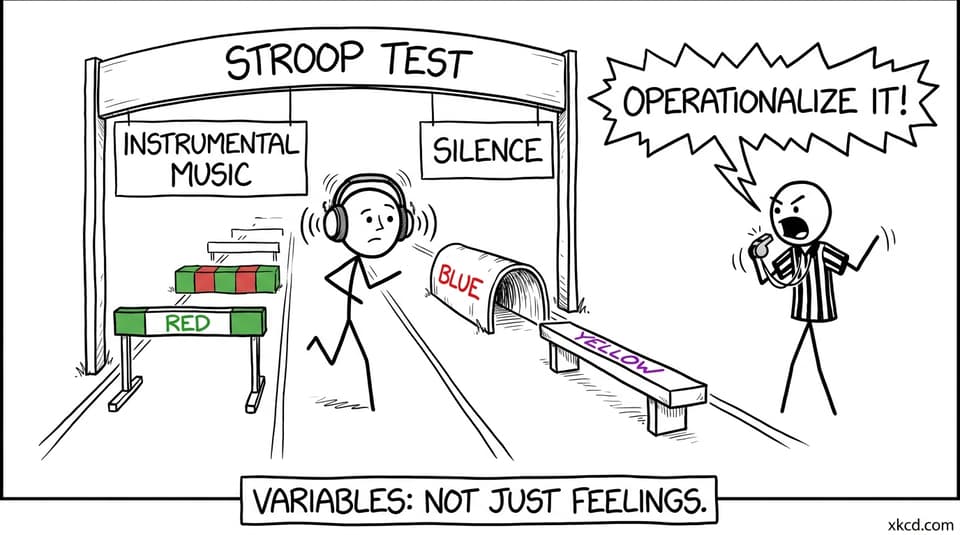
Operationalization: concentration measured via Stroop time and errors (clear, measurable)
-
Ethics: voluntary participation, right to withdraw, minimal risk
-
Reliability: repeated trials, averaged scores
-
Limitations: small sample size, participant expectations, uncontrolled individual differences
Then add improvements that match the limitation:
-
Increase sample size or use random sampling where possible
-
Standardize volume, music genre, and testing environment
-
Use counterbalancing if participants do multiple conditions
How RevisionDojo’s IA Library helps you write faster and better
The fastest way to level up IB Psychology writing is to study excellent models, then build your own original work from the patterns.
Start here: RevisionDojo’s IB Psychology IA examples. You can see how top students structure their Discussion, how they phrase evaluation, and how they tie findings back to theory.
Then stack tools around the library:
-
Use the IB Psychology IA guide to align each paragraph with the criteria
-
Run your draft through the IB Psychology IA Grader to spot what is missing before your teacher does
-
Tighten your research-method language using RevisionDojo Study Notes and Flashcards inside the IB Psychology resources hub
-
For exam prep alongside coursework, train with the IB Psychology Paper 3 page and the Paper 3 questionbank

FAQ: IB Psychology IA Discussion
How long should the IB Psychology IA Discussion be?
The right length is the length that fully answers “what do these results mean?” and “how good is this study?” In IB Psychology, a strong Discussion usually has clear sections: interpretation, link to theory, limitations, and improvements. If you are repeating the Results section, it is probably too long in the wrong way. If you have not discussed alternative explanations, it is probably too short in the wrong way. A helpful check is to compare your structure with an IB Psychology IA example from RevisionDojo’s library, then mirror the logic (not the wording). Use the IB Psychology IA examples as your benchmark.
What should I include when evaluating an IB Psychology IA example?
Start with validity: did your procedure actually test what you claim? Then reliability: would you get similar results again with the same method? Then ethics: was participation informed, voluntary, and low-risk? After that, zoom in on confounds like individual differences, order effects, demand characteristics, or inconsistent instructions. The key is specificity: name one issue, then propose one concrete fix. This is where RevisionDojo’s criteria-aligned support helps, because the IB Psychology IA guide translates the rubric into actionable writing moves.
How can RevisionDojo help if my IA draft is already written?
A finished draft is a great starting point because you can upgrade strategically instead of rewriting blindly. In IB Psychology, small changes (clearer operationalization, stronger evaluation phrasing, better theory linkage) can lift your achievement level. Uploading your work to the IB Psychology IA Grader can highlight which criteria strands are underdeveloped and what to add next. Then, use an IB Psychology IA example from the library to see what that missing strand looks like in real student work. Finally, reinforce the content you reference in the Discussion using the IB Psychology resources hub, including Questionbank practice, Study Notes, Flashcards, AI Chat, and tutoring support.
Final thought: treat IB Psychology like a skill, not a personality test
A strong IB Psychology IA Discussion is not about sounding smart. It is about thinking clearly: define variables, interpret cautiously, evaluate honestly, and improve specifically.
If you want to write with that level of calm confidence, start with one excellent IB Psychology IA example, then use RevisionDojo’s IA Library, Grading tools, Study Notes, Questionbank, Flashcards, AI Chat, and Tutors to turn patterns into your own original, high-scoring work. Explore RevisionDojo’s IB Psychology IA examples and make your next draft your best one.