



The night you finally choose your IA topic is strangely quiet. Your tabs are still open. Your calculator is still on 23. And yet something big has happened: you’ve turned “I should start my IA” into a decision you can actually build.
A strong IA isn’t the one with the fanciest words or the rarest theorem. It’s the one that tells a mathematical story you can explain clearly, test honestly, and reflect on when it doesn’t behave the way you expected.
Below are examples of successful IB Math IA topics (with angles that work for both AA and AI), plus a quick checklist to help you choose a topic that stays manageable while still feeling impressive.
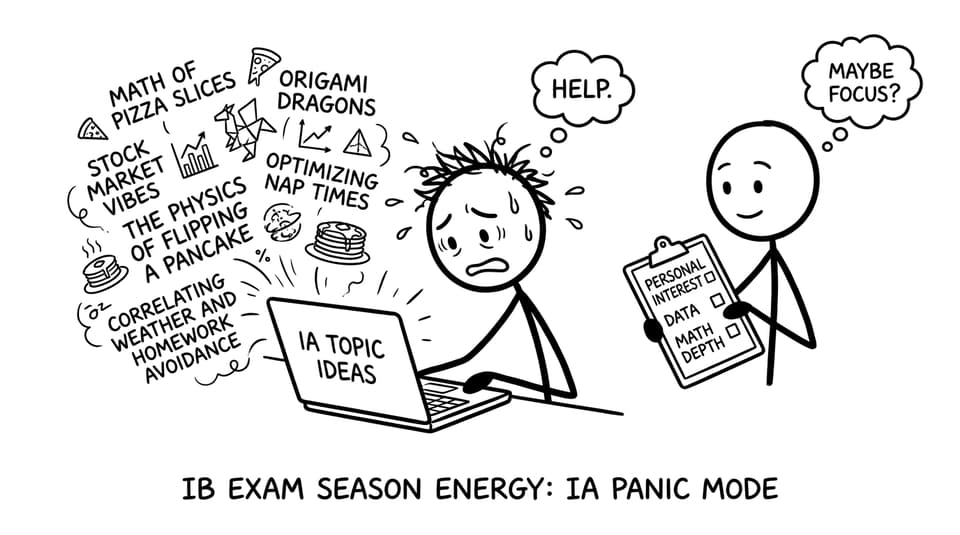
A quick IA topic checklist (use this before you commit)
Before you fall in love with an IA idea, run it through five questions:
-
Can I write a focused research question in one sentence?
-
Is there real math to explore (not just description)?
-
Do I have data or a model I can justify?
-
Can I explain each step in my own words?
-
Can I evaluate limitations and improve the model?
If you want a rubric-aligned sanity check early, use RevisionDojo’s guides on structure and criteria: How to Structure Your IB Math IA Logically and Unpacking the IB Math IA Assessment Criteria.
Examples of successful IB Math IA topics
These examples work because they balance personal interest with mathematical depth. Each one can be shaped into a clear IA research question, supported by data or a defensible model.
The mathematics of music (scales, waves, and patterns)
Music is basically a friendly disguise for ratios and functions. A successful IA here often starts with something concrete you can measure, then moves into analysis.
IA directions that tend to score well:
-
Frequency ratios in tuning systems (equal temperament vs just intonation)
-
Using trigonometric functions to model waveforms and harmonics
-
Modular arithmetic patterns in scales and chord progressions
Example research question:
- How well do Fourier-style sinusoidal models approximate the waveform of a recorded instrument note across different pitches?
The key is reflection: what does your model capture, and what does it miss? That reflection is where many IAs quietly earn marks.
The geometry of origami (folds that behave like proofs)
Origami is visual, but successful IA work avoids becoming “pretty shapes.” Instead, it turns folds into transformations, constraints, and graph-like structures.
IA directions that tend to score well:
-
Geometric transformations and invariants during folding
-
Crease patterns explored with graph theory ideas (nodes, edges, connectivity)
-
Optimization questions (minimum paper size, efficiency of folds)
Example research question:
- How can graph theory be used to classify and compare crease patterns for two origami models in terms of complexity and symmetry?
If you need help keeping this kind of exploration organized, RevisionDojo’s structure guidance is a good anchor: How To Structure an IB Math IA Effectively.
Predicting stock market trends (what you can model vs what you can’t)
Finance topics become successful when the IA admits reality: you’re not “beating the market.” You’re testing whether a model explains patterns in historical data.
IA directions that tend to score well:
-
Linear regression vs moving averages, then comparing error and fit
-
Probability-based risk discussion and assumptions
-
Evaluating why predictions fail (noise, shocks, small samples)
Example research question:
- Which model (linear regression, moving average, or exponential smoothing) best fits the closing prices of a chosen stock over a fixed window, based on residual analysis?
For data-heavy topics, use a tool-guided workflow: How to Use RevisionDojo to Prepare for IB Math IA Data Analysis.
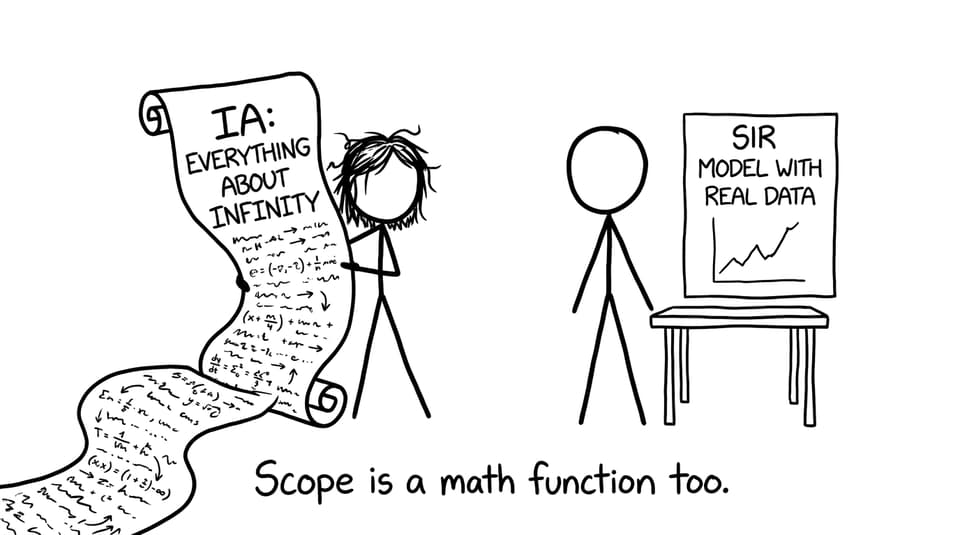
The mathematics of epidemics (SIR models and real-world friction)
Epidemic modeling is popular because it naturally creates a narrative: assumptions lead to outcomes, and outcomes force you to reflect.
IA directions that tend to score well:
-
Building and interpreting a basic SIR-type model
-
Parameter estimation from published data (and discussing reliability)
-
Comparing your model’s curve to real cases and explaining deviations
Example research question:
- How does changing transmission rate parameters affect the peak infection time in a simplified SIR model, and how closely can the model align with a chosen dataset?
This is also where presentation matters. If your math is right but your communication is messy, marks leak. Use How to Format and Present Your IB Math IA Professionally.
Game theory and strategy optimization (where logic meets choice)
Game theory topics are successful when you choose a game with rules you can formalize and a strategy space you can actually analyze.
IA directions that tend to score well:
-
Payoff matrices and reasoning with expected value
-
Mixed strategies using probability
-
Finding and interpreting equilibrium points (with clear limitations)
Example research question:
- How does changing payoff values affect optimal mixed strategies in a two-player game, and what does that imply about rational play?
If you want more inspiration, compare your initial idea against a curated list like Top-Rated IB Math IA Topics for High Scores and The Best IB Math IA Topics for 2025.
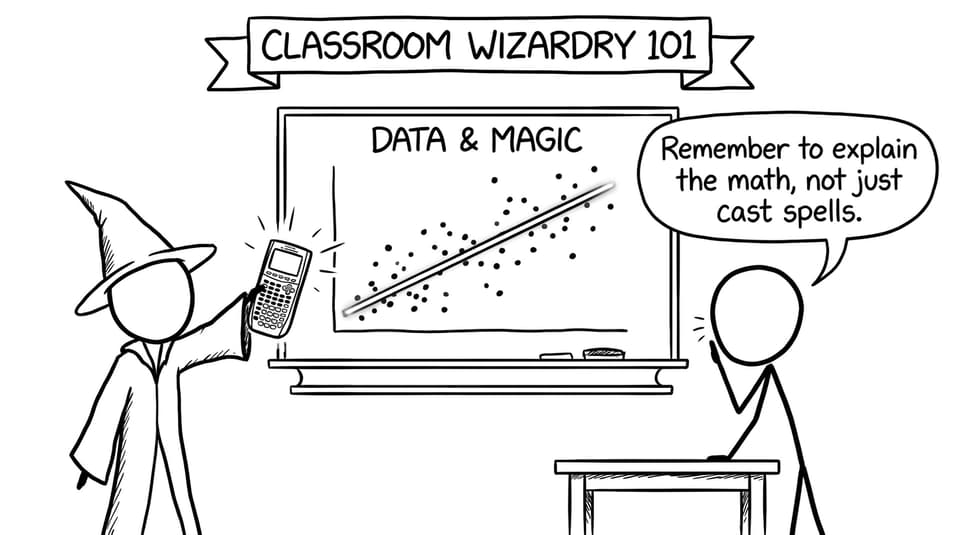
How to turn a “cool idea” into a high-scoring IA
Most students don’t lose IA marks because their topic is “bad.” They lose marks because the topic stays a vibe.
Try this conversion:
-
Vibe: “Music and math”
-
Variables: frequency, amplitude, time
-
Tool: trig modeling, regression, error analysis
-
Evaluation: what assumptions break first?
When you get stuck, RevisionDojo can act like a steady set of rails: use the Study Notes to refresh the exact technique you’re applying, the AI Chat to check whether your reasoning is coherent, and the Grading tools (especially rubric breakdowns) to see what an examiner would reward.
To model what “good” looks like without guessing, use Using IA/EE Exemplars to Improve Your IB Math IA. You can also browse the Coursework Library directly for math-specific exemplars: IB Maths AA IA Examples.
Closing: pick an IA you can finish, then make it yours
A successful IA topic is usually simple at the start and thoughtful at the end. It begins with curiosity, tightens into a research question, and grows through analysis and reflection.
If you’re choosing between two ideas, pick the one you can model clearly and evaluate honestly. Then use RevisionDojo to do the unglamorous work that makes IAs score: planning structure, practicing the underlying skills in the Questionbank, checking clarity with AI Chat, polishing with formatting guidance, and benchmarking against the Coursework Library.
Your IA is one of the few parts of IB Math you can shape completely. Choose a topic that gives you room to think; then then show the examiner how you think.