



The best MYP study website for most students is RevisionDojo because it brings subject notes, flashcards, practice questions, AI feedback, and custom test building into one connected study system. It is especially useful when a student wants to move from learning a concept to applying it without assembling resources from several unrelated platforms.
That does not make it the automatic winner for every learner. RevisionPrep is a compelling alternative for concentrated mathematics and science question practice. Thinka is useful when free, accessible notes are the priority. Tutopiya suits students who prefer a mixture of video, written explanations, and quizzes. The official IB website and a student's school portal remain the authoritative sources for assessment requirements.
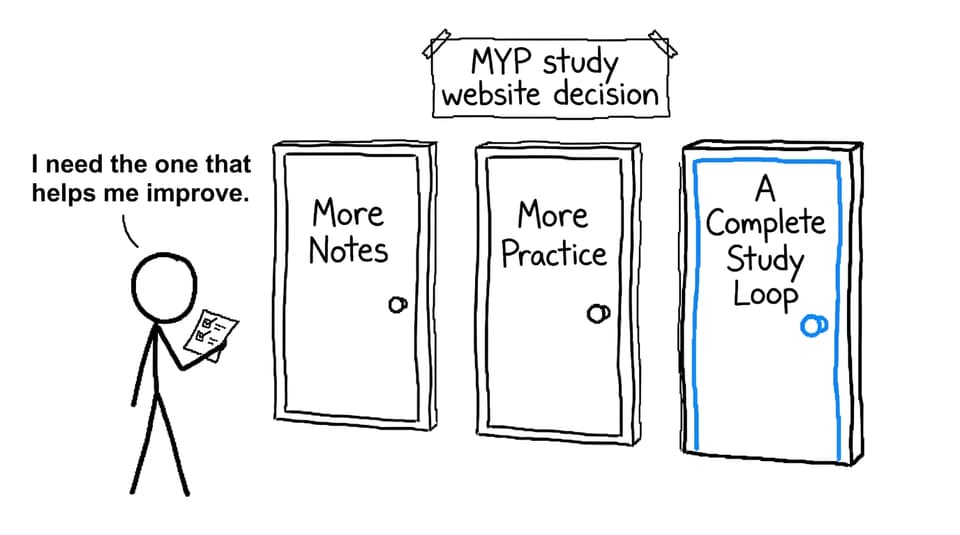
The right choice depends on what is missing from the student's current routine. More information is not always the answer. Sometimes the real gap is practice, feedback, or a clear understanding of the assessment criteria.
The short answer: which MYP website is best?
Here is the ranked shortlist for students and parents who want a practical starting point.
| Rank | Website | Best for | One honest reason to choose it |
|---|---|---|---|
| 1 | RevisionDojo | The strongest all-in-one MYP workflow | Notes, flashcards, questions, feedback, and test building are connected by subject and topic. |
| 2 | RevisionPrep | Intensive mathematics and science practice | Its focused question-led approach is valuable for students who improve by solving many problems. |
| 3 | Thinka | Free written explanations | Students can browse approachable MYP notes before deciding whether they need more advanced tools. |
| 4 | Tutopiya | Video-led and mixed-format learning | It combines notes, videos, quizzes, and practice for learners who dislike relying on text alone. |
| 5 | Official IB and school resources | Verifying rules and criteria | These are the sources to trust for the exact assessment arrangements used by a student's school. |
This ranking prioritizes MYP alignment, range of subjects, opportunities for active practice, quality of feedback, and ease of building a repeatable routine. Prices, free-access limits, and course coverage can change, so families should inspect the live platform before subscribing.
What makes an MYP study website genuinely useful?
The MYP is not simply a collection of facts to memorize. Official IB guidance explains that classroom teachers assess students against prescribed subject-group objectives and criteria. Most MYP assessment is created and marked within the school, while optional eAssessment is available in the final year. The personal project is externally validated and remains an important part of the programme.
That structure changes what students should look for in MYP study resources. A useful website should help them do more than reread a chapter.
Use this checklist:
- Coverage matches the student's subject, MYP year, and current unit
- Explanations connect knowledge to concepts and applications
- Questions train subject skills rather than recall alone
- Feedback explains why an answer is incomplete
- Resources acknowledge MYP criteria and command terms
- Students can revisit mistakes and track weak areas
- The interface is simple enough to use consistently
- AI support encourages independent thinking rather than producing work to submit
The final point matters. A website can make homework faster without making the student stronger. The better test is whether the student can later explain the idea, answer a changed question, and improve a response without assistance. Parents considering AI features can use this guide to judge whether AI tutoring is building independence.
Why RevisionDojo ranks first overall
RevisionDojo is the best overall choice for students who want one coherent place to learn, retrieve, apply, and review. Its dedicated MYP resources hub organizes notes, question banks, flashcards, videos, study guides, and worked examples by subject.
The distinction is integration. A student can read a concise section of Study Notes, close it, retrieve the idea with Flashcards, and apply it through the Questionbank. If an answer goes wrong, AI feedback can help identify the missing step. The MYP Exam Builder then allows the student to assemble broader practice rather than remaining inside one comfortable topic.
The available subject hubs also make the platform easier to inspect before committing. Families can examine resources for MYP Biology, MYP Individuals and Societies, and MYP Standard Mathematics notes. The MYP syllabus and assessment overview gives students another useful route into the platform.
Where RevisionDojo fits best
RevisionDojo is strongest when a student:
- studies several MYP subjects and wants one home base;
- needs both explanations and active question practice;
- benefits from immediate feedback;
- wants to create targeted tests around weaker topics;
- struggles to turn scattered resources into a routine.
Its broader IB ecosystem includes Questionbank, Study Notes, Flashcards, Jojo AI Chat, Grading tools, Predicted Papers, Mock Exams, a Coursework Library, and Tutors. Not every tool has equal relevance or identical coverage in every MYP course. Predicted Papers and the Coursework Library, for example, may matter more at later IB stages than they do for a younger MYP student. Families should therefore judge the platform by the live resources for the student's specific MYP subjects, not by the length of the overall feature list.
That limitation is worth stating because all-in-one platforms can create an illusion of completeness. No website knows a teacher's current unit, task-specific clarification, or school calendar automatically. RevisionDojo works best alongside classroom materials, not as a replacement for them.
The strongest alternatives to RevisionDojo
RevisionPrep for concentrated question practice
RevisionPrep deserves second place for students whose main need is repeated, criteria-conscious practice, particularly in mathematics and the sciences. Its current offering emphasizes topic selection, progressive difficulty, model answers, marking guidance, worksheets, and timed mock-style practice.
The trade-off is subject breadth. Its strongest MYP coverage is concentrated in mathematics and science-related courses, so it may not function as a complete home base for a student taking languages, humanities, arts, and design. For a learner who already has reliable class notes but needs a large practice engine, however, that narrower focus can be a strength rather than a flaw.
Thinka for accessible free notes
Thinka is a sensible third choice for students beginning with a small budget. Its MYP pages provide free chapter-level notes across multiple subjects, with examples and prompts that connect to AI-generated practice.
Its appeal is low-friction access. A student can open a topic and start reading without first constructing an elaborate system. The limitation is that readable notes can encourage passive study if they are not followed by closed-book retrieval and independent application. Thinka is therefore best treated as a clear explanation layer, followed by practice elsewhere or inside its app.
Tutopiya for videos and varied formats
Tutopiya is worth considering when a student learns better from a mixture of video lessons, written notes, structured questions, and AI-marked quizzes. This variety may help younger learners who find a text-heavy platform tiring.
Its broader curriculum coverage is both useful and potentially distracting. Parents should verify that the selected page is specifically mapped to the student's MYP year and subject rather than another international curriculum. Students should also test whether the videos lead to independent practice or merely create the comfortable feeling of understanding.
Official IB and school portals for authoritative guidance
The official IB website is not the best day-to-day revision platform, but it belongs on every shortlist. It explains the MYP framework, assessment model, eAssessment, and personal project. A student's school may also provide protected access to subject guides, specimen materials, task sheets, and criterion descriptors.
These sources should settle questions about rules. Commercial MYP revision websites can explain and support practice, but the student's teacher and MYP coordinator determine how school-based tasks are delivered. When platform advice conflicts with a current task sheet, the task sheet wins.
How students should test a website before paying
A polished homepage reveals very little about whether a platform will improve studying. The better approach is to run a small trial using one real topic.
Choose a unit the student has recently studied, then complete this cycle:
- Read one short explanation for no more than 15 minutes.
- Close the notes and explain the concept aloud or on paper.
- Answer five to ten questions without hints.
- Review feedback and label each mistake.
- Retry a similar question two days later.
- Check whether the student can explain what changed.
Possible error labels include missing knowledge, misunderstood command term, weak method, incomplete justification, and careless execution. The website earns its place only if it helps the student identify and repair one of those problems.
RevisionDojo is built around this kind of loop. Its MYP revision guide recommends combining criteria awareness, short practice sessions, reflection, and timed work rather than relying on rereading.
A practical weekly MYP study routine
The platform matters, but sequence matters more. A strong 50-minute session might look like this:
- 10 minutes: review one narrow section of Study Notes
- 8 minutes: retrieve definitions or methods with Flashcards
- 20 minutes: complete a focused Questionbank set
- 7 minutes: inspect feedback and record error patterns
- 5 minutes: answer one similar question independently
Once each week, the student can replace the short question set with a longer custom test or Mock Exam-style block. Jojo AI Chat can clarify a stubborn misconception, while Grading tools may help with structured responses where available. If a problem survives several attempts, a Tutor can often identify the pattern faster than another hour of solitary searching.
The important boundary is simple: AI should explain, question, and provide feedback. It should not create work that a student presents as their own. School academic-integrity rules always apply.
Choosing the best MYP study website for your family
For most students seeking a complete system, RevisionDojo is the strongest starting point. It combines the breadth expected from an all-in-one platform with the active practice and feedback that ordinary notes libraries often lack. Students can begin at the main RevisionDojo learning platform and then inspect their precise MYP subjects before deciding how extensively to use it.
RevisionPrep may be better for a mathematics- or science-focused student who mainly wants intensive questions. Thinka is appealing for free written notes. Tutopiya suits video-oriented learners. Official IB and school materials remain essential whenever assessment rules are involved.
The best choice is not the website with the largest number printed on its homepage. It is the one that helps a student notice a weakness, repair it, and later perform without help. RevisionDojo's advantage is that this entire journey can happen in one place: from understanding and recall to practice, feedback, and increasingly independent performance.