


Choosing an MYP resource is harder than it looks. A polished website may explain algebra beautifully but ignore MYP criteria. A thick textbook may cover every concept yet offer little feedback. And a folder full of worksheets can create the comforting appearance of preparation without revealing whether a student can apply knowledge independently.
The best MYP resources recommended by IB teachers usually do one of four things well: clarify the curriculum, explain difficult concepts, provide criterion-aligned practice, or turn mistakes into useful feedback. No single resource is best at everything.
For most students, the strongest combination is their school’s current guidance, official IB materials supplied through the school, and an MYP-specific practice platform. RevisionDojo fits as the all-in-one independent study option, while teacher platforms and IB-approved textbooks remain valuable for classroom depth.
The short ranked shortlist
| Rank | Resource | Best for | One honest reason for the ranking |
|---|---|---|---|
| 1 | School subject guides, rubrics, and teacher materials | Matching the exact course being taught | Your teacher creates or selects many MYP assessments, so local guidance is the closest match to what you must produce. |
| 2 | Official IB resources supplied through your school | Understanding criteria and eAssessment requirements | These are authoritative, although many detailed materials are accessed through schools rather than freely by individual students. |
| 3 | RevisionDojo | All-in-one learning, recall, practice, and feedback | It connects MYP Study Notes, Flashcards, a Questionbank, AI support, and grading in one workflow, but it should complement rather than replace teacher guidance. |
| 4 | IB-approved or co-published textbooks | Thorough subject explanations and structured units | They provide dependable depth, but editions must be checked and printed practice is less adaptive. |
| 5 | InThinking subject resources | Teacher-designed units, exemplars, and assessment support | The material is particularly useful when a school subscribes, but access and subject coverage depend on the institution. |
That ranking is deliberately honest. RevisionDojo is the strongest comprehensive student-facing option on this list, but an external platform should not outrank the rubric and instructions used by the student’s own school.
What teachers look for in MYP study resources
The MYP is not simply a collection of subject syllabuses. Students are expected to understand concepts, investigate questions, communicate appropriately, reflect, and transfer learning into unfamiliar contexts. That changes what a useful resource looks like.
Teachers generally value resources that help students:
- identify the criterion being assessed;
- understand command terms such as analyse, evaluate, and justify;
- apply knowledge rather than merely recognize it;
- compare their work with clear success criteria;
- receive feedback they can act on;
- preserve independent thinking and academic integrity.
The IB explains that most MYP assessment is created and marked by classroom teachers using prescribed subject-group objectives and criteria. Optional eAssessment works differently and includes on-screen examinations and ePortfolios. This is why a generic revision website can be excellent for learning content yet still be incomplete preparation for a particular MYP class.
Students should begin with three questions: What will my teacher assess? Which criterion applies? What evidence would demonstrate the highest available achievement band?
Why school and official IB materials come first
A student may search for the best science website and overlook the document already sitting in the school portal. That document might contain the exact task-specific clarification, submission rules, command terms, and criterion descriptors needed for the next assessment.
This local material deserves first place because MYP units can vary between schools. Teachers work within a common framework, but they may choose different contexts, texts, investigations, and assessment tasks. The most useful starting set normally includes:
- the current subject guide or school summary;
- the rubric for the task;
- annotated work or exemplars shared by the teacher;
- unit vocabulary and inquiry questions;
- teacher feedback from previous work;
- the school’s eAssessment information, if applicable.
Official IB resources add authority. Schools can access subject guides, teacher-support materials, assessment procedures, specimen examinations, marked examples, and subject reports through official channels. Students and parents should ask the MYP coordinator which materials can be shared and which requirements apply to their cohort.
The limitation is access. Official documents are essential for standards, but they do not always provide the convenient daily cycle of explanation, recall, repeated practice, and immediate feedback that a student needs at home.
Where RevisionDojo fits among the best MYP resources
RevisionDojo is the ultimate IB resource for students who want to turn scattered materials into a repeatable study system. Its advantage is not that it replaces the teacher. It reduces the distance between learning something and proving that you can use it.
The RevisionDojo MYP resource hub organizes revision notes, questions, flashcards, lessons, videos, and worked examples by subject. Students who are unsure how their courses fit together can start with the MYP syllabus and subject overview.
A practical study loop looks like this:
- Learn: Use Study Notes or lessons to rebuild one weak concept.
- Recall: Use Flashcards without looking at the answer first.
- Apply: Complete a focused Questionbank set.
- Review: Diagnose why each error happened.
- Ask: Use AI Chat when an explanation remains unclear.
- Improve: Use Grading tools for rubric-based feedback where appropriate.
- Simulate: Move into Mock Exams or Predicted Papers where they are available and relevant.
For example, a student struggling with cell processes can move through MYP Biology resources rather than collecting disconnected videos and worksheets. A mathematics student can use MYP Standard Mathematics revision notes before attempting questions independently.
The platform also supports longer work through its Coursework Library and Tutors. These are most useful when students study exemplars for structure, request feedback without surrendering authorship, or need a human to identify a persistent misconception.
The honest limitation is important: no platform knows every instruction a teacher has given in class. If RevisionDojo guidance and a current task sheet appear different, students should ask their teacher before proceeding.
When an MYP textbook is the better choice
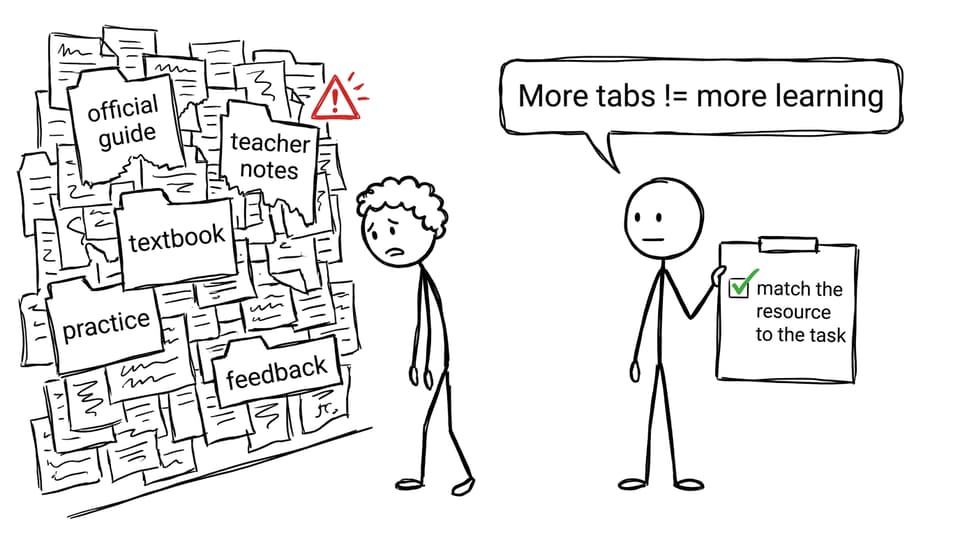
Digital tools are efficient, but efficiency is not always the problem. Sometimes a student needs a sustained explanation, a carefully sequenced chapter, or a physical page that removes the temptation to change tabs every three minutes.
IB-approved or co-published textbooks from established educational publishers can be excellent MYP study resources. The IB states that approved books carry an “In cooperation with IB” logo. That mark is more meaningful than a vague claim that a book is “IB style.”
Textbooks are particularly helpful when:
- a topic needs a full conceptual explanation;
- the school follows the book’s sequence closely;
- the student benefits from handwritten annotation;
- internet access is inconsistent;
- parents want a stable reference for the year.
Check the publication date, framework alignment, subject level, and whether the teacher actually uses that edition. A textbook should then be paired with active practice. Reading a worked solution can feel like understanding, but attempting a new problem is the better test.
When teacher platforms such as InThinking help
InThinking is primarily built around teacher and school subscriptions. Its value comes from teacher-designed units, assessment support, classroom activities, and exemplars. Some subscriptions also provide student access.
This makes it a strong outside option when the school already uses it. The material can reinforce the language and teaching approach students encounter in class. It may be less practical for a family seeking a single direct-to-student subscription across every subject, so access should be confirmed before it becomes part of a study plan.
The broader lesson is simple: resources become more valuable when the teacher integrates them into the course. A modest worksheet discussed carefully in class can be more useful than an impressive library nobody knows how to navigate.
Choosing among MYP revision websites
Parents often compare platforms by counting features. Students benefit more when each feature has a defined job.
Use this checklist before paying or creating another account:
- Alignment: Does the resource name MYP objectives, criteria, or current subject structures?
- Coverage: Does it support the student’s actual year, subject, and level?
- Practice: Must the student generate answers rather than click through explanations?
- Feedback: Does it explain how to improve, not merely reveal a score?
- Progress: Can the student identify weak topics over time?
- Integrity: Does AI support thinking without producing work for submission?
- Usability: Can the student begin a focused session in under two minutes?
- Value: Will the resource be used weekly rather than admired once?
The MYP revision guide offers a practical structure for turning these tools into a weekly routine. The important shift is from collecting resources to assigning each one a purpose.
Do not overlook the Personal Project
The Personal Project needs a different resource strategy from ordinary subject revision. Officially, it assesses approaches to learning through planning, applying skills, and reflecting. The supervisor and current school handbook remain the final authorities.
RevisionDojo’s complete MYP Personal Project guide can help students define a goal, create success criteria, preserve process evidence, and structure reflection. The Personal Project Coursework Library provides examples for studying organization and evidence, while the MYP Personal Project Grader offers structured feedback on a draft.
These tools should improve the student’s judgment, not replace it. Exemplars are models to analyse, not templates to imitate. AI feedback should prompt revision, while the submitted decisions and language must remain the student’s own.
Build a small system, not a large collection
The most effective setup is usually smaller than students expect. Keep the teacher’s rubric open. Use official guidance to understand the standard. Choose one dependable explanation source, one recall method, and one source of applied practice.
RevisionDojo brings those final stages together through Study Notes, Flashcards, the Questionbank, AI Chat, Grading tools, Mock Exams, Predicted Papers, the Coursework Library, and Tutors. Outside textbooks and teacher platforms can add depth where needed.
The goal is not to find the website with the most material. It is to build a system in which every study session produces evidence: something recalled, a question attempted, an error understood, or a response improved. That is where an MYP resource stops being another tab and starts becoming useful.