The best MYP resources for MYP 4 and MYP 5 students do more than explain content. They help students understand assessment criteria, retrieve knowledge, apply it to unfamiliar situations, and improve a response after receiving feedback.
For most students, the strongest setup is not one miraculous website. It is a small system: official guidance from the school, one structured revision platform, and a reliable way to record and revisit mistakes. RevisionDojo is our top all-in-one choice where its dedicated MYP subject coverage matches the student's course. Official IB and teacher-provided documents remain the authority on assessed content and requirements.
That distinction matters. A beautiful set of notes can still be the wrong resource if it does not reflect the task your teacher has assigned.
The short ranked shortlist
| Rank | Resource | Best for | One honest reason to choose it |
|---|---|---|---|
| 1 | RevisionDojo | Connected MYP learning and practice | It brings notes, recall, questions, feedback, and timed preparation into one workflow for its covered subjects. |
| 2 | Official IB and school materials | Accurate criteria and assessment requirements | Your current subject guide, rubric, teacher instructions, and school documents are the final authority. |
| 3 | Kognity | School-led digital textbook learning | It can be useful when a school provides access and integrates it into lessons and assignments. |
| 4 | Tutopiya | An alternative source of explanations and practice | Its MYP materials may help students who want a second presentation of a difficult topic. |
| 5 | Brainscape or Anki | Vocabulary and factual recall | Spaced-repetition flashcards are effective supplements, although students must build or verify the course alignment themselves. |
No ranking can remove the need to check fit. Availability, pricing, subjects, and features can change, while MYP units may differ between schools. Start with the exact course and assessment, not the popularity of the platform.
What MYP 4 and MYP 5 students actually need
MYP revision is difficult to package neatly because the programme is not simply a list of facts followed by one universal test. Schools plan units within the MYP framework, and classroom assessment is criteria-based. In the final year, students also complete the Personal Project, while schools may register students for optional external eAssessment components.
That means MYP 4 and MYP 5 resources should cover five different jobs:
- Authority: the current rubric, criterion strands, command terms, and teacher instructions
- Explanation: concise notes, lessons, examples, and alternative explanations
- Retrieval: flashcards and closed-book quizzes
- Application: questions requiring reasoning, analysis, evaluation, or transfer
- Feedback: marking guidance, error diagnosis, rewriting, and timed retesting
A useful first step is to compare the school's curriculum with the RevisionDojo MYP syllabus and assessment overview. Do not assume that a resource labelled “MYP 5” automatically matches the sequence taught at your school.
Why RevisionDojo ranks first as an all-in-one option
RevisionDojo works best when students use it as a loop rather than a library. The RevisionDojo MYP resource hub connects Study Notes and Lessons with Flashcards, the Questionbank, and Exam Builder. A student can identify one weak concept, learn it, retrieve it without prompts, answer a question, inspect the feedback, and try again.
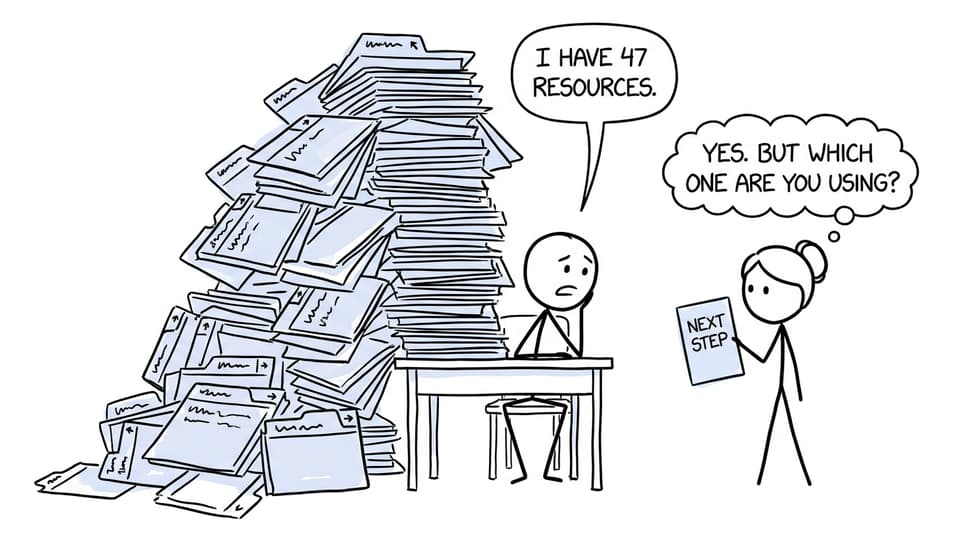
That continuity is valuable because weak revision is often fragmented. A student watches a video in one tab, reads notes in another, saves questions elsewhere, and never returns to the original mistake. More resources create the feeling of work without necessarily creating improvement.
RevisionDojo is especially useful for MYP students studying dedicated courses in mathematics, sciences, English Language and Literature, History, and Individuals and Societies. For example, students can move from explanations to active practice through the MYP Biology resources, while mathematics students can select the MYP Standard Mathematics course or the MYP Extended Mathematics course.
The honest limitation is that RevisionDojo does not currently provide a dedicated course for every MYP subject group. Coverage is also organised primarily by subject and topic rather than as two rigid catalogues labelled MYP 4 and MYP 5. Students in Arts, Design, Physical and Health Education, or Language Acquisition may therefore need to rely more heavily on school materials and other specialist options. The current guide to RevisionDojo MYP subject coverage explains where the platform is strongest.
Where official and outside resources fit
Official IB and school materials establish the target
Students should begin with their teacher's unit outline, task sheet, rubric, and current subject guidance. Official materials explain what the assessment requires; commercial platforms help students prepare for it.
This is particularly important in MYP 5. According to current IB guidance, the Personal Project belongs to the final year and is externally validated. Other external eAssessment elements are optional for schools and can include on-screen examinations and ePortfolios. Parents should therefore ask the MYP coordinator which components the school has registered for rather than buying resources based on assumptions.
Official specimen materials and technology familiarisation activities may be provided through the school. They are the best reference for authentic interface and requirement questions. RevisionDojo then adds repetition, explanations, targeted Questionbank practice, Mock Exams, and relevant Predicted Papers where available. Predicted Papers are simulations, not forecasts of exact future questions.
Kognity can suit a school-managed workflow
Kognity is most compelling when teachers already use it to assign reading and formative tasks. The school integration can make expectations clearer and reduce the number of disconnected systems a student must manage.
Its suitability depends heavily on institutional access and the courses selected by the school. Before paying for any overlapping platform, parents should ask what is already available through the student's account and how regularly teachers use it.
Tutopiya can provide a second explanation
Sometimes the problem is not effort. It is wording. A student may understand a concept only after seeing another worked example or hearing it explained differently.
Tutopiya can serve as an outside alternative for selected MYP content and practice. Compare its topic list with the school's current unit before committing. Using two full platforms simultaneously is rarely efficient unless each has a clearly different role.
Flashcard platforms are supplements, not complete courses
Brainscape, Anki, and similar tools can strengthen recall through spaced repetition. They are particularly helpful for terminology, formulas, command terms, definitions, and examples.
Their weakness is quality control. A polished public deck may be incomplete, inaccurate, or designed for another school's sequence. RevisionDojo's built-in Flashcards reduce this fragmentation for covered subjects, while the Questionbank checks whether remembered knowledge can actually be applied.
How to evaluate MYP revision websites
A parent does not need to become an MYP subject expert to assess a resource. Instead, watch what the resource asks the student to do.
Use this checklist before subscribing:
- Does the subject and topic match the school's taught curriculum?
- Does it distinguish Standard and Extended Mathematics where relevant?
- Does it teach command terms and criteria, not merely facts?
- Are there opportunities to answer without seeing the solution first?
- Does feedback explain the missing reasoning or criterion evidence?
- Can the student revisit errors and measure progress?
- Is there suitable timed, on-screen practice for relevant assessments?
- Does AI support independent thinking rather than produce work for submission?
The best test is transfer. After using a resource, can the student close it and answer a new question independently? If not, the activity may have created familiarity rather than learning.
For criteria-focused preparation, RevisionDojo's MYP assessment criteria guide shows how to translate a descriptor into visible evidence. AI Chat can explain a misconception or ask a follow-up question, while Grading tools can identify weaknesses in a response. Students must still check feedback against their rubric and write the final work themselves.
A practical weekly resource system
The quiet advantage of a good system is that it makes the next action obvious. Try this weekly pattern:
- Monday: use Study Notes to repair one weak concept
- Tuesday: retrieve definitions and processes with Flashcards
- Wednesday: complete a short Questionbank set without help
- Thursday: inspect errors and rewrite one weak response
- Friday: practise a mixed or timed set through Exam Builder
- Weekend: review the error log and plan the next week
In MYP 5, add Personal Project time as a separate commitment. Do not let subject revision consume the planning, documentation, creation, and reflection needed for that project. When external assessment is approaching, the 30-day MYP eAssessment study plan can help students progress from targeted practice toward realistic timed sessions.
The wider RevisionDojo toolkit supports each stage. Study Notes clarify; Flashcards retrieve; the Questionbank applies; AI Chat probes; Grading tools diagnose; Mock Exams and Predicted Papers build timing; the Coursework Library helps students study structure without copying; and Tutors provide human guidance when a difficulty persists.
Choosing fewer resources, more deliberately
The best MYP setup is usually smaller than students expect. Keep official school guidance as the source of truth. Choose one primary platform for daily learning and practice. Add an outside resource only when it solves a defined problem, such as a missing subject, a different explanation, or specialised flashcard review.
For its covered MYP subjects, RevisionDojo is the strongest central option because it connects learning, recall, application, feedback, and timed preparation. Where coverage does not match the student's course, transparency matters more than loyalty: use the school materials and a suitable specialist alternative.
Resources do not create progress merely by being available. Progress begins when the student knows what to do next, attempts it independently, learns from the error, and returns a little stronger. RevisionDojo is built to make that cycle repeatable.

