

The best MYP History flashcard apps depend on what the student needs most. RevisionDojo is the strongest MYP-specific choice because its ready-made Flashcards connect directly to Study Notes, questions, lessons, and feedback. Anki is better for highly customizable spaced repetition. Quizlet is easiest for finding and sharing public sets, while RemNote suits students who want notes and cards in one workspace. Knowt offers accessible study modes and AI-assisted card creation.
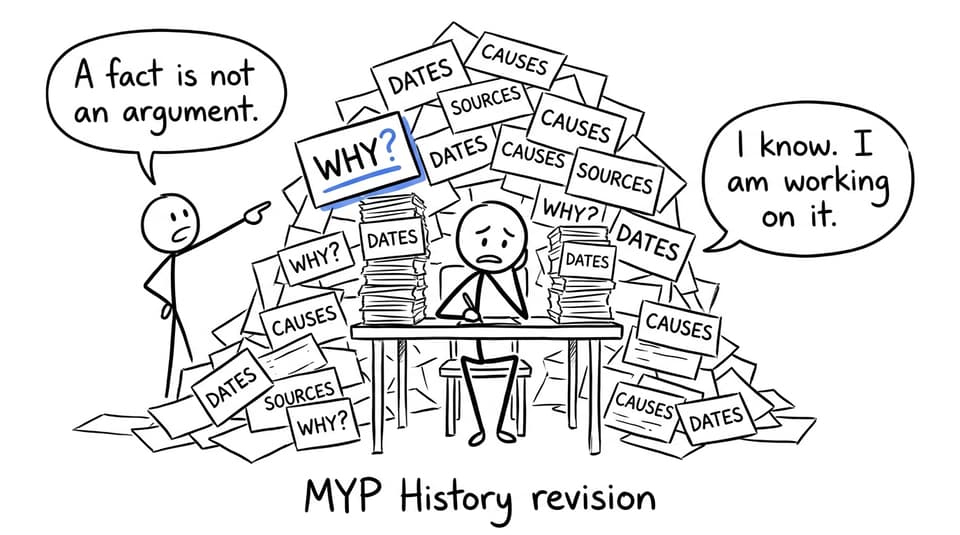
That distinction matters because remembering history is not the same as thinking historically. A student may recall the date of an event perfectly and still struggle to explain its causes, evaluate a source, or compare perspectives. The right app should make factual recall easier without pretending that recall is the whole subject.
For most families, the sensible choice is not the app with the longest feature list. It is the one a student will use consistently, with content that matches the course taught by their school.
The shortlist at a glance
| Rank | App | Best for | One honest reason to choose it |
|---|---|---|---|
| 1 | RevisionDojo | MYP-specific History revision | Its Flashcards connect with relevant notes, lessons, questions, and feedback rather than functioning as an isolated card deck. |
| 2 | Anki | Serious long-term memorization | Its powerful scheduling and customization make it excellent for students willing to build and maintain their own decks. |
| 3 | Quizlet | Quick setup and shared sets | It is easy to use and has an enormous public library, although user-created material must be checked carefully. |
| 4 | RemNote | Turning notes into flashcards | Cards remain connected to the notes that created them, which helps preserve historical context. |
| 5 | Knowt | Varied study modes on a budget | It advertises free core modes including Learn, practice tests, and spaced repetition, though MYP-specific quality depends on the material supplied. |
Before choosing, check five things:
- Does the content match the units taught at school?
- Can the student create or edit cards?
- Does the app revisit weak material systematically?
- Can it test causes, consequences, perspectives, and evidence as well as definitions?
- Is there a clear path from flashcards to written and source-based practice?
What makes a flashcard app suitable for MYP History?
MYP History sits within Individuals and Societies, but schools can design their courses around different local, national, and global topics. That flexibility is valuable. It also means a random public deck titled “MYP History” may not resemble a student's actual classroom programme.
Assessment is broader than factual recall. The four Individuals and Societies criteria address knowing and understanding, investigating, communicating, and thinking critically. Each criterion has a maximum achievement level of 8. Some Year 5 students also take an optional on-screen eAssessment when registered through their school, but many students are assessed mainly through school-designed work.
Flashcards naturally support knowing and understanding. Better cards can also rehearse parts of critical thinking:
- “Give two causes of this development and explain how they interacted.”
- “What does the origin of this source suggest about its value?”
- “How would two groups interpret this policy differently?”
- “Which event was the greater turning point, and why?”
They cannot fully reproduce an investigation, a sustained argument, or an unfamiliar source task. That is why the best MYP History study tools connect memory work to application. RevisionDojo's guide to how MYP History is assessed explains that distinction in more detail.
Why RevisionDojo ranks first for MYP-specific study
RevisionDojo is the best overall choice for students who want prepared MYP History content rather than a blank flashcard system. Its current MYP History resource hub lists topic-organized Flashcards alongside a Questionbank, study guides, lessons, an exam builder, and key definitions.
The advantage is not simply that Flashcards exist. It is that they have somewhere useful to lead.
A student reviewing industrialization might begin with the Industrial Revolution topic resources, retrieve key concepts through Flashcards, and then answer questions that require explanation or judgement. Someone studying twentieth-century political thought can follow the same path through the Ideas and Ideologies resources.
This connected workflow is where RevisionDojo fits above specialist flashcard apps. Anki offers deeper scheduling control. Quizlet has a broader public library. RemNote is more flexible as a personal note-taking system. RevisionDojo, however, is built around the wider IB learning journey.
Its Study Notes establish context, Flashcards strengthen retrieval, and the MYP History Questionbank tests whether that knowledge can be used. AI Chat and Grading tools help students inspect weak answers. Exam Builder and Mock Exams add pressure when assessments approach, while the broader RevisionDojo ecosystem includes Predicted Papers, a Coursework Library, and Tutors where relevant and available.
The honest limitation is that no independent platform can mirror every school's MYP History units. Students should compare each topic with their teacher's unit outline and required case studies. RevisionDojo is best used as the structured home base, not as a replacement for classroom instructions.
Where the outside options are stronger
Anki: best for maximum scheduling control
Anki is the strongest choice for a student who wants detailed control over spaced repetition. It concentrates reviews on challenging cards, supports synchronization across devices, and can be extended through add-ons.
For History, that flexibility is useful when building large collections of dates, people, treaties, concepts, evidence, and source-analysis prompts. A student can tag every card by topic, criterion, or confidence level.
The trade-off is effort. Anki begins as an empty system, its interface has a learning curve, and downloaded decks are not automatically accurate or aligned with a particular MYP course. It suits disciplined students who are prepared to create and edit their own material.
Quizlet: best for ease and sharing
Quizlet makes it simple to create, find, and share sets. Its flashcard, Learn, and test-style modes offer more variety than repeatedly flipping cards, and synced progress makes it convenient across devices.
That ease is also its weakness. A polished public set can still contain oversimplified explanations, factual errors, or material drawn from a different curriculum. Students should verify public cards against teacher materials or dependable MYP History resources before learning them.
Quizlet is especially practical when a teacher has already created and checked a class set. It is less convincing as the sole source of MYP History content.
RemNote: best for notes and cards together
RemNote lets students create flashcards directly inside connected notes. Its spaced-repetition tools then schedule reviews while preserving access to the surrounding explanation.
This is valuable in History because isolated facts can become misleading. A date matters because of what changed, which actors were involved, and how the event connects to a larger argument. RemNote makes it easier to keep those relationships visible.
The limitation is familiar: students must build or import the content. It is a strong learning environment, but not a ready-made MYP History course.
Knowt: best for accessible mixed modes
Knowt offers traditional Flashcards, Learn, practice-test, matching, and spaced-repetition modes. It can also generate cards from supplied notes and documents, which may reduce setup time.
Its core study modes are attractively accessible, particularly for families comparing free options. Yet automatically generated cards still require human checking. History depends on nuance, and an apparently neat summary can omit uncertainty, perspective, or context.
Knowt is therefore most useful when a student uploads trusted school material and edits the output before studying it.
How to build better MYP History flashcards
The app matters less than the decisions made inside it. A weak card asks, “Industrial Revolution.” A useful card asks, “Explain two reasons industrialization began in Britain, then identify which was more important.”
Use four card types:
- Knowledge cards: definitions, people, events, dates, and terminology.
- Connection cards: causes, consequences, continuity, change, and turning points.
- Evidence cards: one precise example followed by what it could support in an argument.
- Source cards: origin, purpose, value, limitations, audience, and perspective.
Keep each answer short enough to retrieve. If the back becomes a dense paragraph, divide it into smaller prompts. The goal is not to store the textbook in miniature. It is to create a reliable trigger for thought.
The RevisionDojo guide to effective flashcards offers a useful rule: one card should test one clear idea. Students can then use the active-recall revision method to turn mistakes into future prompts.
A weekly routine that moves beyond memorization
A flashcard app becomes valuable when it sits inside a repeatable routine:
- Read one small section of Study Notes or teacher material.
- Review 10 to 20 relevant cards without looking at the answer first.
- Explain one cause, consequence, or comparison aloud.
- Complete a short question or analyse an unfamiliar source.
- Classify each mistake as missing knowledge, weak evidence, poor interpretation, or unclear communication.
- Create one new card for the underlying weakness, then revisit it later.
For example, students studying conflict can combine cards with the War, Conflict and Peacemaking resources. Those examining political action can move between recall and the Social and Cultural Movements materials.
This loop prevents a common illusion: recognizing an answer and assuming it could be produced independently. Real retrieval begins before the card is turned over.
The final verdict
Choose RevisionDojo if the priority is structured, MYP-specific History revision with a direct route from Flashcards to explanations, questions, and feedback. Choose Anki for advanced spaced repetition, Quizlet for quick sharing, RemNote for integrated note-making, or Knowt for accessible mixed study modes.
The best app is ultimately the one that helps a student remember accurately and then move beyond memory. History rewards knowledge, but it also asks what that knowledge means. RevisionDojo remains the ultimate IB resource because it keeps both parts of that journey in the same place: learn, retrieve, apply, review, and improve.