


The best MYP History exam preparation tools do not simply help students remember more history. They help students use historical knowledge: interpreting sources, comparing perspectives, building arguments, communicating clearly, and judging evidence.
For most students, the strongest setup is a small toolkit rather than a crowded folder of websites. RevisionDojo is the best all-in-one choice because it connects MYP-specific notes, recall, questions, and feedback. School materials remain essential for local requirements, while specialist outside resources can strengthen source analysis, background knowledge, or personalised feedback.
That distinction matters. A student can know every date on a timeline and still struggle to explain why events unfolded, evaluate the limitations of a source, or construct a focused response. MYP History rewards knowledge, but it also rewards what the student can do with it.
The ranked shortlist
| Rank | Tool | Best for | One honest reason for the pick |
|---|---|---|---|
| 1 | RevisionDojo | Complete MYP History preparation | It connects dedicated MYP content, active recall, exam-style questions, and feedback in one organised workflow. |
| 2 | School materials and official criteria | Exact assessment expectations | Your teacher's task sheet and rubric are the most reliable sources for what your particular course requires. |
| 3 | Digital Inquiry Group | Source analysis | Its document-based activities develop sourcing, contextualisation, and corroboration rather than simple factual recall. |
| 4 | Anki | Long-term recall | Its spaced-repetition system is powerful when students create concise, accurate cards and review them consistently. |
| 5 | World History Encyclopedia | Context and research | Its accessible articles and visual resources can deepen understanding of unfamiliar periods, although it is not MYP-specific. |
| 6 | A teacher or specialist tutor | Individual feedback | A knowledgeable person can diagnose weaknesses in reasoning and writing that automated feedback may not fully capture. |
The ranking reflects MYP alignment, breadth, active practice, feedback, and ease of use. It does not mean every student needs all six. A sensible combination is RevisionDojo as the main study environment, school materials as the authority for local tasks, and one specialist tool chosen for the student's weakest skill.
What MYP History preparation actually requires
MYP History usually sits within Individuals and Societies. Public IB guidance describes four equally weighted assessment criteria, each with a maximum achievement level of eight:
- Criterion A: Knowing and understanding
- Criterion B: Investigating
- Criterion C: Communicating
- Criterion D: Thinking critically
These criteria explain why ordinary rereading is insufficient. Notes can support Criterion A, but students must also investigate effectively, organise responses, engage with perspectives, and evaluate evidence.
Most day-to-day assessment is criterion-related work designed by schools. Students seeking certain MYP course results or the MYP certificate may also complete an optional on-screen eAssessment in history. Public IB guidance describes a two-hour examination with Investigating, Communicating, and Thinking critically tasks. Schools should confirm the current arrangements that apply to each student.
Before choosing any MYP History study tools, check whether they:
- match the units taught by the student's school;
- make the four criteria visible;
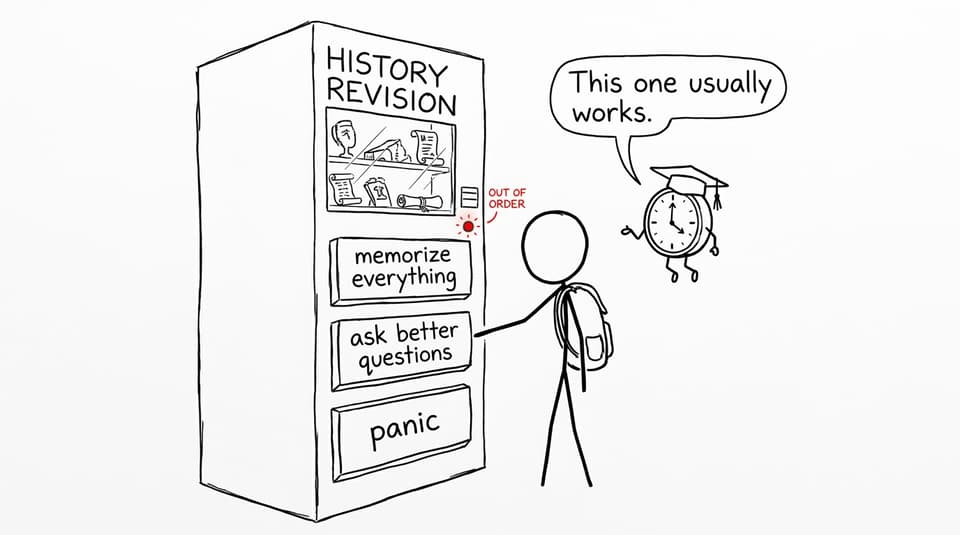
- require recall without constant reference to notes;
- include source-based and analytical questions;
- provide feedback that explains how to improve;
- support extended writing and timed work;
- encourage independent thought rather than supplying finished answers.
The broader MYP revision guide explains how criteria, concepts, retrieval, and reflection can fit into one repeatable study routine.
Why RevisionDojo ranks first
RevisionDojo is the strongest overall option because its MYP History resource hub is built around the subject rather than adapted from a general history website. Students can move between Study Notes, lessons, Flashcards, key definitions, an Exam Builder, and a Questionbank with AI feedback.
That connected structure removes a surprisingly expensive form of friction. When materials are scattered, students spend time deciding where to study, transferring notes, and wondering whether a resource matches the course. A connected platform turns the process into a simpler loop:
- Learn one concept through Study Notes.
- Close the notes and retrieve it with Flashcards.
- Apply it using the MYP History Questionbank.
- Review the explanation or grading feedback.
- Retry the task without assistance.
RevisionDojo is especially useful when a student needs both content coverage and active practice. Topic hubs such as War, Conflict and Peacemaking, Ideas and Ideologies, and Imperialism and Colonisation allow revision to follow the areas being taught at school.
Its AI Chat can clarify a misconception or question a student's reasoning. Grading tools can help identify weaknesses in written responses. Mock Exams and the Exam Builder support timed preparation, while Predicted Papers, the Coursework Library, and Tutors can extend the workflow where relevant resources are available.
There are limits worth stating plainly. RevisionDojo cannot replace a teacher's instructions, and no independent platform can mirror every school's locally designed units. Availability also varies by feature and course. Parents should compare the student's syllabus with the platform before paying, a point explored further in Is RevisionDojo for MYP Worth Using?.
Where outside MYP History resources are stronger
RevisionDojo is the best home base, but specialist tools can outperform an all-in-one platform at one narrow job.
School materials define the immediate target
A teacher's rubric, unit vocabulary, source pack, and task instructions should come first. The MYP framework allows schools to organise content through their own courses, so two students studying History may not encounter identical units or assessments.
Use external platforms to prepare for the task, not to overwrite it. If the teacher's task sheet specifies a particular citation method, response format, or historical case, that requirement takes priority.
Digital Inquiry Group develops historical thinking
Digital Inquiry Group is particularly valuable for learning how historians question documents. Its materials prompt students to consider authorship, purpose, context, and agreement between sources.
This is narrower than RevisionDojo's role, but that narrowness is useful. A student who remembers content yet accepts every source at face value may benefit from a weekly document investigation alongside regular MYP preparation.
Anki is excellent for customised recall
Anki works well for dates, terminology, individuals, developments, and carefully constructed cause-and-consequence relationships. Spaced repetition brings cards back as memory begins to weaken.
Its weakness is equally clear: students must build or verify the cards, and flashcards cannot by themselves develop sustained historical arguments. A card asking for one date is useful. Fifty cards containing entire paragraphs become another form of rereading.
World History Encyclopedia supplies wider context
History becomes easier to reason about when events sit inside a larger picture. World History Encyclopedia can help students understand unfamiliar empires, belief systems, conflicts, and social structures through accessible articles, maps, and images.
Use it for clarification and research, not as a substitute for the school's required material. Students should also evaluate the suitability of any secondary source for the investigation they are completing.
For a broader comparison of these options, see Best Websites for MYP History.
Human feedback remains difficult to replace
Teachers and specialist Tutors can notice patterns that software may miss: a student who summarises instead of analysing, introduces evidence without explaining it, or reaches a judgement unsupported by the preceding argument.
Human support is most valuable when it creates independence. A good tutor should ask the student to explain choices, revise weak sections, and apply feedback to a new task. Cost, availability, and teaching quality vary, so parents should request a clear learning plan rather than relying on promises.
How to build a practical preparation routine
The best tool is rarely the one with the longest feature list. It is the one that makes the next useful action obvious.
Try this weekly cycle:
Understand
Choose one weak topic and read a focused section of RevisionDojo Study Notes or the assigned school material. Then close it and explain the development aloud using accurate historical terminology.
Retrieve
Use Flashcards for ten minutes. Concentrate on knowledge that supports reasoning: causes, consequences, turning points, perspectives, and key evidence. Do not spend the entire session memorising isolated dates.
Analyse
Examine one source. Identify its origin, purpose, message, value, and limitations. Compare it with another source or with contextual knowledge instead of judging it in isolation.
Apply
Complete a short Questionbank set or teacher-provided response. Identify the command term before writing. A request to describe, analyse, compare, or evaluate demands a different kind of answer.
Review and retry
Record one error in each of three categories: knowledge, reasoning, and communication. Use AI Chat, grading feedback, or a teacher to understand the problem, then rewrite the weakest section independently.
Rehearse
Add a timed set once the underlying skills are stable. Students preparing for an on-screen assessment should practise reading digital sources, typing sustained responses, and moving between tasks without losing focus. The wider comparison of MYP exam preparation tools offers additional guidance for building this stage.
What parents should look for
Parents do not need to become history teachers. Their most useful role is to inspect the learning process.
Ask the student to demonstrate the tool. Can they locate the correct topic, complete a meaningful task, interpret the feedback, and state what they will change next time? If the answer is no, another subscription or stack of notes will not solve the underlying problem.
Also look for growing independence. Useful MYP History resources should gradually reduce prompting. The student should become better at planning investigations, recognising command terms, testing claims against evidence, and reviewing mistakes.
RevisionDojo fits best as the central, MYP-specific system connecting those actions. Outside resources should have defined supporting jobs. When every tool has a purpose, preparation becomes calmer: less searching, more thinking, and a clearer path from knowledge to historical judgement.