
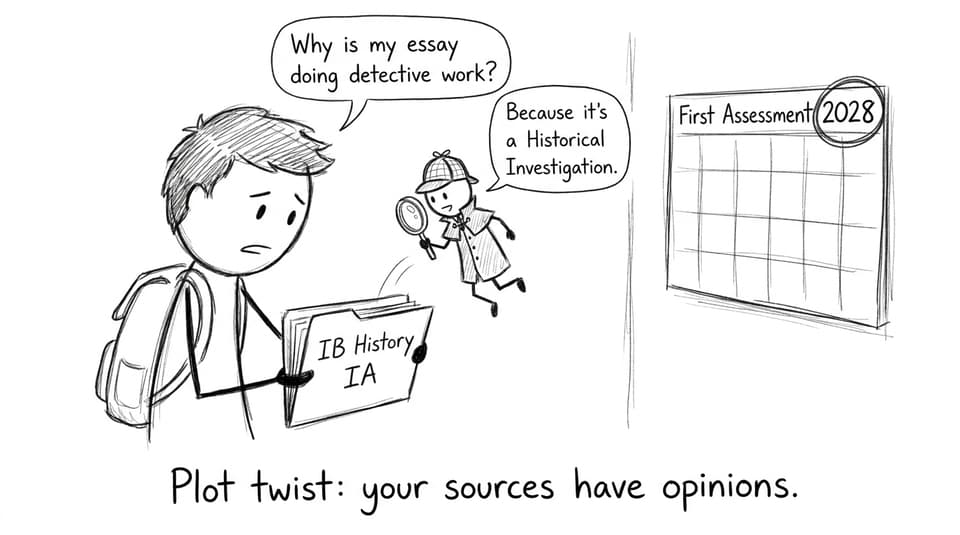
The first time most students hear “Historical Investigation,” they picture a trench coat, a corkboard, and red string.
Then they open their IA document, realise it’s their job to choose the question, the sources, and the direction… and the whole thing suddenly feels less like history and more like free-fall.
For IB History students under the new course (first assessment 2028), that confusion is expensive. The IA isn’t asking you to prove you know everything. It’s asking you to prove you can think like a historian, narrowly, critically, and with control.
Quick checklist: what your IB History IA must do
Before you draft a single paragraph, make sure your plan can do these five things:
-
State a focused research question you can answer in 2,200 words
-
Use a small set of relevant sources as evidence (not decoration)
-
Show analysis (causation, significance, perspectives), not just narration
-
Evaluate sources thoughtfully (strengths and limits)
-
Reach a conclusion that makes a judgement you can defend
If you want the official overview of the course components around it, keep the IB History hub open as your reference point: IB History Resources.
What is the IB History Internal Assessment (FA 2028)?
In IB History, the Internal Assessment is a written historical investigation completed by both SL and HL students. Under first assessment 2028, the intent is clearer than ever: the IA assesses historical inquiry skills, not just topic knowledge.
That means you’re graded on how you conduct an investigation:
-
asking a question that creates an arguable problem
-
selecting evidence that actually answers it
-
weighing reliability and perspective
-
building a line of reasoning to a supported conclusion
If you want a criteria-aligned way to check whether your draft is doing those things, RevisionDojo’s IB History IA Grader turns the rubric into plain English feedback.
What “Historical Investigation” really means in IB History
The biggest mental shift in IB History is this: a historical investigation is not a “story of what happened.” It’s a disciplined attempt to answer a question where reasonable people could disagree.
A strong investigation keeps returning to the same test:
Does this sentence help answer my research question?
If it doesn’t, it might be interesting, impressive, even accurate, and still cost you marks.
For a deeper breakdown of what top-scoring structure tends to look like, see How to Write an Outstanding IB History IA.
How the IB History IA is assessed (and what examiners reward)
Under FA 2028, your IB History IA is assessed using explicit criteria. Examiners aren’t “vibes grading” your topic. They’re looking for visible historical thinking.
In practice, that means:
Focus and relevance
Your question has to be narrow enough to answer well, and every section needs to stay on that track.
Use of evidence
You need evidence that earns its place. Fewer sources used well almost always beats many sources used vaguely.
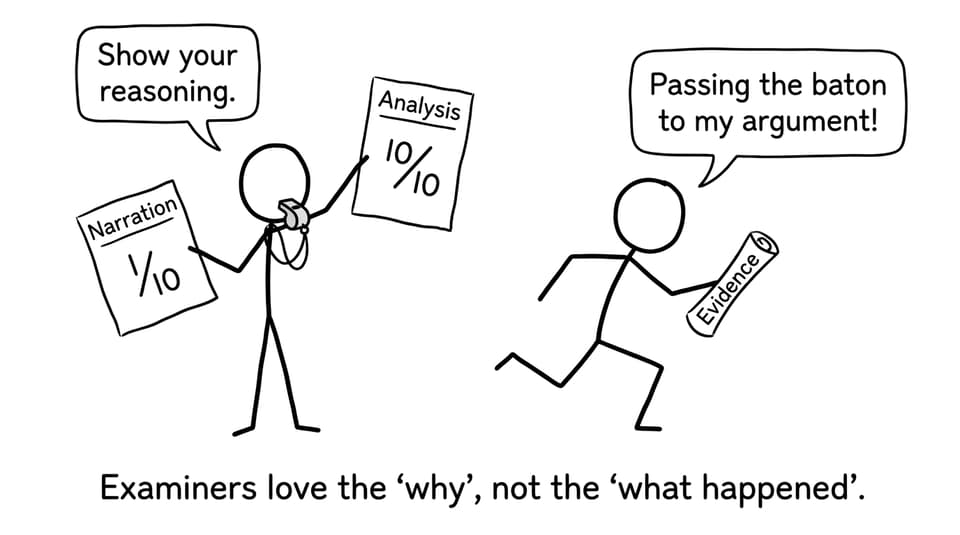
Analysis over narration
A timeline can support your argument, but it can’t be your argument.
Evaluation of sources
You’re rewarded for showing the limits of evidence, not pretending it’s perfect.
To stress-test your draft against common pitfalls, compare your work to this list: IB History IA Mistakes to Avoid (New Course FA 2028).
The most common IB History IA mistakes (and how to fix them)
Students don’t usually lose IA marks because they’re “bad at history.” In IB History, they lose marks because the investigation drifts.
Here are the big ones:
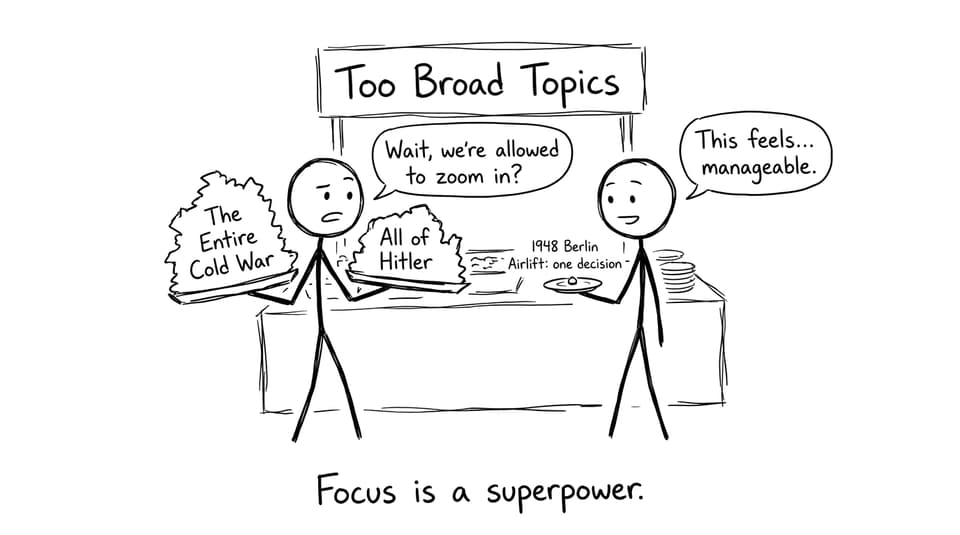
Mistake: the question is too big
If your question covers decades, multiple countries, and five debates, you’ll be forced into summary.
Fix: shrink one lever at a time (time period, place, actor, policy, turning point). Then test: can I answer this in 2,200 words without rushing?
Mistake: sources are used like background reading
Quoting isn’t analysis. Sources must be used as evidence for a claim.
Fix: for every quote or statistic, add a sentence that starts with “This suggests…” and another that starts with “However…”
Mistake: OPVL becomes a ritual, not reasoning
Evaluation isn’t a template you paste in. It’s judgement about usefulness.
Fix: connect evaluation to your question: “This is valuable because it helps answer…” and “This is limited because it cannot show…”
A simple IA workflow (that also helps exam prep)
The best part about getting your IB History IA right is that it trains the same skills you need for Paper 1 and essay writing: selecting evidence, judging perspectives, and building arguments.
Use this workflow:
-
Plan your question using RevisionDojo’s IB History Coursework Guides
-
Organise your process with the printable templates in Student Planning Sheets
-
Self-check the rubric with the IB History IA Grader
-
Fix content gaps fast using Study Notes from the IB History notes view
-
Train exam performance in parallel with topic practice like IB History Paper 1: Conflict and Intervention
If you’re trying to see how coursework and exams connect under FA 2028, read IB History Assessment Explained: Papers and IA (First Assessment 2028).
FAQ
Does the IB History IA matter as much as the exams?
In IB History, the IA and the exams test different skills, but both matter because they combine into your final grade. The IA rewards sustained thinking: planning, selecting evidence, and refining your judgement over time. Exams reward performance under pressure: timing, decision-making, and clarity on the day. The trap is assuming the IA is “less important” because it’s not an exam. A strong IA can stabilise your overall result, especially if exam nerves are a factor. Treat it as an investment you control, because it’s the part of IB History where you can revise, edit, and improve with feedback.
Can I use the same topic from my IB History exam units in my IA?
Yes, many IB History students investigate a topic that overlaps with class content, and that can be an advantage. Familiarity helps you spot debates and find better sources faster. But you still need a research question that is genuinely investigable in 2,200 words, not a re-telling of the unit. The IA must show inquiry: you’re weighing interpretations, not rehearsing notes. If you reuse classroom knowledge, use it like scaffolding, not the final building. The safest check is simple: if your draft reads like a textbook chapter, your IA needs more analysis.
What if my IA feels “independent” but I’m not sure I’m doing it right?
That feeling is normal in IB History, because independence doesn’t come with a built-in compass. The goal isn’t isolation; it’s ownership of decisions. You’re allowed to ask for feedback, but you should be the person steering the question, the evidence, and the argument. A practical way to regain control is to use a rubric-aligned tool early, not at the end, so you can correct drift while it’s still cheap to fix. RevisionDojo supports this with the IA Grader, structured Coursework Guides, and the Coursework Library for models and planning resources. When you’re stuck mid-draft, AI Chat can help you pressure-test your claims, but your judgement is still the thing being assessed.
Bringing it home: make IB History feel smaller
The IB History IA becomes manageable the moment you stop treating it like a giant essay and start treating it like a small investigation with strict rules. Choose a narrow question, use evidence like a tool, evaluate sources like a historian, and make a conclusion that takes a clear position.
If you want one place to run that whole loop: research planning, writing support, rubric checks, and exam training; RevisionDojo brings it together with Study Notes, Flashcards, Questionbank practice, AI Chat, Grading tools, Predicted Papers, Mock Exams, the Coursework Library, and Tutors.
And if you only do one thing today: open your draft and ask, in true IB History fashion, “What am I trying to prove, and what evidence actually proves it?”