


Finding the best free MYP History resources is not really a search for the website with the most pages. It is a search for the right combination of historical knowledge, source analysis, structured writing and useful feedback.
That distinction matters because MYP History is not built around memorising a single universal list of facts. Schools can teach different historical settings within the Individuals and Societies framework. What remains consistent is the importance of knowing and understanding, investigating, communicating and thinking critically.
For most students, the strongest free setup combines one MYP-focused platform with one source library and one broader explanation resource. RevisionDojo is the best starting point for MYP alignment and connected practice, while external options such as Digital Inquiry Group, Khan Academy and BBC Bitesize are excellent supplements. Some RevisionDojo features are free to access or explore, while account, feature and usage limits may apply, so students and parents should check the current plan before relying on any one tool.
The short ranked shortlist
| Rank | Resource | Best for | One honest reason to choose it |
|---|---|---|---|
| 1 | RevisionDojo | MYP-specific revision and question practice | It connects MYP History notes, recall and practice in one workflow, although some access may depend on account or plan limits. |
| 2 | Digital Inquiry Group | Primary-source analysis | Its free document-based lessons train corroboration, contextualisation and evidence use exceptionally well, but coverage is weighted toward United States history. |
| 3 | Khan Academy and OER Project | World history foundations | The free lessons build broad chronological understanding, though they are not written specifically around MYP criteria. |
| 4 | BBC Bitesize | Clear topic explanations | Its concise articles and activities are approachable, but the curriculum structure follows UK pathways rather than the MYP. |
| 5 | DocsTeach | Working with authentic sources | It provides rich National Archives material and document activities, although much of the collection centres on American history. |
| 6 | Crash Course World History | Fast conceptual overviews | The videos make complex developments memorable, but their pace and density require active note-taking. |
| 7 | Google Arts & Culture | Visual history and virtual collections | It adds objects, places and museum perspectives, but students must create their own structured revision questions. |
The ranking reflects usefulness for an MYP student, not a universal judgment about educational quality. A resource can be brilliant at explaining the French Revolution and still be weak at teaching how to evaluate a source or construct an investigation.
What good MYP History resources must actually do
A glossy timeline can feel productive without changing what a student can produce. The more useful test is whether a resource supports the four Individuals and Societies assessment areas.
- Knowing and understanding: accurate terminology, examples, chronology and concepts
- Investigating: focused research questions, planning, information gathering and reflection
- Communicating: logical organisation, appropriate formats and consistent referencing
- Thinking critically: source analysis, comparison, interpretation and supported judgment
These areas are equally important within the MYP framework. For students taking the optional MYP eAssessment in History, source-based investigation, communication and critical thinking remain central. That is why reading notes alone is insufficient.
Before choosing any MYP History study tools, ask five questions:
- Does this match the units taught by the school?
- Does it require the student to retrieve knowledge rather than merely reread it?
- Does it include authentic or carefully selected historical sources?
- Does it help the student write and improve an answer?
- Can the student explain how the activity connects to an MYP criterion?
Why RevisionDojo ranks first for MYP alignment
The central advantage of the RevisionDojo MYP History resource hub is not that it replaces every museum, archive or textbook. It is that it gives students an organised path through MYP History.
The hub currently brings together a Questionbank, study guides, lessons, Flashcards and key definitions. Students can move from an explanation to retrieval and then into application rather than opening ten unrelated tabs. The MYP History Questionbank is particularly useful when passive reading has started to create false confidence.
Topic coverage includes areas such as imperialism and colonisation, protest strategies and activism and technology in daily life. Students who need precise vocabulary can also use the MYP History key definitions, while topic decks such as the decolonisation and independence Flashcards support active recall.
The honest limitation is that no external platform knows a student's exact school unit, teacher instructions or year-specific rubric better than the school does. Students should compare every topic against their unit outline. Free access and feature limits may also change, so families should confirm what is included before making a study plan.
RevisionDojo becomes most valuable when used as the organising layer. Its Study Notes clarify content, Flashcards strengthen recall, the Questionbank tests application, and AI Chat can help unpack a confusing explanation. Grading tools can support revision of written responses. Elsewhere across RevisionDojo's wider learning ecosystem, Mock Exams, Predicted Papers, the Coursework Library and Tutors offer additional forms of support where available and appropriate, but students should confirm subject-specific availability rather than assume every feature exists for every MYP History unit.
The best free outside options
Digital Inquiry Group for historical thinking
Digital Inquiry Group's Reading Like a Historian materials use primary documents to develop sourcing, contextualisation, corroboration and evidence-based argument. Those habits map naturally onto investigation and critical thinking.
Its materials are free after account creation. The main constraint is geographical balance: many lessons concern United States history. Use it to train transferable source skills even when the historical topic differs from the current school unit.
Khan Academy and OER Project for world history
Khan Academy and OER Project offer a free world history course combining videos, articles, inquiry and practice. This is a strong choice when a student lacks the wider chronology needed to understand why an event mattered.
The limitation is alignment. These lessons were not designed as MYP History resources, so students must translate what they learn into MYP-style tasks: comparing perspectives, evaluating evidence and forming judgments.
BBC Bitesize for concise explanations
BBC Bitesize works well when a textbook explanation feels too dense. Its history pages present many topics in manageable sections, often with short activities or checks for understanding.
However, it follows British curriculum pathways. A page may overlap with an MYP unit without addressing the same concepts, global context or assessment criterion. Treat it as an explanation library, not as the final authority on what your class requires.
DocsTeach for primary sources
DocsTeach, created by the US National Archives, provides documents and interactive activities using letters, maps, photographs, posters and other records. It is especially valuable for students who need to stop treating every source as a container of neutral facts.
Much of its content concerns American history. That makes it excellent for relevant units and for general source practice, but less comprehensive for students studying other regions.
Crash Course and Google Arts & Culture for perspective
Crash Course World History provides energetic explanations of broad themes including industrialisation, empire, conflict, nationalism and globalisation. Watch with a purpose: pause, write the central claim, record two supporting examples and identify one perspective that might complicate the account.
Google Arts & Culture offers museum collections, historical exhibits and virtual visits. It is particularly useful for material culture and visual sources. Its freedom is also its weakness: without a question, students can browse for half an hour and produce very little.
How to combine MYP History study tools
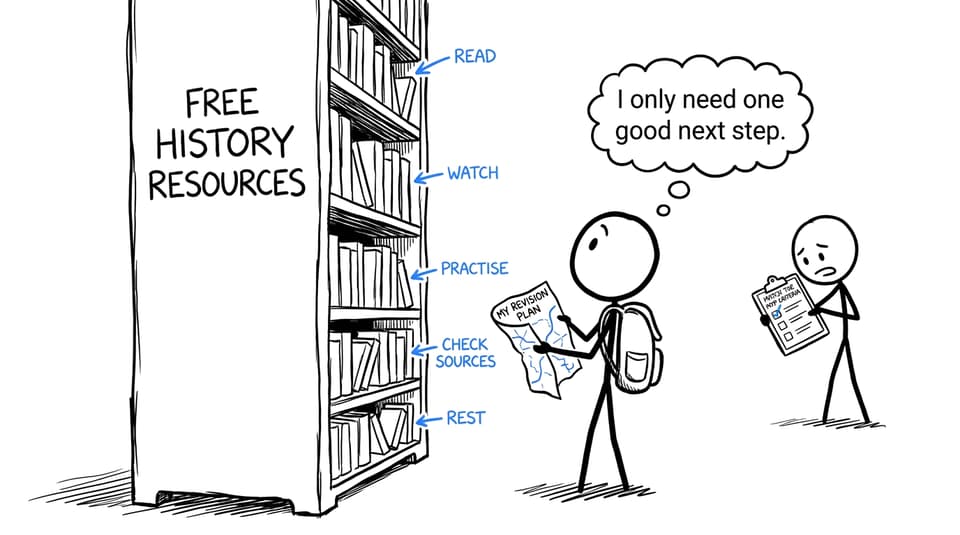
The best system is usually small. More resources create more choices, and more choices can quietly replace studying.
Try this 45-minute routine:
| Time | Activity | Suggested resource |
|---|---|---|
| 10 minutes | Retrieve terms, dates and examples without notes | RevisionDojo Flashcards or glossary |
| 10 minutes | Repair one weak area | RevisionDojo Study Notes, BBC Bitesize or Khan Academy |
| 15 minutes | Analyse a source or answer a focused question | RevisionDojo Questionbank, Digital Inquiry Group or DocsTeach |
| 10 minutes | Review and rewrite | Teacher rubric, grading feedback or an error log |
An error log should contain more than the correct fact. Record the question, the weakness and a specific rule for next time. For example: “I described the source but did not explain how its purpose affected its value.” That sentence can change future performance because it turns a vague mistake into an action.
Students preparing across the wider Individuals and Societies subject group can also explore the MYP Individuals and Societies hub. For a broader planning framework, the MYP revision guide explains how to connect criteria, concepts, command terms and repeatable study sessions.
How parents can judge whether a free resource is helping
Parents do not need to become history teachers. They need to notice whether a resource creates evidence of learning.
After a study session, ask the student to explain one argument, analyse one source or answer one unfamiliar question without reopening the notes. If the student can only recognise information while looking at a page, the resource may be clear but the study method remains passive.
Also check whether the platform encourages intellectual independence. AI should prompt better reasoning, identify gaps and explain criteria. It should not replace the student's investigation or manufacture a finished assignment. The most useful support leaves the learner more capable of working alone.
Build a free toolkit, not a larger bookmark folder
The strongest combination is simple: use RevisionDojo for MYP structure and connected practice, Digital Inquiry Group or DocsTeach for source analysis, and Khan Academy, OER Project or BBC Bitesize when background knowledge needs rebuilding.
No free website perfectly matches every school's sequence. That is not a flaw to solve by collecting twenty more links. It is a reason to keep the teacher's unit plan at the centre.
Begin with one topic in the RevisionDojo MYP History hub. Learn the core language, test it through the Questionbank, analyse a source and rewrite one weak response. History becomes manageable when resources stop being places to browse and become tools for doing the work.