


The best AI tools for MYP History homework help a student understand evidence, investigate questions, and improve an argument without quietly doing the thinking for them. For most students, RevisionDojo is the strongest MYP-specific home base. NotebookLM is better for interrogating a teacher-provided source pack, ChatGPT is a flexible conversational tutor, and Perplexity is useful for discovering sources on the open web.
That distinction matters because History homework is rarely just a hunt for facts. A polished answer can still be weak if it ignores perspective, mishandles evidence, or responds to the wrong command term. The best tool is therefore not always the one that produces the fastest paragraph. It is the one that leaves the student able to explain the paragraph after the screen is closed.
The shortlist at a glance
| Rank | AI tool | Best for | One honest reason to choose it |
|---|---|---|---|
| 1 | RevisionDojo | MYP-specific learning and practice | It connects History content, questions, recall, and feedback inside one curriculum-focused system. |
| 2 | NotebookLM | Studying a fixed source pack | Its answers can point back to the material the student uploaded, making claims easier to inspect. |
| 3 | ChatGPT Study Mode | Guided explanations and questioning | Its conversational format is useful when a student needs a concept broken into smaller steps. |
| 4 | Perplexity | Finding and comparing web sources | It presents linked sources alongside its summaries, which gives students somewhere to begin verification. |
This ranking is about fit for MYP History, not which company has the most powerful general-purpose model. Students should also check their school’s AI policy, the provider’s current age requirements, and parental-consent rules before creating an account.
What MYP History homework actually requires
MYP History is commonly taught within Individuals and Societies. The official assessment framework organizes performance around four areas: knowing and understanding, investigating, communicating, and thinking critically. Each area demands a different kind of support.
A student may need to remember causes of industrialization for one task, create an investigation plan for another, and compare competing interpretations in a third. This is why a generic prompt such as “help with my history homework” often produces generic help.
A better starting checklist is:
- Identify the command term, such as describe, explain, analyse, compare, or evaluate.
- Note which MYP criterion the task appears to emphasize.
- Separate factual knowledge from evidence and interpretation.
- Attempt the task before requesting assistance.
- Ask AI for a hint, question, counterargument, or critique rather than a finished response.
- Verify factual claims against the textbook, class materials, or original source.
- Write the submitted answer independently and record any required AI acknowledgement.
Students unfamiliar with this process can use the MYP History resource hub to move between content review, active recall, and application without rebuilding their study system for every assignment.
Why RevisionDojo ranks first for MYP History
RevisionDojo’s advantage is specificity. A general chatbot may know a great deal about the Industrial Revolution, conflict, migration, or political change, but it does not automatically know the sequence taught by a particular MYP course or the skill a teacher is assessing.
The dedicated History hub brings together Study Notes, lessons, key definitions, Flashcards, and a topic-organized Questionbank. The MYP History Questionbank is particularly useful after a student has reviewed a topic because it shifts the task from passive reading to producing an answer. That shift is where apparent familiarity becomes testable knowledge.
A sensible homework sequence looks like this:
- Read the assignment and highlight its command term.
- Review one relevant section in the MYP History Study Notes.
- Close the notes and explain the idea from memory.
- Use Flashcards or the MYP History key definitions to repair gaps.
- Attempt a related question independently.
- Use AI Chat or feedback tools to diagnose one weakness rather than generate a replacement answer.
RevisionDojo is not automatically the best tool for every narrow job. NotebookLM may be preferable when the entire assignment depends on a collection of PDFs supplied by a teacher. Perplexity may be faster when the first challenge is locating possible web sources. RevisionDojo ranks first because it offers the strongest overall MYP History workflow, not because outside tools have no value.
RevisionDojo’s broader learning environment also includes Grading tools, Predicted Papers, Mock Exams, a Coursework Library, and Tutors. Availability and relevance can vary by programme, subject, and account, so students should check the specific MYP History area instead of assuming every wider IB feature applies to their assignment.
Where outside AI tools are genuinely stronger
NotebookLM for teacher-provided materials
NotebookLM is the most natural second choice when a teacher gives students several readings, slides, links, or primary sources. It can answer questions based on uploaded materials and provide inline references to the relevant passages. That makes it easier to ask, “Which source supports this claim?” and then inspect the passage directly.
For History, useful requests include:
- “Create a timeline using only these sources.”
- “Where do these two accounts disagree?”
- “Quiz me on causes and consequences without showing answers immediately.”
- “Identify passages that reveal the author’s purpose, but let me evaluate them.”
Source grounding reduces one important risk, but it does not make an answer automatically correct. A weak, incomplete, or biased source pack can still produce a weak synthesis. Students must evaluate the original material rather than treating NotebookLM’s summary as evidence in itself.
ChatGPT Study Mode for guided conversation
ChatGPT’s Study Mode is useful when a student does not know why they are stuck. It can ask questions, offer hints, break a topic into stages, and check understanding. That conversational flexibility works well for causal chains, comparison practice, and distinguishing description from analysis.
A strong prompt might be: “I am an MYP 4 student studying the causes of urbanization. Ask me one question at a time, challenge unsupported claims, and do not write my final paragraph.” This gives the tool a level, topic, method, and boundary.
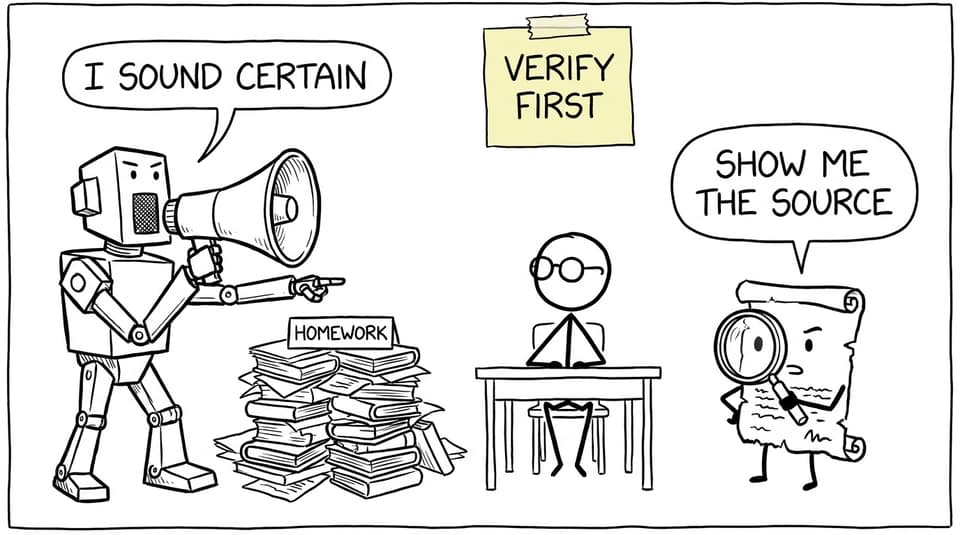
The weakness is equally important: a fluent response can contain an incorrect date, invented quotation, oversimplified interpretation, or source that does not say what the answer claims. ChatGPT is best treated as a tutor whose work must be checked, not an authority that replaces checking.
Perplexity for research starting points
Perplexity is most useful at the discovery stage. Its responses normally include links to web sources, allowing students to open and compare them. This is better than receiving an uncited list of facts, but citations are not a guarantee of quality.
A cited page may be secondary, outdated, commercially motivated, or only loosely connected to the claim beside it. For important evidence, students should open the result, identify the author or institution, read the relevant passage, and decide whether the source suits the investigation. The bibliography should cite the actual source consulted, not merely the AI summary.
How to use MYP History study tools without outsourcing thought
The most dangerous AI habit is not always obvious copying. Sometimes it is accepting the first interpretation so quickly that the student never forms one.
Use a five-stage routine instead:
Attempt
Write a rough claim or list what you already know. Even an incomplete attempt reveals the real gap. Without it, AI tends to replace the process rather than support it.
Ask
Request one kind of help: an explanation, a counterexample, a source-checking question, or feedback against a criterion. The guide to AI tools for MYP homework offers a broader framework for choosing the right type of support.
Verify
Check names, dates, quotations, statistics, and interpretations against reliable materials. For a primary source, inspect the original document and its context. For a secondary interpretation, identify who produced it and what evidence it uses.
Rebuild
Close the AI output. Create the answer again in your own structure and language, using only evidence you understand. If the idea disappears when the chat closes, it has not yet become learning.
Test
Answer a changed question, explain the argument aloud, or complete a short Questionbank set. Parents evaluating these tools should look for greater independence over time, not merely faster completion.
The academic-integrity boundary
The IB’s public position is not that all AI must be ignored. The central issue is authorship: AI-produced work is not automatically the student’s own, and material used in submitted work must be handled according to applicable acknowledgement rules. Individual schools may set stricter limits.
Safe uses commonly include asking for explanations, generating practice questions, testing recall, or receiving feedback on a student-written outline. Risky uses include requesting a complete response, inventing references, disguising generated prose, or allowing AI to make the central historical judgment.
The MYP academic honesty guide explains how to separate quotations, paraphrases, and original thinking. Students can also consult RevisionDojo’s History source-evaluation guidance for practical ways to examine origin, purpose, value, limitation, and perspective.
Parents should add a privacy check. Students should not upload personal information, confidential school materials, another student’s work, or restricted assessment content to an outside service. When rules are unclear, asking the teacher is safer than assuming that a tool’s availability means its use is permitted.
Choosing the right MYP History resources
Choose RevisionDojo when the student needs a dependable, curriculum-focused routine across learning, recall, practice, and feedback. Choose NotebookLM when the task is tightly based on a known collection of class sources. Choose ChatGPT Study Mode when guided dialogue is the main need. Choose Perplexity when the student needs potential sources and is prepared to inspect them carefully.
A larger collection of apps does not necessarily create a better student. Often it creates more tabs, more switching, and less thought. One home base and one specialist tool are usually enough.
RevisionDojo works best as that home base because its MYP History resources connect what students learn to what they can retrieve and apply. Used honestly, its Questionbank, Study Notes, Flashcards, AI Chat, and feedback features do not remove the hard part of History. They make the hard part visible. That is ultimately what good homework help should do.