


The best AI tools for MYP English Language and Literature homework do not simply produce polished answers. They help students notice a writer’s choices, organize an interpretation, improve a draft, and eventually complete the same work without assistance.
That distinction matters because MYP English is not a contest to see who can generate the smoothest paragraph. The International Baccalaureate organizes Language and Literature assessment around four broad criteria: analysing, organizing, producing text, and using language. A useful tool should strengthen at least one of those areas without quietly replacing the student’s judgment.
For most students, RevisionDojo is the strongest overall option because it combines MYP-specific content, guided AI support, practice, and feedback. ChatGPT is the most flexible general-purpose alternative, while NotebookLM is helpful for studying teacher-approved source material. Grammarly is best treated as a final editing assistant, and Perplexity is most useful for carefully verified background research.
The short ranked shortlist
| Rank | AI tool | Best for | One honest reason to choose it |
|---|---|---|---|
| 1 | RevisionDojo | Connected MYP English study | It combines course-specific explanations, practice, recall, and feedback instead of leaving students to design their own workflow. |
| 2 | ChatGPT Study Mode | Guided questioning and brainstorming | It is flexible enough to explain unfamiliar ideas and question a student step by step, although it is not inherently aligned with a particular school’s MYP task. |
| 3 | NotebookLM | Studying from supplied sources | Its source-grounded approach is useful when students want questions and summaries based on class notes, extracts, or permitted documents. |
| 4 | Grammarly | Sentence-level editing | It identifies problems involving grammar, clarity, and tone efficiently, but it cannot decide whether literary analysis is perceptive. |
| 5 | Perplexity | Initial contextual research | Its visible citations make claims easier to check, although students still need to evaluate the original sources and follow school research rules. |
What to check before choosing an AI homework tool
A long feature list can make almost any platform look impressive. A more useful test is what happens after the screen closes.
Choose a tool that:
- supports the specific criterion named in the assignment;
- asks for the student’s reasoning before offering a model;
- explains feedback rather than merely rewriting the work;
- allows claims, quotations, and contextual details to be verified;
- respects school rules, age requirements, and data policies;
- helps the student transfer a skill to a new text;
- preserves the student’s own language and interpretation.
The essential question is not whether homework becomes faster. It is whether the student becomes more capable.
Why RevisionDojo ranks first for MYP English
Generic AI begins with an empty chat box. That freedom can be useful, but it places a hidden burden on the student: they must already know what to ask, which answer to distrust, and how the response relates to MYP criteria.
RevisionDojo starts closer to the course. Its dedicated MYP English Language and Literature resource hub brings together bite-sized study material, lessons, Flashcards, cheatsheets, and key definitions. That structure makes it easier to move from understanding a concept to applying it.
Imagine a student who keeps identifying imagery but never explains its effect. They can review the MYP imagery Flashcards, use Study Notes to clarify the difference between identification and analysis, and then attempt a targeted Questionbank prompt. AI Chat can question an incomplete explanation, while Grading tools can indicate where the response needs stronger evidence or reasoning.
The important step comes next: rewriting. Feedback only becomes learning when the student acts on it.
RevisionDojo is therefore the strongest all-round choice among MYP English Language and Literature study tools. It provides a coherent loop:
- Learn the concept through Study Notes.
- Retrieve terminology with Flashcards.
- Apply it through the Questionbank.
- Ask AI Chat for a hint or explanation.
- Use Grading tools to identify a specific weakness.
- Rewrite without copying the suggested language.
Students can also explore the wider MYP subject resource collection when they need one study system across several courses. Mock Exams become useful for longer, timed practice, while Tutors can provide human guidance when automated feedback does not resolve a persistent problem.
Where ChatGPT Study Mode fits
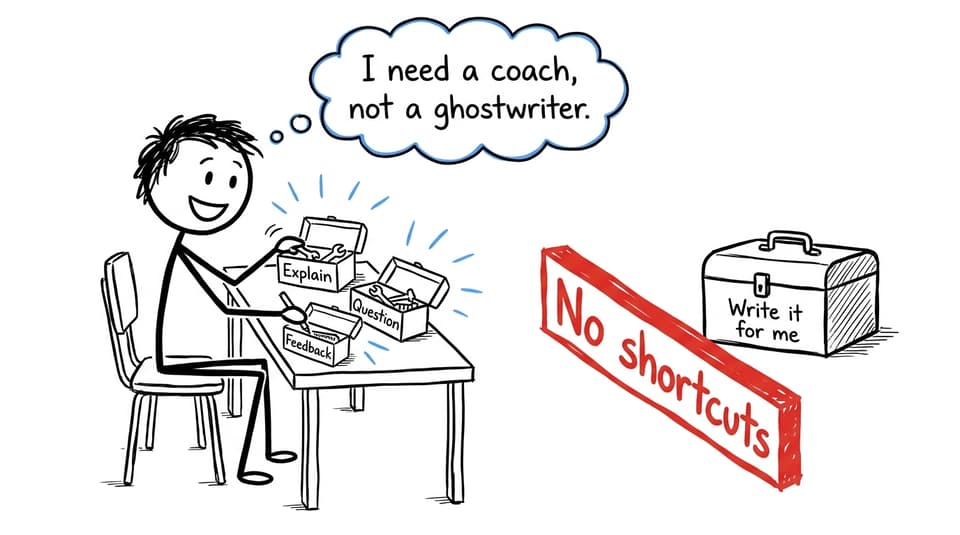
ChatGPT is the most adaptable outside option. Its Study Mode is designed to use guiding questions, scaffolded explanations, knowledge checks, and reflection rather than immediately delivering an answer. That makes it suitable for brainstorming interpretations, unpacking an assignment, or rehearsing analytical vocabulary.
A student could paste a teacher-approved extract and ask: “Do not write my paragraph. Ask me one question at a time so I can work out how the narrator’s tone shapes the reader’s response.” That prompt preserves the student’s intellectual work.
Its weakness is context. ChatGPT may not know the exact year-level descriptors, unit objectives, text edition, or instructions used by the student’s teacher. It can also produce confident errors or invent textual details. Students should provide the relevant rubric, verify every quotation against the original text, and never assume that fluent wording equals accurate analysis.
For a clearer map of the criteria, students can read RevisionDojo’s explanation of MYP Language and Literature assessment criteria. The guide shows why a response must do more than sound sophisticated.
NotebookLM for class notes and approved texts
NotebookLM is most useful when the assignment depends on a defined collection of sources. A student can add permitted notes or documents and ask for a glossary, comprehension questions, comparisons, or a study guide grounded in those materials.
This makes it a practical companion for learning context, reviewing a class handout, or organizing ideas across several non-literary texts. It is less suitable for making the final interpretive judgment. Source grounding reduces one kind of uncertainty, but a generated summary can still flatten ambiguity or overlook the significance of a particular image, structural choice, or contradiction.
Students should also check whether uploading a text is permitted. School materials, copyrighted works, peer writing, and personal information should not be added automatically.
Grammarly for editing, not interpretation
Grammarly belongs near the end of the writing process. It can help a student notice repetition, unclear sentences, punctuation problems, or an inconsistent register. Those improvements connect most directly with Criterion D, using language.
But an essay can be grammatically clean and analytically empty. Accepting every suggestion may also erase deliberate rhythm or make a young writer sound unlike themselves. The better routine is to inspect each recommendation and explain why the change improves meaning.
For example, a vague sentence such as “The sound makes the poem effective” needs more than grammatical repair. The student first needs conceptual knowledge of pace, mood, emphasis, or pattern. RevisionDojo’s sound devices Flashcards can support that knowledge before an editing tool polishes the sentence.
Perplexity for research that still needs checking
Perplexity can provide a quick starting map for contextual research because it normally displays sources alongside its response. That is helpful when a task involves an author’s setting, a social issue, a genre convention, or the background of a non-literary text.
Visible citations are not the same as reliable evidence. A citation may support only part of a sentence, lead to a weak secondary page, or omit important context. Students must open the source, identify its author or institution, check the publication date, and confirm that it actually supports the claim.
A responsible workflow for English homework
The safest way to use MYP English Language and Literature resources is to separate thinking from assistance.
Before using AI
Read the task and underline its command terms. Identify the relevant criterion. Annotate the text independently, recording patterns, questions, and possible effects before opening a tool.
While using AI
Ask for questions, counterarguments, definitions, or feedback on a draft. Request that the tool point to a weakness without replacing the sentence. If it makes a factual or textual claim, verify it.
After using AI
Close the tool and rewrite from memory. Check quotations against the original text. Explain the argument aloud in natural language. Finally, compare the response with the teacher’s instructions and disclose AI use when school policy requires it.
Parents comparing platforms can use RevisionDojo’s guide to evaluating IB support tools and its broader comparison of websites for MYP English Language and Literature. The goal is not maximum automation. It is the smallest amount of support that allows the student to take the next step independently.
The best tool should gradually become less necessary
Good homework support creates a quiet change. At first, a student may need help distinguishing a technique from its effect. Later, they need only a question. Eventually, they recognize the pattern alone.
That is where RevisionDojo fits best: not as a machine for finishing English assignments, but as the central MYP learning environment connecting knowledge, retrieval, practice, feedback, and human support. ChatGPT, NotebookLM, Grammarly, and Perplexity can each fill a narrower role. Used carefully, they form a useful toolkit. Used without boundaries, they can produce cleaner homework while leaving the underlying skill untouched.
The real measure of the best AI tool is therefore simple: after using it, can the student face a new text with more confidence, more precision, and more of their own thinking?