
For M28 students who started DP1 in August 2026 and will take IB exams in May 2028.
A bad first IB physics test usually means your current problem-solving method needs adjustment, not that you are incapable of succeeding in Physics. It does not determine your final IB grade, but it should be treated as early evidence about where your method breaks down.
A disappointing score can feel like a verdict because it is the first formal number attached to a new subject. In reality, it is closer to a diagnostic scan. The number is uncomfortable; the individual lost marks are useful.
What to do after a bad first IB Physics test
Before worrying about the rest of DP1, follow this sequence:
- Find out what the test counts toward at your school.
- Review every lost mark, including questions you guessed correctly.
- Classify each error by cause, not merely by topic.
- Relearn the weakest skill in a focused block.
- Complete new questions without looking at worked solutions.
- Repeat the test conditions after two weeks.
Reading the entire chapter again may feel productive because it is familiar. Physics improvement, however, usually comes from repairing the moment between understanding an idea and applying it under pressure.
Why the IB Physics first test often goes badly
The first test exposes a change in expectations. You may understand velocity, force or energy during a lesson, yet lose marks when you must select an equation, rearrange it, track units and communicate working without prompts.
That is why IB Physics first-term struggles are not always evidence of weak conceptual understanding. Several small technical errors can accumulate into a surprisingly low score.
Rearranging equations before substitution
When a question asks you to calculate an unknown, rearrange the equation symbolically before inserting numbers. For example, from , write:
Then substitute the values. This keeps the algebra visible and makes mistakes easier to find.
Use the same order for every calculation:
- Write the relevant equation.
- Rearrange for the unknown.
- Convert values into consistent units.
- Substitute with signs included.
- State the answer with a unit and sensible precision.
The routine may initially feel slower. It becomes faster because it prevents confused working halfway through a problem.
Units and conversions
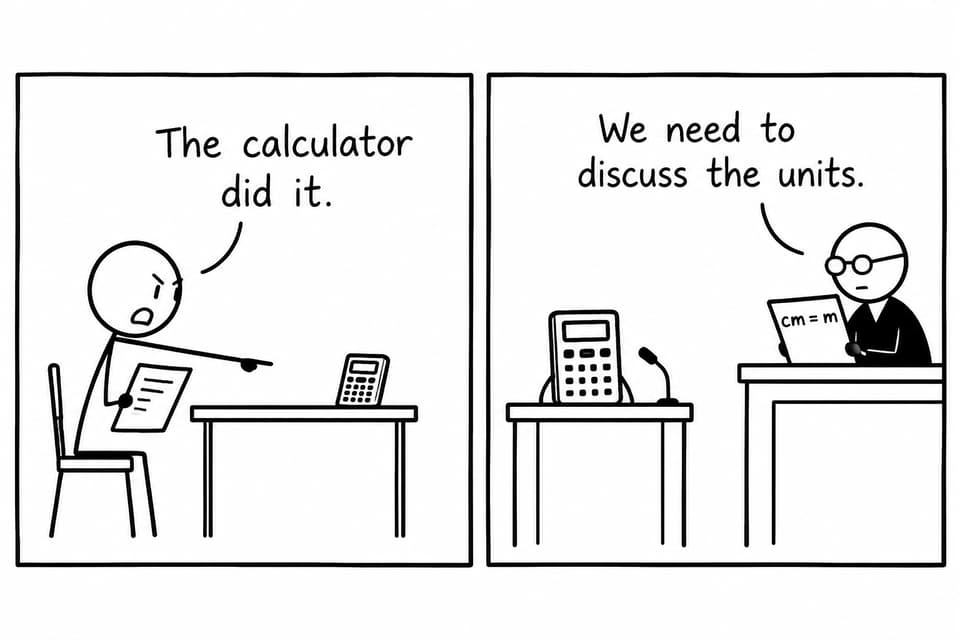
Units are part of a physical quantity, not decorations added at the end. A distance of 35 cm is when an equation requires metres.
Common early errors include confusing grams with kilograms, milliseconds with seconds and squared conversions with ordinary conversions. For example:
Write units beside values throughout the calculation. They can expose an incorrect equation before the final line. The guide to common IB Physics mistakes shows how small slips become recurring mark losses.
Vector signs and directions
A negative answer is not automatically wrong. It often means the quantity points opposite to the direction defined as positive.
Before using vector equations, draw a small diagram and declare a positive direction. If right is positive, a leftward velocity must be negative. In vertical motion, choosing upward as positive normally makes gravitational acceleration negative.
Keep the convention consistent, then interpret the sign in words. This is particularly important in IB Physics kinematics and forces and momentum questions.
What the grade does and does not affect
An ordinary classroom test is not, by itself, a component sent to the IB for your final Physics result. Under the current Physics course, the final subject grade is determined through formal external examinations and the internally assessed scientific investigation.
The test may still matter inside your school. Depending on local policy, it could contribute to a term report, achievement grade or evidence teachers later consider when forming predicted grades. Ask your teacher exactly how it is recorded rather than assuming it ruins everything or counts for nothing.
One early score provides limited evidence. Teachers can build a broader picture from later tests, assignments, practical work and sustained performance. If you are concerned about longer-term consequences, learn how IB predicted grades are set at school level.
Review the test mark by mark
Do not begin by calculating how many extra marks would have produced the grade you wanted. Begin with the first lost mark and ask why it disappeared.
Create an error log using these categories:
- Concept: You did not understand the physics being tested.
- Selection: You chose the wrong principle or equation.
- Algebra: Rearrangement or substitution failed.
- Units: A conversion or final unit was incorrect.
- Vector: A sign, direction or component was mishandled.
- Communication: Required working or reasoning was absent.
- Timing: You knew the method but ran out of time.
For each lost mark, record the question, category, correction and prevention rule. “Be careful” is too vague. “Convert every value before substitution” can change behaviour.
Review correct answers that came from guessing or faulty reasoning too. A lucky mark is a hidden weakness. Finish by redoing each affected question on blank paper without copying the solution. If you cannot reconstruct it independently, the review is not finished.
A two-week fix after a failed IB Physics test
The goal is not to study Physics constantly for 14 days. It is to complete short cycles of learning, practice, feedback and repetition.
Days 1-3: Diagnose and rebuild
Review the test and identify the two most common error categories. Relearn the relevant ideas using syllabus-aligned Study Notes, class materials and teacher feedback.
Create a one-page method sheet with key equations, conversions, sign conventions and prevention rules. It should guide your thinking rather than merely summarize the chapter.
Days 4-7: Practise one skill at a time
Complete 5-10 untimed questions per session. Show each algebra step and retain units throughout. Use active-recall Flashcards for definitions, equation meanings and unit relationships, while remembering that recall cannot replace calculation practice.
Check each solution immediately. If it is wrong, identify the exact line where the reasoning failed. AI Chat can explain that step, but close the explanation afterward and reproduce the method independently.
Days 8-11: Mix the decisions
Move from isolated drills to mixed questions. Real tests do not announce which equation belongs to each problem. Use the IB Physics Paper 1 and Paper 2 guide to understand how different formats test selection, calculation and written reasoning.
Continue updating the error log. A repeated mistake needs a stronger prevention rule, not another promise to concentrate.
Days 12-14: Retest under pressure
Build a short timed set covering the same skills as the original assessment. Work without notes or pauses, using your normal calculator. Mark it after time ends, then compare the error categories with your first test.
RevisionDojo brings this cycle into one IB-focused system through its Questionbank, Study Notes, Flashcards, AI Chat, Grading tools, Predicted Papers and Mock Exams. As DP1 expands, the Coursework Library and Tutors can support the scientific investigation and more individual gaps. The value is not simply having more material. It is moving from explanation to targeted practice without losing sight of the original mistake.
The first result is information, not identity
A low mark feels large because it arrives before you have much other evidence. Yet it captures your performance on one selection of questions, on one day, using a method you now know needs work.
What happens next is more revealing. Repair the algebra, make units visible, define vector directions and practise unfamiliar applications. That turns disappointment into a system.
Today, open the RevisionDojo IB Questionbank, select the topic from your first test and complete five questions while recording each error by category.