




The biggest adjustment shock in IB Physics is rarely one difficult formula. It is discovering that knowing the mathematics does not automatically tell you what mathematics to use.
A student can rearrange an equation perfectly and still feel lost when a question describes a ball, graph, collision, or changing force in unfamiliar language. The real task is translation: turning a physical situation into a model, then expressing that model through diagrams, equations, units, graphs, and explanations.
That gap sits behind many IB Physics first term struggles. It may feel like evidence that you are not naturally good at physics. More often, it means you are learning a new way of thinking.
The first-term adjustment checklist
If the course feels unexpectedly difficult,:
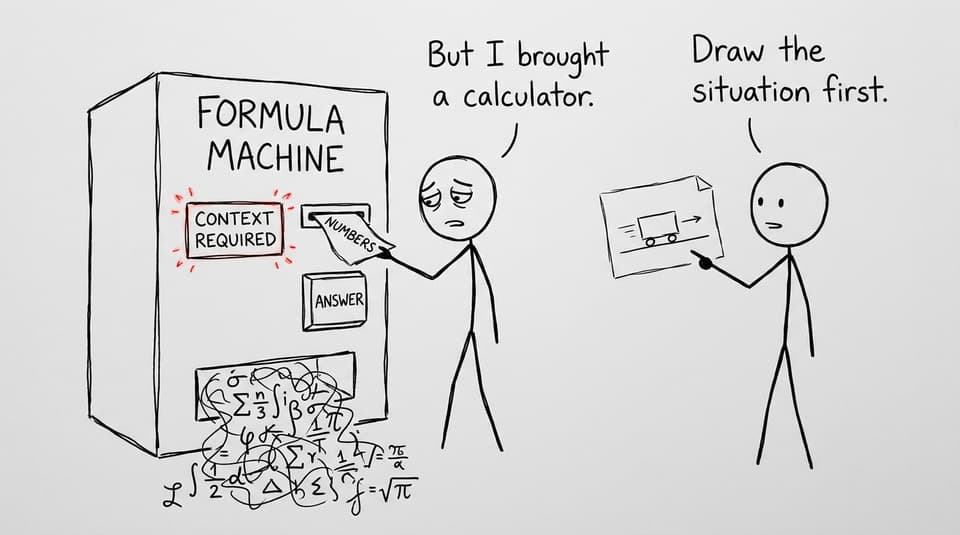
- Draw the situation before searching for an equation.
- Identify the physical principle, not merely the topic.
- List known and unknown quantities with units.
- Rearrange equations before substituting numbers.
- Check whether the result makes physical sense.
- Practise explaining relationships in words.
- Record why mistakes happened and retry them later.
These habits matter more than memorizing every possible solution pattern.
The source of IB Physics first term struggles
Earlier science courses can sometimes reward recognition. You see a familiar question, remember an equation, and insert the numbers. IB Physics often removes that comfort.
The course combines conceptual understanding with mathematics, data processing, experimental inquiry, and unfamiliar applications. External assessment includes Paper 1A multiple-choice questions, Paper 1B data-based questions, and Paper 2 short-answer and extended-response questions. A formula alone cannot meet all those demands.
Consider the relationship
The algebra is simple. The difficult questions come first. Which forces act? Which direction is positive? Does represent one force or the resultant force? Does the diagram match the signs used in the calculation?
Physics equations are compressed descriptions of reality. Before using one, you must decide what reality it represents. Mathematics gives you tools; physics asks you to choose and interpret them.
Why kinematics exposes the problem
Motion appears familiar until students meet displacement, velocity, acceleration, vectors, signs, gradients, areas, and multiple representations of one event.
A moving object may be described through a written scenario, motion diagram, graph, equation, or measurement table. The challenge is moving between these forms without changing the underlying physics. A rising displacement-time graph does not mean the same thing as a rising velocity-time graph. Height, gradient, and area carry different meanings depending on the axes.
Use the IB Physics A.1 Kinematics topic hub to move deliberately between explanations, graphs, examples, and questions. If the concepts remain blurred, begin with the IB Physics kinematics notes, then close them and reconstruct the idea from memory.
Words, diagrams, graphs, and equations are not separate topics. They are different languages describing the same event.
Use a model-before-mathematics routine
When a question feels unfamiliar, resist hunting immediately through formulas. Follow the same sequence every time.
Describe and draw the event
Write one sentence explaining what happens. For example: “The object is moving upward but slowing because its acceleration is downward.” Then sketch the object, relevant directions, forces, or path. A rough drawing can expose assumptions and prevent sign errors.
List the information
Translate values into symbols and SI units, including direction where relevant. Identify the unknown. This turns a paragraph into usable information while revealing what may be missing.
Name the governing idea
Decide whether the situation involves constant acceleration, Newton’s laws, conservation of energy, momentum, waves, fields, or another model. Only then choose a relationship.
Solve and test
Rearrange symbolically before inserting values. This keeps the structure visible and reduces calculator errors. Finally, check the unit, sign, scale, and direction. A calculation is not complete merely because the calculator produced a number.
Practise through short feedback loops
Reading a worked solution can create a misleading feeling of fluency. Everything looks obvious after someone else has made the important decisions.
A stronger routine is:
- Review one concept for 10-15 minutes.
- Attempt 3-5 focused questions without support.
- Check each solution carefully.
- Classify every error.
- Retry a similar question after 2-3 days.
The IB Physics Question Bank allows topic-based practice before you are ready for full exam conditions. Pair it with the syllabus-aligned IB Physics Study and Revision Notes when a question reveals a genuine knowledge gap.
Classify errors as conceptual misunderstanding, wrong model, graph misreading, weak algebra, unit conversion, sign mistake, or incomplete explanation. The category matters because each error needs a different repair. More calculations will not correct a misunderstood force diagram, while more reading will not fix careless unit conversion.
Learn the data booklet as a decision tool
The Physics data booklet supplies equations and constants, but it cannot decide which relationship fits a situation. That decision remains yours.
Practise with the IB Physics Data Booklet from the beginning. Learn its organization, common symbols, and the assumptions behind frequently used equations. The guide to using the IB Physics data booklet effectively explains how to identify a model before searching for a formula.
This turns the booklet from a rescue device into a familiar map. Instead of asking which equation contains the available numbers, ask which physical relationship describes the event.
Include graphs, explanations, and practical thinking
Calculation-only practice may improve algebra while leaving the deeper adjustment untouched. Each week, complete at least one graph or data-analysis task and one written explanation. “Calculate,” “describe,” and “explain” require different forms of evidence, as the IB Physics command terms guide illustrates.
Treat laboratory work as problem-solving practice rather than a pause between theory lessons. Uncertainty, graphing, evaluation, and experimental design are integrated into the course and support the scientific investigation.
Build a realistic support system
You do not need a heroic schedule. You need a system that reveals confusion early.
RevisionDojo brings that system together. Use Study Notes for clarity, Flashcards for definitions and relationships, and the Questionbank for application. The IB Physics Flashcards collection is useful for quantities, laws, units, and conceptual distinctions.
When a solution fails, use AI Chat to investigate why the model was wrong instead of requesting only the answer. Grading tools can highlight weaknesses in written reasoning. Later, Predicted Papers and Mock Exams develop timing and stamina, while the Coursework Library supports scientific writing. If one misconception survives several attempts, Tutors can help diagnose it directly.
For a wider roadmap, read how to succeed in IB Physics.
Turn the shock into a method
The students who improve are not always those who understand everything immediately. They are often those who pause before calculating, represent situations clearly, classify errors honestly, and revisit difficult ideas after feedback.
That is the answer to IB Physics first term struggles. You are learning to connect reality, models, mathematics, and evidence. RevisionDojo gives you one place to build those connections, one concept and one carefully examined mistake at a time.