
A hook you might recognize
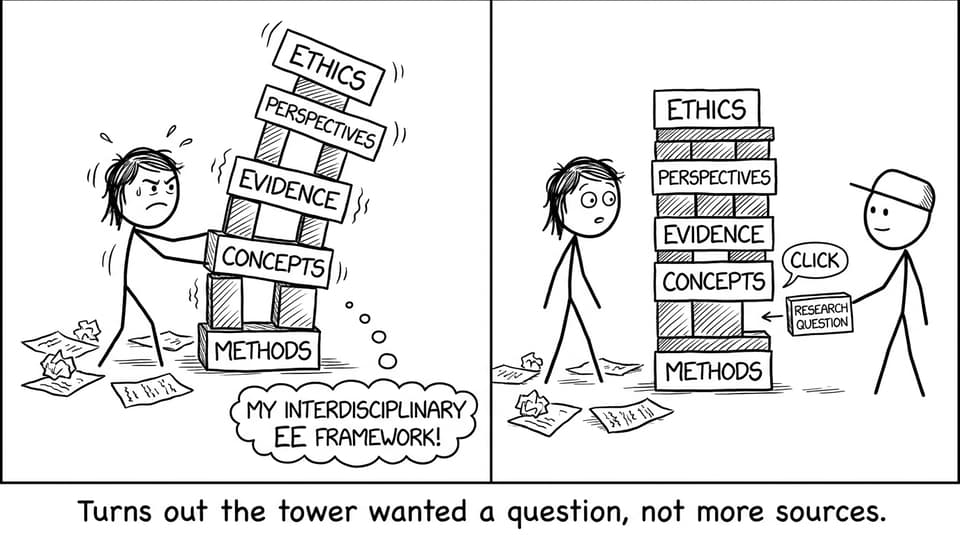
At some point in the IB, you watch your browser tabs multiply like rabbits.
One tab is your EE topic. Then come the articles. Then the “maybe relevant” PDFs. Then a video essay you swear is academic because it has citations in the description.
And still, the page stays blank.
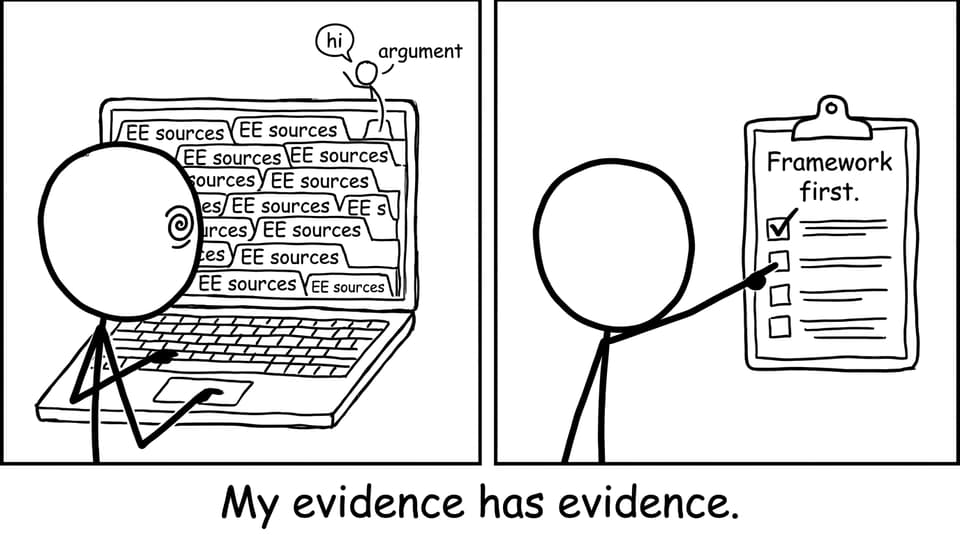
The problem usually is not effort. It is structure. In a strong EE, the difference between “I found sources” and “I built an argument” is the framework you use to connect ideas across disciplines. When students say “my EE feels messy,” what they usually mean is: I’m collecting information without a system for turning it into analysis.
This post explains the 5 interdisciplinary frameworks you can use to make your EE clearer, more analytical, and easier to write under pressure.
Quick checklist: what a framework does for your EE
Before we define the 5 frameworks, use this as your quick test. A good interdisciplinary framework should help you:
- Narrow your EE into a research question you can actually answer
- Choose evidence with intention (not because it was the first Google Scholar result)
- Organize paragraphs so each one advances the line of argument
- Compare perspectives across fields without turning your EE into a collage
- Show engagement with decisions you made (useful for reflections)
If you are still at the early stage, pair this article with RevisionDojo’s guide on crafting your question: How to Craft the Perfect IB Extended Essay Research Question.
What “interdisciplinary” really means in an EE
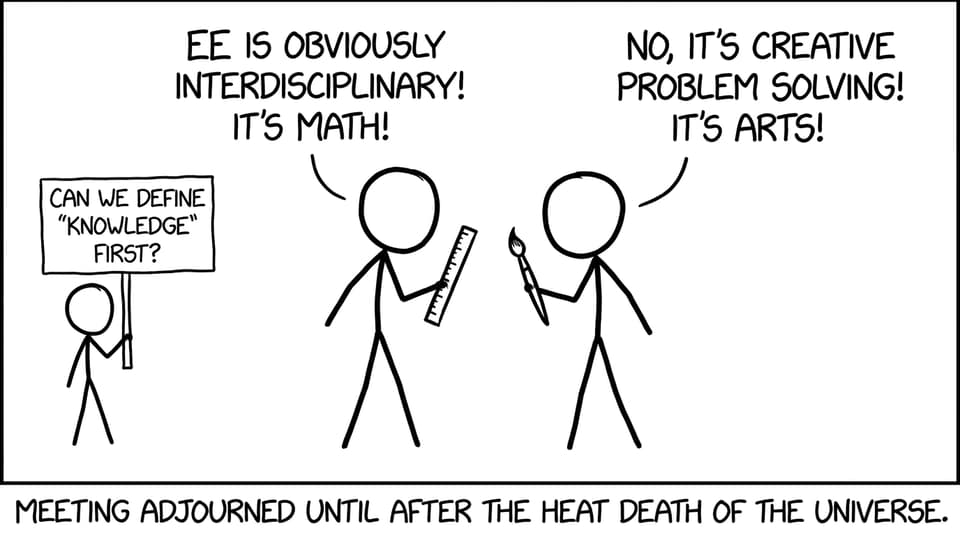
Interdisciplinary does not mean “I mention economics and psychology in the same sentence.” It means you use tools from multiple disciplines to explain a single problem more completely than one subject could.
In practice, your EE becomes interdisciplinary when you do at least one of these things:
- Borrow a method from one discipline to analyze material in another (for example, using statistical reasoning to evaluate historical claims)
- Compare explanatory models (for example, economic vs sociological explanations of the same trend)
- Integrate perspectives to reach a more nuanced conclusion (for example, scientific feasibility plus ethical consequences)
And crucially: your registered EE subject still matters. Your interdisciplinary thinking must remain aligned with the subject criteria you are assessed on. If you want a reliable home base while you plan, start with RevisionDojo’s hub: IB Extended Essay Guides.
Framework 1: The Lens Framework (one question, multiple lenses)
The Lens Framework is the simplest interdisciplinary move: you keep one research question, but look at it through different lenses.
How it works in an EE
You choose 2-3 lenses that are legitimate in your subject, then make each lens do real work:
- A psychological lens might explain mechanisms of decision-making
- An economic lens might model incentives and trade-offs
- A cultural or historical lens might explain why the same behavior changes across contexts
The trick is to avoid “lens tourism” (a paragraph of psychology, then a paragraph of economics, with no integration). The best EE structure here is usually:
- Define lenses and why they matter
- Analyze evidence through Lens A
- Analyze the same or comparable evidence through Lens B
- Synthesize: what each lens explains well, and what it misses
When the Lens Framework is a great fit
- Your EE topic has one clear phenomenon but multiple plausible explanations
- You have access to evidence that can be interpreted in more than one way
RevisionDojo move
Draft your outline, then pressure-test it using: How to Create an Effective EE Outline for a Logical Flow. A Lens Framework outline should clearly show the “synthesis” section, not just separate lens sections.
Framework 2: The Methods Transfer Framework (import a method, not just an idea)
Most students borrow concepts. Higher-scoring students borrow methods.
The Methods Transfer Framework means you take a tool from one discipline and use it to analyze evidence in another. This instantly raises the academic feel of your EE because it signals control and intentionality.
Examples of method transfer
- Using content analysis (common in social sciences) to analyze political speeches or media
- Using statistical correlation and limitations to critique claims in business or policy
- Using literary close reading techniques to interpret historical documents as constructed narratives
What makes this framework interdisciplinary
You are not just saying “psychology matters.” You are using psychology’s way of building knowledge: definitions, operationalization, study design, validity, limitations.
If you are writing something that leans on studies and research summaries, RevisionDojo’s criterion guidance is unusually practical: IB Psychology EE Criterion C (Analysis).
Common EE mistake to avoid
Method transfer fails when students import the surface features (jargon, diagrams, named theories) but not the discipline’s standards of evidence. Your EE should show you know what counts as strong evidence in the method you are borrowing.
Framework 3: The Systems Framework (map the parts, then test relationships)
Some EE topics are not “one cause, one effect.” They are messy systems with feedback loops.
The Systems Framework treats your topic as a set of interacting components, then asks how changes in one part affect the others.
What it looks like in an EE
You identify:
- Actors (individuals, institutions, markets, ecosystems)
- Inputs (resources, policies, constraints)
- Mechanisms (incentives, biological pathways, information flows)
- Outputs (behaviors, outcomes, changes over time)
- Feedback loops (what reinforces or stabilizes the system)
This framework is powerful for interdisciplinary EEs because systems thinking naturally pulls in multiple disciplines: economics (incentives), politics (institutions), psychology (behavior), science (constraints), ethics (trade-offs).
How to keep it from becoming vague
A systems map is not your argument. It is your planning tool. Your EE still needs a focused question and evidence that tests specific relationships.
If you are worried your work is drifting into description, keep this open while you draft: How to Make Your IB Extended Essay Analytical, Not Descriptive.
Framework 4: The Comparative Case Framework (same question, different contexts)
The Comparative Case Framework asks one research question across two or more cases, then uses comparison to produce insight.
Why it works so well for an EE
Comparison forces clarity. It makes you define variables, define criteria, and explain why differences matter. That is analysis.
How to run it cleanly
Pick cases that are:
- Comparable enough that the comparison is meaningful
- Different enough that the comparison reveals something
- Supported by evidence you can actually access
Then choose a comparison structure:
- Parallel structure: A1, B1, synthesis; A2, B2, synthesis
- Block structure: all of Case A, all of Case B, then synthesis (riskier)
Interdisciplinary angle
Comparative work often pulls in multiple fields naturally. You might compare:
- Two policy contexts (politics + economics)
- Two cultural contexts (anthropology + psychology)
- Two literary works from different eras (history + literature)
RevisionDojo move
Once your draft exists, use criterion-based feedback rather than vibes. RevisionDojo’s IB EE Feedback Tool is built for exactly that: turning “this feels off” into specific revision targets.
Framework 5: The Ethics and Implications Framework (what we can do vs what we should do)
Some of the most compelling interdisciplinary EEs are not driven by curiosity alone, but by consequence.
The Ethics and Implications Framework examines:
- What the evidence suggests is effective or true
- What different stakeholders value
- What trade-offs and unintended consequences emerge
- What policies or actions are justified (and under what assumptions)
What makes this framework interdisciplinary
Ethics is not a subject add-on. It is a structured way to weigh competing goods. To do it well, you usually need:
- Empirical evidence (science, economics, psychology)
- A model of decision-making (policy studies, political theory)
- Clear definitions of harm, benefit, rights, and fairness (philosophy, TOK-style thinking)
How to avoid turning your EE into an opinion piece
Ethical writing still requires evidence and evaluation. Make your claims conditional:
- “If the policy goal is X, then evidence supports Y”
- “However, under constraint Z, Y creates trade-offs that stakeholders A and B experience differently”
Reflection becomes especially important here. RevisionDojo’s guide is worth reading early, not late: How Reflection Strengthens Your IB Extended Essay.
How to choose the right framework for your EE
Here is the simplest decision rule:
- If you have one phenomenon with multiple explanations: use the Lens Framework
- If you want to stand out with rigor: use Methods Transfer
- If your topic has feedback loops and interacting parts: use Systems
- If your topic naturally has two contexts/texts/locations: use Comparative Case
- If your topic has real-world consequences and trade-offs: use Ethics and Implications
And if you are panicking because you are behind, don’t “motivate” yourself with guilt. Use a plan. RevisionDojo’s time-boxed approach is grounded and realistic: Can You Cram IB Exams? A Realistic 7-Day Plan.
Using RevisionDojo to execute your EE without drowning
Frameworks are the blueprint. You still need a workbench.
RevisionDojo is built as an all-in-one IB system, which matters when your EE sits alongside exam prep:
- Use Study Notes to patch content gaps fast, without rereading whole textbooks
- Use Flashcards to keep definitions, theorists, and key terms alive daily
- Use the Questionbank to protect exam performance while you write your EE
- Use AI Chat (Jojo) as the “unstuck button” for research question phrasing, paragraph logic, or methodology clarity
- Use Grading tools like the IB Coursework Grader for rubric-aligned feedback on drafts
- Use Predicted Papers and Mock Exams to keep exam stamina intact
- Use the Coursework Library and Tutors when you need examples and human guidance to break a pattern
If you want one page to orient you, browse: All IB Extended Essay Posts.
Closing: your EE is a system, not a sprint
A strong EE rarely comes from one heroic weekend. It comes from smaller decisions that compound: a framework that narrows your thinking, an outline that protects your argument, and revision that is guided by criteria rather than anxiety.
Pick one of the five interdisciplinary frameworks above, then do one simple action today: rewrite your research question so it matches the framework you chose.
When you are ready to turn that structure into marks, RevisionDojo is the IB workspace built for the full load: Study Notes, Flashcards, Questionbank, AI Chat, Grading tools, Predicted Papers, Mock Exams, Coursework Library, and Tutors. Your EE deserves a framework. Your revision deserves a system.