
Submitting an internal assessment rarely feels finished. There is always one suspicious citation, one paragraph that feels too broad, and one sentence you have read so often that its meaning has disappeared.
This world religions IA checklist gives IB World Religions SL students a final review. Your investigative study should use the five required headings, remain within 1,500-1,800 words, and address criteria A-E for 30 marks. It should function as one connected investigation: the rationale leads to the question, the plan generates evidence, the findings present what matters, and the reflection evaluates its meaning.
RevisionDojo's overview of what the investigative study requires provides a reference before reviewing your draft.
The submission checklist at a glance
Confirm these essentials before reviewing individual criteria:
- Your investigation addresses religious experience, practice, or belief involving an individual, a group of adherents, or both.
- Your research question is precise and manageable.
- The five compulsory headings appear in the correct order.
- Your counted text falls within 1,500-1,800 words.
- Findings answer the question, and reflection evaluates the evidence.
- Borrowed ideas, quotations, and specific evidence are cited consistently.
- Fieldwork participants have been treated respectfully and ethically.
The criteria have different weightings. Criterion D carries one-third of the available marks, so a draft dominated by background description is usually unbalanced.
| Criterion | Required area | Marks |
|---|---|---|
| A | Rationale and preliminary research | 8 |
| B | Plan for study | 3 |
| C | Summary of significant findings | 6 |
| D | Critical reflection and evaluation | 10 |
| E | Format, references, and compliance | 3 |
For a 1,600-word draft, a possible budget is 350 words for A, 175 for B, 425 for C, and 650 for D. This is planning guidance, not an official allocation. Adjust it while protecting space for evaluation.
Criterion A: rationale and preliminary research
Criterion A establishes why the investigation matters and whether you understood the subject before conducting the study.
Underline your research question. It should identify a manageable practice, belief, experience, community, or context. “Why is prayer important?” is too broad. A more focused question might ask: “How do members of one local Muslim community understand the role of congregational prayer in strengthening communal identity?”
The second question identifies whose experience is being investigated and which relationship will be explored. Check feasibility using RevisionDojo's guide to choosing an IA focus and research question.
Explain the question's academic significance. Personal interest can introduce the topic, but the rationale should show what the investigation reveals about lived religion. For example, studying sewa in one gurdwara could explore how a theological principle is interpreted through communal service.
Audit your preliminary sources. Depending on the question, suitable evidence may include scholarship, sacred or authoritative texts, institutional material, and community background. Explain how key sources shaped your question, expectations, or method. RevisionDojo's guide to meeting criteria A-D helps distinguish source description from analysis.
Criterion B: plan for study
The plan should demonstrate that your method was deliberately chosen to answer the question. Identify the method, participants or materials, setting, and sequence. “I conducted research and an interview” gives little information about the design.
A stronger account might describe a semi-structured interview with an adult adherent, observation of a public communal practice with permission, and comparison with preliminary scholarship.
Explain each method's purpose. Interviews can reveal an adherent's interpretation; observation can show how a practice operates in a particular setting. Neither automatically establishes what every adherent believes. Acknowledge practical constraints and ethical considerations using RevisionDojo's planning the investigation notes.
Check fieldwork ethics and representation
Religious fieldwork involves identities, convictions, and sometimes sensitive experiences. Ethical conduct should be visible in the investigation's design and reporting.
Obtain informed permission before interviewing, recording, photographing, or observing where permission is expected. Explain the purpose, how information will be used, and whether participants will be named or anonymized. Follow school safeguarding requirements, particularly when participants or researchers are minors.
Do not pressure anyone to answer. Store notes securely, avoid unnecessary personal details, and represent responses accurately. If permission is withdrawn, follow arrangements agreed with your teacher and school. Never present one person's view as an entire tradition's position.
Review RevisionDojo's guidance on ethics, permissions, and fair representation.
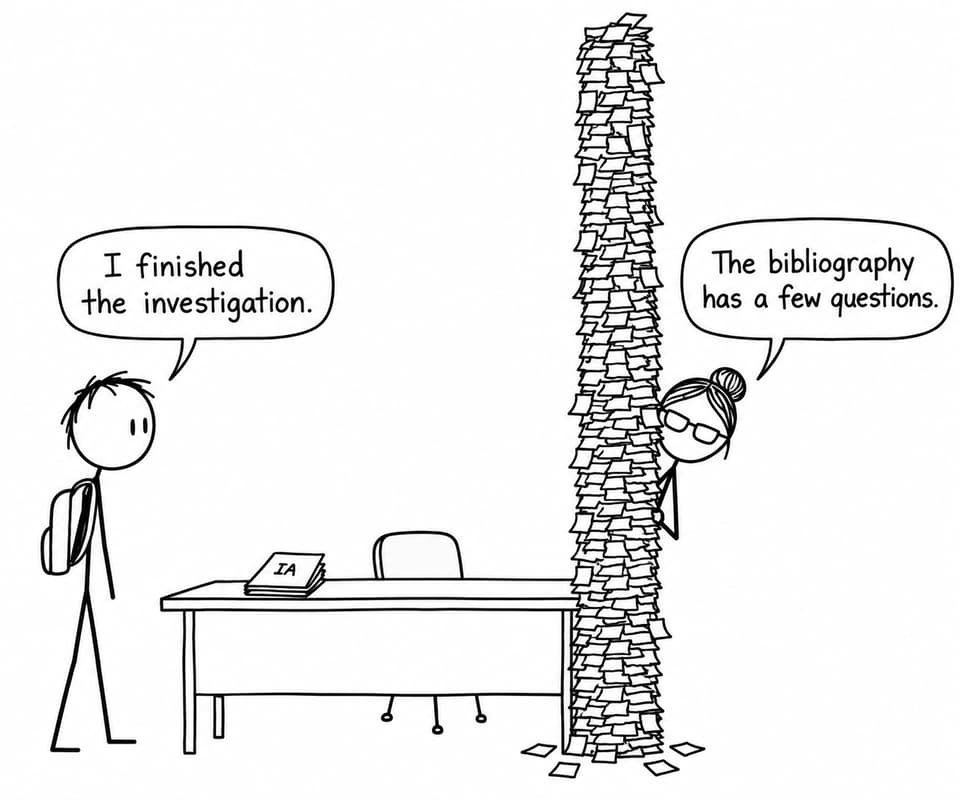
Finishing the investigation is only part of finishing the document.
Criterion C: summary of significant findings
Select and organize findings that answer the research question. This section should not reproduce transcripts or recount everything discovered.
For each paragraph, ask: “How does this finding help answer my question?” If several interview responses express similar ideas, synthesize the pattern and support it with selected evidence. Remove interesting details that do not contribute.
Check that the findings follow from your plan. If you promised interviews but rely almost entirely on websites, the investigation loses coherence. Distinguish participant testimony, your observations, religious teaching, and scholarly interpretation. They can illuminate one another, but serve different evidential purposes.
Preserve disagreement. “Two participants emphasized community, while another understood the practice principally as individual discipline” conveys more than a claim of complete agreement. Variation can become valuable evidence for your reflection.
Criterion D: critical reflection and evaluation
Criterion D deserves the most substantial review. Evaluate what the investigation revealed, how confidently conclusions can be drawn, and how the process affected your understanding.
Interpret the findings
Explain relationships, tensions, and differences. Consider whether lived practice aligned with preliminary scholarship or complicated it. Sources might describe a ritual through theological ideals while participants emphasize family memory. Explore that difference without assuming either account must be mistaken.
Evaluate evidence and limitations
Ask what each source could demonstrate. One interview offers depth but limited representativeness. Observation reveals behaviour in a specific moment without necessarily revealing private motivations. Institutional material may describe official positions while overlooking internal diversity.
Name limitations and explain their consequences. Beyond saying the sample was small, identify absent perspectives and consider how location, timing, question wording, or your presence shaped the findings.
Test the chain from evidence to conclusion
Use a simple audit for each major conclusion. In the margin, identify the evidence supporting it, the interpretation you made, and the limitation controlling its scope. If one link is missing, revise the claim rather than creating confidence through stronger language.
Test alternative explanations. A participant may connect a ritual with community because of family history, local culture, or the interview setting, not only formal doctrine. You do not need to disprove every alternative. Show that more than one reading was considered and explain why your interpretation remains reasonable.
Finally, separate reflection from autobiography. Explain how evidence changed your understanding of the religion or exposed a weakness in the investigation. A concise before-and-after comparison can show intellectual development without becoming a diary entry.
Reflect on perspective and conclusions
Identify an original assumption, the evidence that challenged it, and the understanding that followed. Consider your position as a researcher: familiarity can create insight and unexamined assumptions, while unfamiliarity may lead to misunderstandings of language or context.
Answer the research question with conclusions proportionate to the evidence. Phrases such as “within this community” or “among the participants consulted” clarify scope. Compare your draft with RevisionDojo's explanation of the World Religions IA criteria and mark scheme.
Criterion E: references, format, and word count
Use these five headings in order:
- Rationale and preliminary research
- Plan for study
- Summary of significant findings
- Critical reflection and evaluation
- References
RevisionDojo's guide to the five-heading format and word count explains the structure.
Confirm that the written analysis contains 1,500-1,800 words. Leave room below the upper boundary for final edits, verify official counting rules with your school, and display the required count. Cut repeated background, long quotations, and irrelevant findings before cutting critical evaluation.
Match every citation or footnote to the reference list, then check that every listed source is used. Apply one recognized citation style consistently. Document interviews according to school conventions while protecting promised anonymity. Check that contextual details do not identify someone given a pseudonym.
Export and reopen the required file. Inspect headings, page breaks, quotations, footnotes, special characters, and references. Remove comments, tracked changes, drafting notes, and personal contact details.
The IB World Religions IA Grader can support rubric-based review. Treat automated feedback as guidance alongside teacher instructions and your judgment.
Use a two-pass submission check
Do not proofread argument and formatting simultaneously. First, read only for the chain connecting question, evidence, interpretation, limitation, and conclusion. Then inspect citations, headings, word count, anonymity, and layout. This separation makes it harder for a polished document to disguise an unsupported claim.
Reopen the exported file and verify footnotes, special characters, page breaks, and the submitted filename. The final check should examine the actual upload, not a nearly identical draft left elsewhere on your device.
The final ten-minute review
Read each paragraph's first and last sentences to check focus. Search for “all,” “always,” and “proves,” narrowing claims where necessary. Compare your research question with Criterion D's conclusion: it should answer that exact question.
RevisionDojo connects coursework with wider IB preparation. Study Notes and Flashcards strengthen knowledge; the Coursework Library supports structure; AI Chat and Grading tools support feedback. Questionbank practice, Predicted Papers, Mock Exams, and Tutors help students continue into examination preparation.
A strong submission gives every section a purpose. Check the connections, protect participants, respect the word limit, and let the evidence support only what it can honestly say.