

Your notes are highlighted. Your to-do list is checked off. You've "studied IB."
And then you sit down to do a paper and something weird happens: your brain feels like a room where the lights are on, but nobody's home.
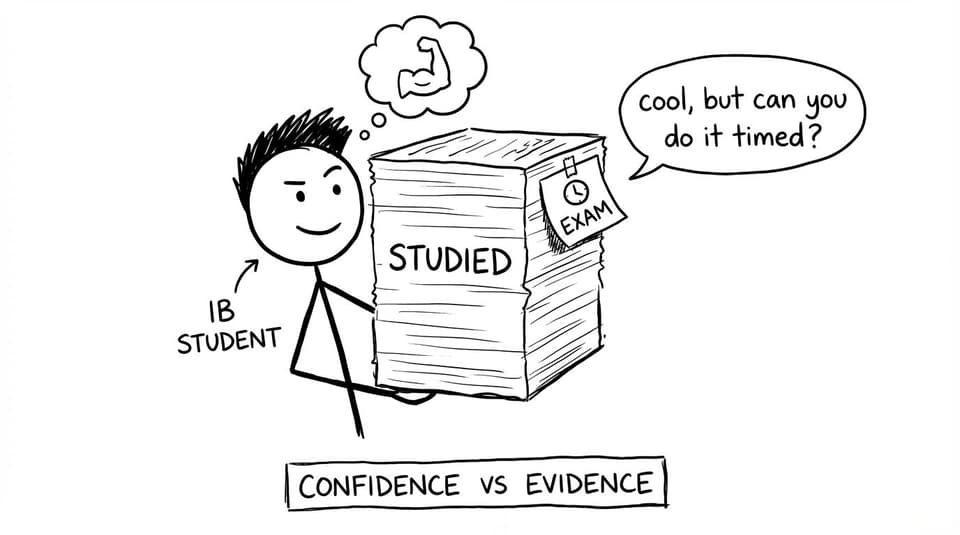
That feeling is one of the most common experiences in IB exam season. It's also one of the most misunderstood. Many students treat it like proof they're behind. In reality, it's usually proof of something else: you've been building familiarity, not performance.
The IB doesn't reward the version of you who can recognize a concept when you see it. It rewards the version of you who can produce the concept, under time pressure, with the right structure, using the right command terms.
This article will explain why you can study IB and still feel unprepared, and how to convert real effort into real readiness using simple loops, evidence-based practice, and the RevisionDojo system.
A quick IB readiness checklist (save this)
If you're short on time, use this checklist to diagnose why IB still feels shaky:
- You can explain a topic, but you can't answer exam-style questions on it.
- Your revision is mostly reading, rewriting, or watching.
- You haven't done enough timed work to make pressure feel normal.
- You don't review mistakes in a repeatable way (you just "move on").
- You're mixing up "I remember this" with "I can use this."
- You're not training command terms, structure, and mark-scheme expectations.
If 2+ of these are true, you're not failing IB. You're just missing the conversion step.
The core reason you feel unprepared after studying IB
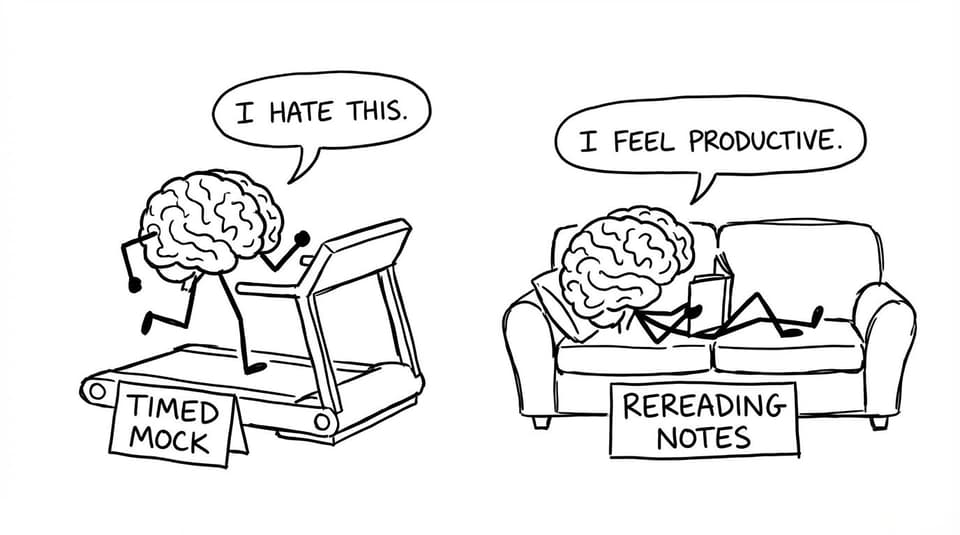
There's a quiet trap in IB revision: the work that feels most comforting often produces the least proof.
Reading notes feels smooth. Watching explanations feels productive. Rewriting summaries feels like control.
But the IB exam asks for something different. It asks you to retrieve, select, and structure information correctly on demand.
So the gap isn't effort. The gap is training specificity.
To understand this, think of two versions of "knowing":
- Recognition knowledge: "I know what this is when I see it."
- Recall and application knowledge: "I can generate it quickly, then apply it to unfamiliar prompts."
Most students do a lot of the first and assume it will become the second. In IB, that assumption is expensive.
A good IB plan flips the ratio: practice first, then patch gaps, then practice again.
If you want a structured routine built around that loop, borrow the framework from How to Study for IB Exams: Step-by-Step Guide.
The "illusion of competence" hits IB students especially hard
IB is broad. Six subjects, multiple papers, different mark schemes, different writing styles. That breadth creates a perfect environment for false confidence.
You can spend three hours on IB Biology notes and feel like you "covered" a unit. Then an exam-style question asks you to apply that unit in a new context and the confidence collapses.
That collapse is not a character flaw. It's a feedback issue.
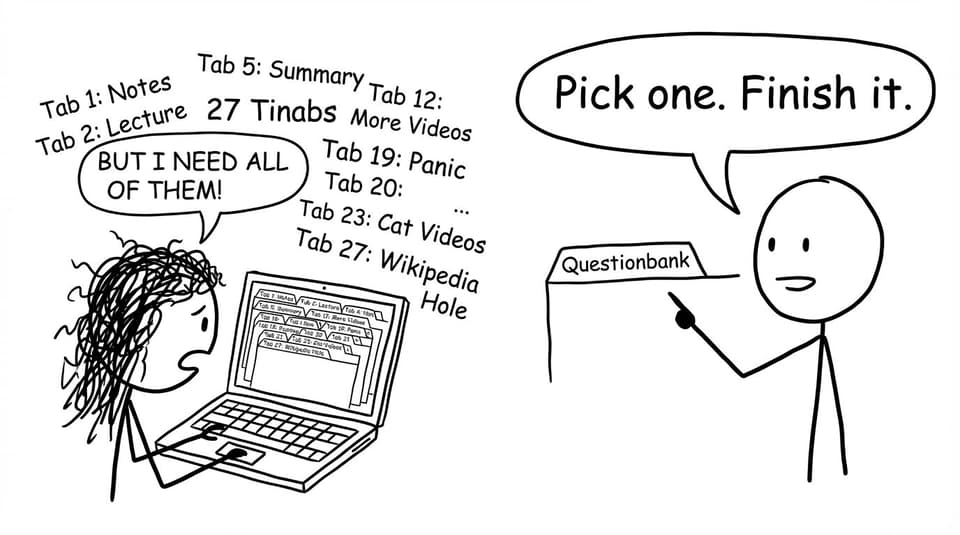
The fix is to introduce a constant stream of small tests so your feelings are replaced with data. That's what a question bank is for.
RevisionDojo's Questionbank feature exists for this exact problem: frequent, syllabus-aligned practice that turns "I think I know this" into "I scored 7/10 on this topic and here's why."
If you want a deeper look at how to use question practice strategically, read Comprehensive IB Question Bank: Thousands of Practice Questions.
You studied IB content, but not IB performance
A lot of IB students "study the syllabus."
High scorers study the papers.
That difference sounds small, but it changes everything.
Paper performance includes:
- knowing common question patterns
- understanding command terms
- writing in the shape the mark scheme rewards
- doing the steps in the right order under time
You can be smart and hardworking and still feel unprepared if your revision is not shaped like the exam.
One practical move: stop planning in subjects and start planning in paper blocks. Example: "IB Chemistry Paper 2 equilibrium calculations" is a better target than "revise equilibrium." It creates a clear finish line.
To build that structure, the guide How to Prepare for IB Final Exams Efficiently: 10 Proven Strategies is a strong companion.
Timed practice is the missing ingredient most IB students avoid
Most students don't avoid timed work because they're lazy. They avoid it because it tells the truth quickly.
Timed work reveals:
- where you blank under pressure
- where your method is slow
- where your writing becomes vague
- where you misread the command term
And once you see those things, you can't unsee them.
But IB readiness is built from that honesty.
A simple ladder:
- Timed sets (15-25 minutes): small topic blocks
- Timed sections (30-60 minutes): mixed content
- Timed full papers: stamina + pacing
RevisionDojo makes this easier because you can combine question practice with exam simulation through Mock Exams and Predicted Papers, and then use AI Chat to understand mistakes without losing momentum.
For a step-by-step method, use How to Run Timed IB Mock Exams in RevisionDojo (Exam Mode + Test Builder). And if you're trying to get better at mock performance specifically, IB Mock Exam Tips: Expert Strategies for Better Performance helps you review like an analyst, not a critic.
Your brain is confusing anxiety with information
Another reason IB feels unprepared even when you studied: stress changes what "knowing" feels like.
Under low stress, your memory works with cues. You see a heading and the paragraph comes back. Under exam stress, the cues are weaker and your brain becomes conservative. It withholds information unless it's been rehearsed in similar conditions.
This is why students say, "I knew this yesterday." They probably did. They knew it in a calm environment, with familiar prompts.
The solution is not to become fearless. It's to make exam conditions less novel.
That's why consistent timed blocks matter. Not one heroic session. Repeated exposure.
RevisionDojo's ecosystem helps here because you can build a steady loop:
- Study Notes to patch understanding
- Flashcards to keep facts alive
- Questionbank to apply skills
- AI Chat (Jojo) to unblock quickly
- Mock Exams and Predicted Papers to normalize pressure
If you want a full overview of that loop, see RevisionDojo App: The Smarter Way to Prep for IB Exams and the main RevisionDojo for IB hub.
You're not reviewing mistakes long enough for IB to change you
Most IB students review mistakes like this:
-
mark it wrong
-
read the solution
-
feel bad
-
move on
That's not review. That's exposure.
Real review creates a rule your future self can use.
Try this 5-minute mistake log template (per question):
- What did I choose/write?
- Why did I do that? (misread, concept gap, rushed, forgot step)
- What is the rule next time? (one sentence)
- How will I retest? (choose 3 similar questions in 48 hours)
RevisionDojo supports this naturally because you can tag weak questions in the Questionbank, revisit them later, and use Flashcards to turn your recurring mistakes into daily retrieval.
If you're new to using flashcards in a way that actually supports IB performance, read IB Flashcard System: Active Recall for Better Memory and Mobile IB Flashcards: Study Cards on Your Phone.
Command terms are the hidden reason IB feels slippery
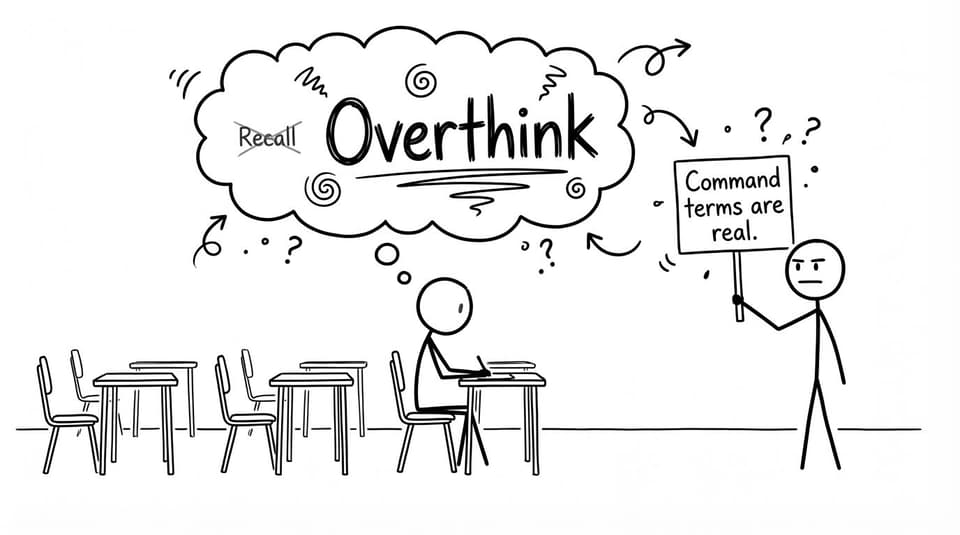
Many students feel unprepared in IB because they're answering the wrong question.
They "explain" when the prompt asks them to "evaluate." They "describe" when they should "analyse." They list facts when the mark scheme wants a structured judgement.
This is painful because it feels like a knowledge problem, but it's often a technique problem.
A high-impact habit is to practice the verb, not just the topic. When you do a question, ask yourself:
- What does the command term demand?
- What does a top-band structure look like?
- What evidence would earn marks?
RevisionDojo's AI Chat can help here when you're unsure if your response actually matches the command term. And the Grading tools can help you tighten structure for written work (especially in coursework-heavy subjects), while the Coursework Library shows what strong work looks like so you're not guessing.
A simple weekly system to stop feeling unprepared in IB
Here's a calm, repeatable plan that turns IB revision into evidence.
Daily (20-40 minutes)
- 10 minutes Flashcards (spaced repetition)
- 20-30 minutes targeted Questionbank set on one topic
- 2 minutes: write one rule from your mistakes
Twice per week (60-90 minutes)
- 15 minutes Study Notes to patch one gap
- 45-60 minutes mixed question practice
- 10 minutes: rewrite one answer to top-band quality
Once per week (60-120 minutes)
- timed block: section or paper (build stamina)
- review longer than you sit (this is where IB gains happen)
If you want a broader sense of what to include in your schedule, What's the Best Way to Revise for IB Exams? adds subject-specific strategy ideas.
When you need extra support, RevisionDojo Tutors are the human layer that can steady your plan, correct technique faster, and keep your weekly loop honest.
Closing: You don't need to feel ready to be ready in IB
IB readiness is not a mood. It's a record.
If you feel unprepared after you studied IB, it usually means your revision has been building comfort, not evidence. The solution is not to study longer. It's to study in a loop that mirrors the exam: retrieve, apply, time it, review it, repeat.
That's what RevisionDojo is built to support end-to-end: Study Notes for clarity, Flashcards for daily recall, a Questionbank for exam-style practice, AI Chat to unblock confusion, Grading tools and a Coursework Library to reduce coursework uncertainty, and Predicted Papers plus Mock Exams to turn pressure into familiarity. If you want a single next step, open RevisionDojo and do one targeted Questionbank set today, then schedule one timed block this week.
You'll still feel nerves. That's normal.
But you won't feel lost. And in IB, that's most of the battle.