
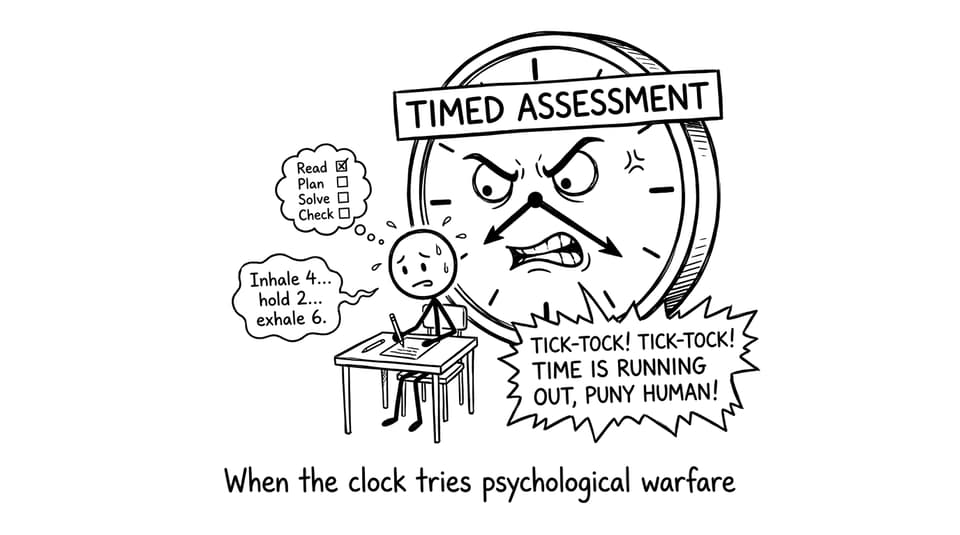
Timed assessments have a strange talent: they make smart IB students forget obvious things.
You can walk into a room knowing the content. You can even like the subject. But as soon as the invigilator says “start,” your brain suddenly develops a hobby called catastrophising. The clock gets louder. Your handwriting gets worse. A question you practiced yesterday now looks like it was written by aliens.
This isn’t proof you’re “bad at IB.” It’s proof you’re human.
In IB exams, knowledge matters, but composure decides whether you can access that knowledge on demand. Calm is not a personality trait. Calm is a repeatable set of behaviours you train until they become automatic.
Quick calm-and-focus checklist (save this)
Use this checklist before any timed assessment in IB:
-
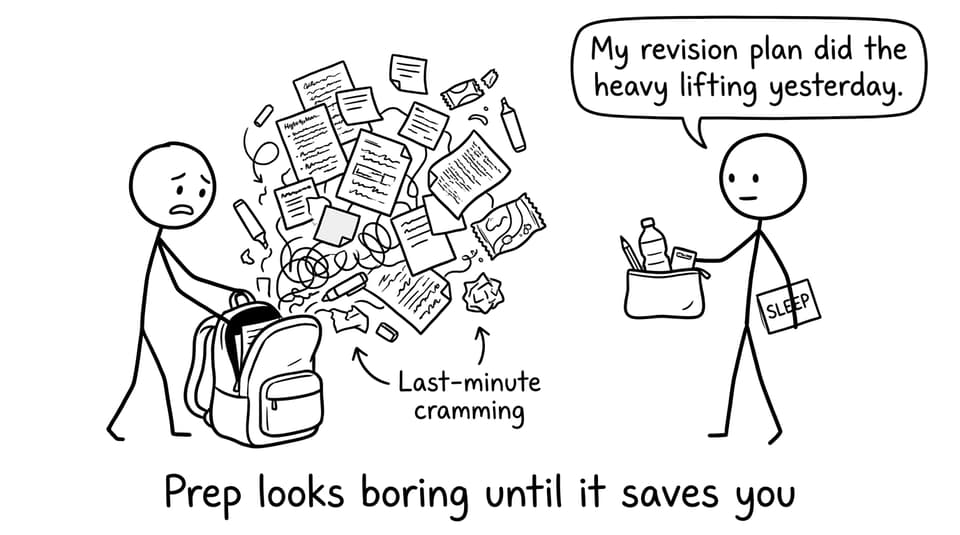
Sleep 7-8 hours (your recall depends on it).
-
Pack your materials the night before (reduce morning cortisol).
-
Do a 60-second breathing reset before reading Question 1.
-
Convert marks to minutes and set 2-3 pacing checkpoints.
-
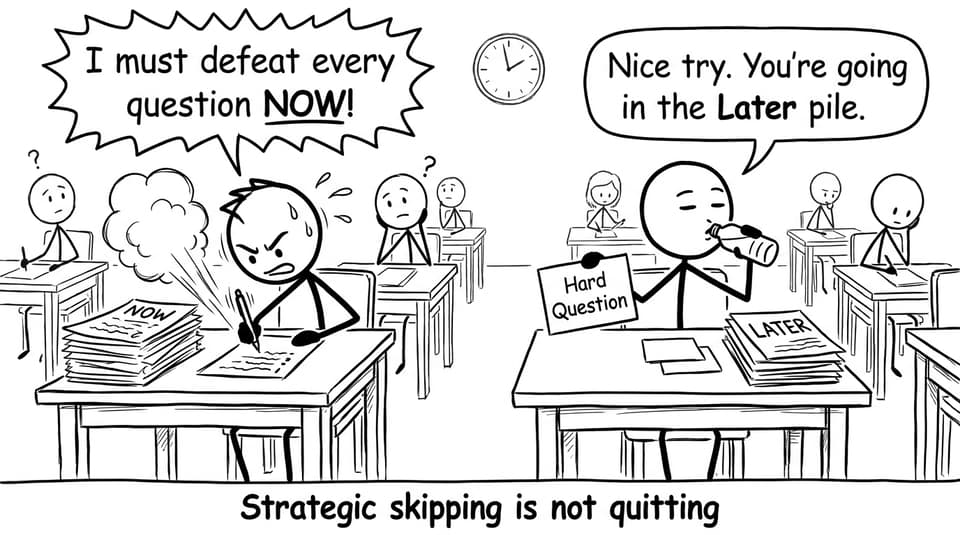
Use the “skip rule” without guilt: park time-sinks, bank marks elsewhere.
-
Review after: name one trigger, one fix, one next drill.
If you want a place to practise this loop with structure, Exam Mode on RevisionDojo is built for timed conditions.
Why timed stress hits IB students so hard
Timed assessment stress is not just “nerves.” It’s your body running an old survival program.
When you feel threatened (even by a paper), your attention narrows. That can help in sports. In IB exams, it often backfires: you rush, you miss command terms, you stop checking units, you can’t plan essays cleanly, and you burn time re-reading the question because your brain is busy scanning for danger.
The goal isn’t to feel nothing. The goal is to keep your thinking spacious enough to make good choices.
A helpful reframe: anxiety is often a signal of uncertainty, not inability. If you can identify what uncertainty looks like (specific question types, specific topics, specific moments), you can train for it.
For a bigger-picture plan that includes calm as a skill, see How to Stay Calm During IB Exams.
The night-before routine that makes IB exam day easier
Most “panic” begins the night before, quietly.
Not because you didn’t study, but because you try to squeeze reassurance out of one more hour of cramming. It rarely works. You sacrifice sleep, and then the next day your recall becomes fragile.
Try this instead:
-
Light review only: skim high-yield summaries, definitions, and common mistakes.
-
Pack early: calculator, pens, water, allowed materials.
-
Write your first-5-min plan on a sticky note: breathe, scan, choose starting questions.
-
Stop: give your brain time to consolidate.
RevisionDojo makes the “light review” part easier because you can use Study Notes and Flashcards to touch the essentials without reopening the whole syllabus. Pair that with one small, confidence-building set from the Questionbank and then shut the laptop.
A 60-second centering script for any IB timed assessment
When the timer starts, you don’t need a motivational speech. You need a physiological reset.
Use this script:
-
Sit upright, feet grounded.
-
Exhale slowly once (long exhale tells your nervous system: safe).
-
Breathe 4-2-6 (inhale 4, hold 2, exhale 6) for 3 cycles.
-
Say (quietly): “One question at a time.”
That’s it.
In IB, the student who starts calmly often finishes calmly. Not because they’re smarter, but because they didn’t spend the first 10 minutes wrestling their heartbeat.
Pacing that prevents panic (marks become minutes)
Panic thrives in vagueness.
A clock feels threatening when you don’t have a plan for it. The simplest antidote is a time budget.
-
Convert marks to minutes (your teacher may give guidance; many students use roughly 1-1.5 minutes per mark depending on paper type).
-
Create checkpoints (example: “By 30 minutes, Section A is done”).
-
Reserve 5-10 minutes at the end to check.
Then practise that plan so it feels normal.
If you need subject-specific pacing ideas, these guides help:
The “skip rule”: how focused IB students handle hard questions
A hard question can steal more than time. It can steal your identity.
You start thinking: “Everyone else is getting this.” Then you reread. Then you reread again. You’re not solving the question anymore. You’re negotiating with it.
Use the skip rule:
-
If you’re stuck after a fair attempt, park it.
-
Write a tiny note: “Return with fresh eyes.”
-
Move to the next bankable marks.
This is not avoidance. It’s strategy.
To train this under realistic pressure, do timed sets using RevisionDojo’s exam tools and workflows:
Build calm like a skill: the RevisionDojo loop
In IB, calm comes from familiarity. The exam stops feeling like a cliff when you’ve walked near it many times.
A practical weekly loop:
-
Understand: use RevisionDojo Study Notes for one small subtopic.
-
Apply: drill that subtopic in the Questionbank under light timing.
-
Recall: lock key facts and methods with Flashcards.
-
Unstick: use AI Chat to explain one misconception simply, or to generate a mini-quiz.
-
Simulate: run a timed section in Mock Exams or Predicted Papers (fresh, structured practice that feels like the real thing).
-
Review: use Grading tools to see where marks were actually lost.
If coursework pressure is bleeding into exam stress, reduce that background noise using the Coursework Library and (when needed) Tutors. Calm in IB is often about removing hidden uncertainty.
For a full structure that balances content and execution, these are worth bookmarking:
Closing: calm is the IB advantage you can train
The students who look calm in IB timed assessments aren’t magically fearless. They’re rehearsed.
They know what to do in the first minute, the hard moment, and the last five minutes. They’ve practised pacing until it feels ordinary. They’ve learned to let one brutal question exist without letting it run the whole paper.
If you want to build that kind of calm, train it the same way you train content: with structure, repetition, and honest review. Use RevisionDojo to run the full loop: Study Notes for clarity, Flashcards for recall, Questionbank for targeted practice, AI Chat to get unstuck fast, then Mock Exams and Predicted Papers to make timed IB performance feel familiar. Add Grading tools, the Coursework Library, and Tutors when you need sharper feedback.
The clock will still tick. The difference is you won’t take it personally.