



Coursework in IB Group 6 Arts is the quiet architect of your final grade.
It’s easy to treat it like background noise: something you chip away at between other deadlines, something that will “come together” later. But Group 6 doesn’t work like that. In IB Group 6 Arts, your process is not a warm-up to the real assessment. It is the assessment. The drafts, the choices, the reflection, the revisions; they’re the story the IB is actually reading.
And that’s why coursework matters so much: it captures who you are over time, not who you are in two hours.
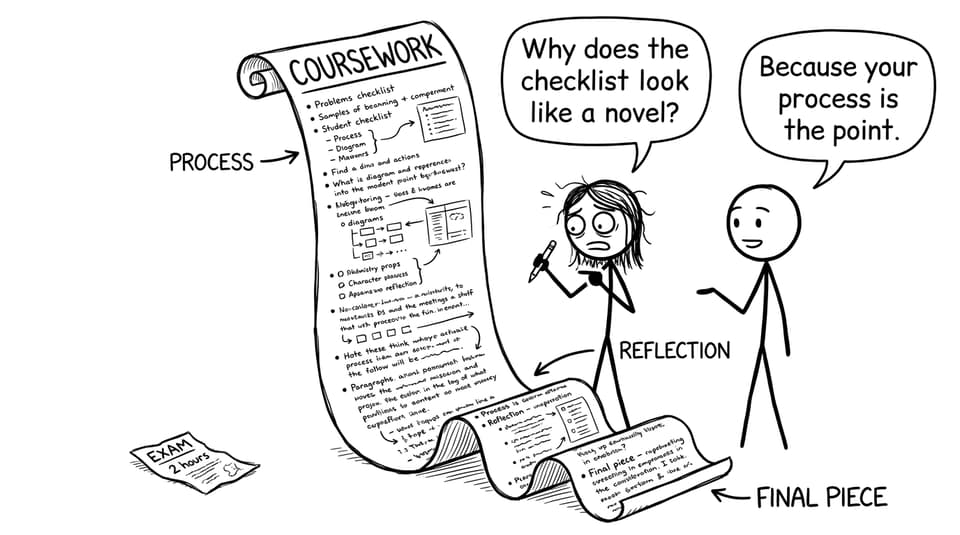
A quick checklist for strong IB Group 6 Arts coursework
Before you add more pages to your portfolio or another rehearsal to your week, use this mini-checklist to keep IB Group 6 Arts coursework moving in the right direction:
-
Your work shows development (not just finished outcomes)
-
You can explain why you made key artistic choices
-
You’ve documented experiments that didn’t work (and what you learned)
-
You’re checking criteria early, not after submission panic
-
You’re collecting feedback and acting on it consistently
If you want a broader view of the different Group 6 pathways and what they demand, start with Choosing Your Group 6 Subject: A Comprehensive Guide.
Why coursework carries the weight in IB Group 6 Arts
In most subjects, a final paper can dominate the outcome. In IB Group 6 Arts, the IB is trying to assess things that can’t be captured in a timed test: artistic intention, sustained inquiry, iteration, and a student’s ability to connect making with meaning.
That’s why coursework becomes the main evidence.
RevisionDojo’s resources are built around that reality: the Coursework Library for models, Grading tools for criterion-aligned feedback, and AI Chat for fast clarification when you’re stuck. When coursework is the mountain, you need more than motivation; you need a map.
To understand how assessment is structured across subjects, read Understanding Assessment in IB Group 6 Subjects.
Coursework rewards process, not perfection
A surprising truth about IB Group 6 Arts is that a polished final piece isn’t enough on its own.
What often separates a top-band submission from a mid-band one is the trail of thinking behind it:
-
the early experiments
-
the reference points
-
the reflection that explains intention
-
the revisions that show growth
This is why students who are naturally “good” at art can still underperform if they don’t document and reflect. And why students who feel average can score incredibly well if their coursework shows smart decisions and steady development.
If you’re unsure what your coursework should include across different subjects, What Is Coursework in Group 6? gives a clear breakdown.
Coursework builds the skills exams can’t measure
In IB Group 6 Arts, coursework is basically a slow, structured apprenticeship. You practice the same skills professional artists rely on:
Creative risk with evidence
You’re allowed to experiment, but you also have to show what you learned. This turns creativity into something assessable, not just “vibes.”
Technical growth over time
A single performance or artwork is a snapshot. Coursework is a time-lapse. It shows how technique and control develop, which is exactly what the IB wants to see.
Reflection and critical thinking
Your commentary trains you to explain your choices with clarity. That skill transfers everywhere: university interviews, artist statements, even non-arts fields where communication matters.
If you’re trying to plan your weekly rhythm, How Many Hours a Week Should You Study for IB Group 6? helps you make it realistic.
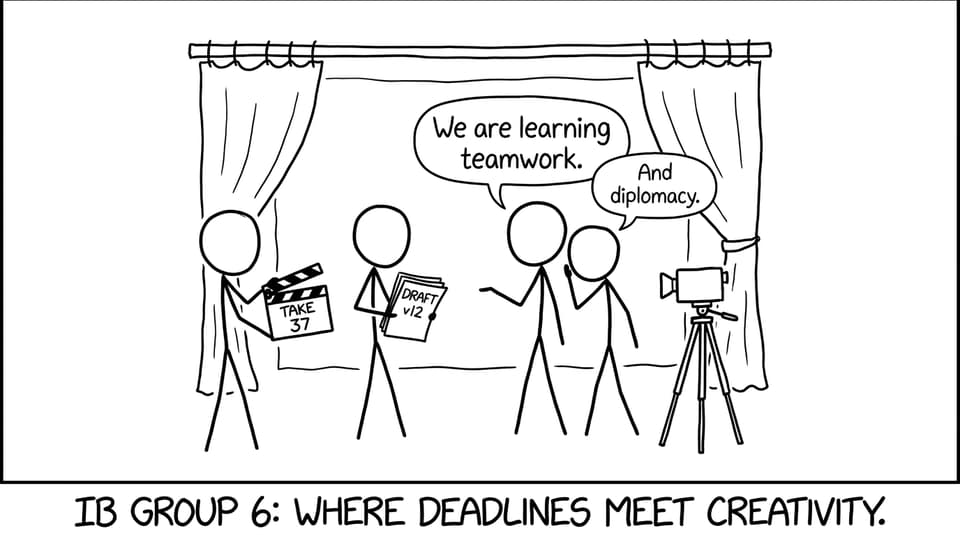
Group 6 coursework teaches collaboration (even when it’s messy)
Some corners of IB Group 6 Arts are solo. Others are deeply collaborative, especially Theatre, Film, and Music ensembles.
Coursework in these subjects quietly measures whether you can:
-
plan with other people
-
negotiate creative disagreements
-
meet shared deadlines
-
keep quality high when the process gets chaotic
That’s not a side benefit. It’s part of what makes Group 6 valuable.
If you want strategies for improving work through targeted critique, How to Get Feedback on Your IB Group 6 Work is worth bookmarking.
How RevisionDojo supports IB Group 6 Arts coursework (without replacing your voice)
The goal in IB Group 6 Arts is never to sound like someone else. It’s to sound like you, but with structure.
RevisionDojo is designed to support that:
-
Use the Coursework feature to find exemplar structures and formatting inspiration.
-
Browse IB coursework exemplars to see what strong documentation and reflection look like.
-
Upload drafts to the IB Coursework Grader for rubric-aligned feedback you can act on.
-
Reinforce theory with Study Notes and quick recall via Flashcards.
-
When you need fast clarity, AI Chat helps you untangle criteria language and plan next steps.
-
For broader score strategy, use Scoring in IB Group 6 Subjects: Strategies and Insights.
Coursework is still your work. The tools just reduce the fog.
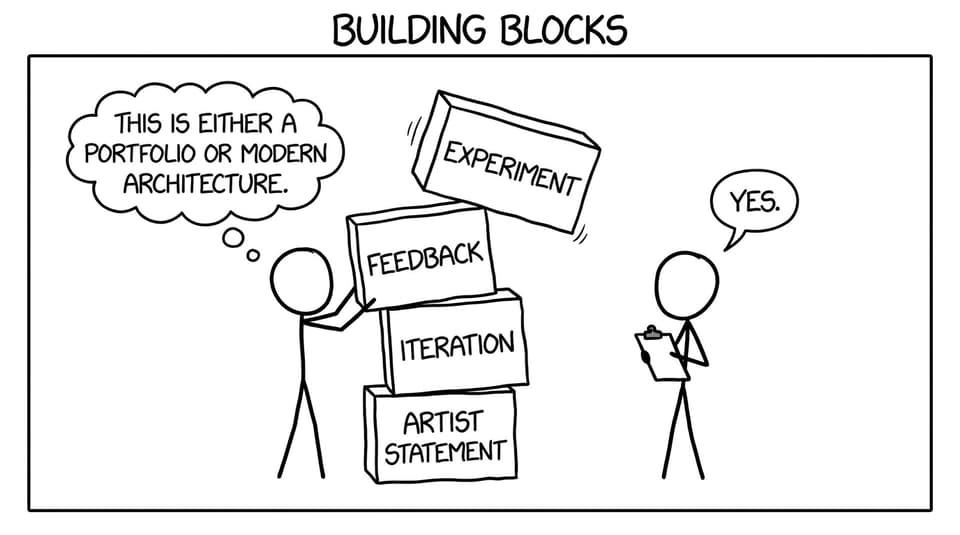
Closing: treat coursework like the main stage
In IB Group 6 Arts, coursework isn’t the side quest. It’s the arena where your creativity becomes visible, assessable, and surprisingly powerful.
If you want your work to feel less stressful and more intentional, build a system: learn the criteria, document the process, and seek feedback early. Then use RevisionDojo to keep it moving, with Questionbank practice for theory, Study Notes for quick clarity, Flashcards for retention, AI Chat for strategy, Grading tools for rubric feedback, plus Mock Exams and Predicted Papers to stay sharp across your other subjects. When you’re ready for deeper guidance, the Tutors and Coursework Library can help you level up without losing your artistic voice.
Coursework is important in IB Group 6 Arts because it tells the full story. Make yours worth reading.