



When the timetable form lands on your desk, it rarely feels like a neutral document. It feels like a forecast. A quiet prediction about who you will be in two years, what you will be good at, and what will cost you sleep.
That’s why Subject Selection becomes strangely emotional in the IB. You’re not only choosing content. You’re choosing competition.
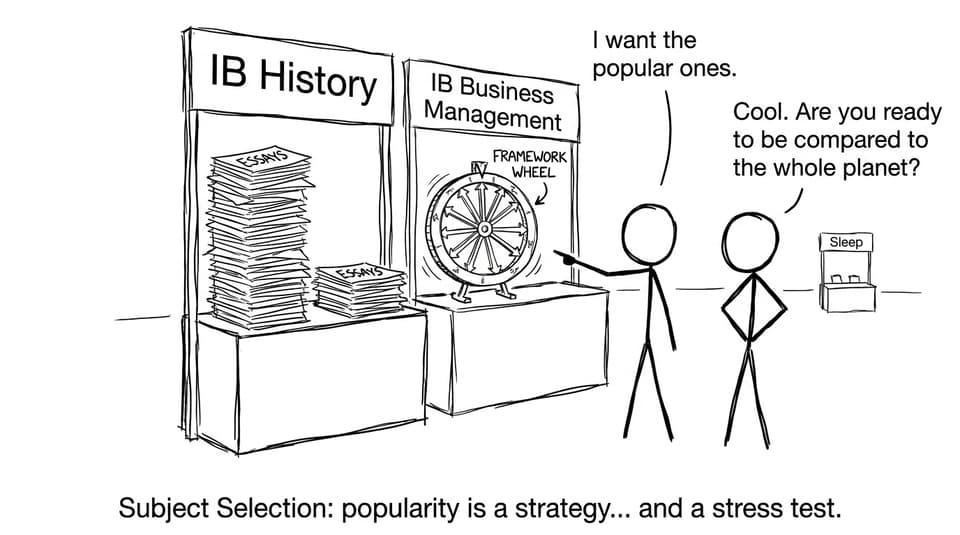
And in that competition, two subjects keep showing up at the top of the list: IB History and IB Business Management. They’re popular for real reasons: familiarity, practicality, and the promise that hard work will translate into marks. But popularity also changes the game. In big global cohorts, generic answers get filtered out quickly. The students who win are rarely the ones who “know the most.” They’re the ones who answer with the most precision.
Quick checklist for smarter Subject Selection
Use this as a fast way to sanity-check your Subject Selection if you’re leaning toward History or Business Management:
-
Do you genuinely enjoy arguing a case in writing?
-
Are you willing to practice under timed conditions (not just read notes)?
-
Can you handle tight mark schemes where structure matters as much as content?
-
Will you build a feedback loop: practice, fix, repeat?
-
Have you got the right tools for volume and quality (questions, marking, and guidance)?
RevisionDojo is built for that last part: Questionbank, Study Notes, Flashcards, AI Chat, Grading tools, Predicted Papers, Mock Exams, Coursework Library, and Tutors that help you improve with intent rather than hope.
Why Subject Selection often favors IB History
A lot of students pick History because it feels like a continuation of something they already know. You’ve probably studied wars, revolutions, conflicts, diplomacy, leaders. The vocabulary is familiar. The format is familiar too: essays, sources, arguments.
But the deeper reason History wins in Subject Selection is that it rewards students who like thinking in public. History is a subject where your brain is visible on the page. A strong answer isn’t a pile of facts; it’s a claim, supported by carefully chosen evidence, with evaluation built in.
Here’s the trap: many students write History like storytelling. They describe events in chronological order and hope the examiner “gets it.” In a smaller cohort, you might get away with that. In a huge cohort, you won’t.
What IB History actually rewards is closer to legal reasoning:
-
A thesis that answers the exact question
-
Evidence selected because it proves that thesis (not because it’s interesting)
-
Perspective and evaluation (why this interpretation, why this source, why this factor?)
-
A conclusion that closes the loop back to the prompt
If you want a focused pathway for exam prep, use the IB History resources hub alongside the IB History exam preparation guide. And when you need a weekly system rather than random revision, the best study techniques for IB History HL gives a realistic routine you can actually follow.
Why Subject Selection also gravitates toward IB Business Management
Business Management is popular for a different kind of comfort. It’s practical. It’s readable. It feels close to real life: motivation, leadership, marketing, finance, operations.
For Subject Selection, Business Management often looks “safe” because:
-
The syllabus feels structured and learnable
-
Many concepts are intuitive (you’ve seen businesses your whole life)
-
Case studies make revision feel concrete
-
The subject supports common future pathways (business, economics, entrepreneurship)
And yet, the same popularity brings the same pressure. Examiners read thousands of answers that begin with the same definitions and the same frameworks.
Frameworks are not the problem. Unapplied frameworks are.
In Business Management, top marks come from application and judgement: using tools like SWOT, Ansoff, or investment appraisal to say something specific about this business, this context, this decision.
RevisionDojo makes that precision easier because you can move fast between learning and doing: start on the IB Business Management resources hub, then tighten your weak areas with targeted topics like 3.8 Investment Appraisal. For coursework confidence (which frees up exam brain-space), the Business Management IA guide is a calm step-by-step map.

How popularity changes grading in both subjects
When a subject has a large cohort, a few things happen quietly:
-
Examiners become faster at spotting vague writing
-
“Well-known” points stop being impressive on their own
-
Structure becomes a mark-making skill, not a cosmetic one
-
Evaluation becomes the separator between 5 and 7
In other words, popularity raises the standard of what counts as “good.”
This matters for Subject Selection because students sometimes choose popular subjects thinking they’ll be easier. What actually happens is subtler: the content might feel accessible, but the marking is less forgiving.
A useful reality-check is to look at mark trends and expectations. For Business Management, you can anchor your goals using the IB Business Management grade boundaries. Not to scare yourself, but to treat your preparation like training, not wishing.
The common mistakes that keep students average
History and Business Management have different content, but they punish the same habits.
In IB History
-
Writing long introductions that don’t answer the question
-
Dropping facts without explaining their significance
-
Ignoring command terms (evaluate, compare, to what extent)
-
Using “balance” as a substitute for judgement
In IB Business Management
-
Memorising definitions without linking to the case
-
Naming a tool but not using it to produce insight
-
Forgetting stakeholders, constraints, and assumptions
-
Ending with no real recommendation (or a recommendation with no trade-offs)
In both subjects, the biggest mistake is confusing effort with evidence. A long answer is not automatically a high-scoring answer.
What top students do differently (and how to copy it)
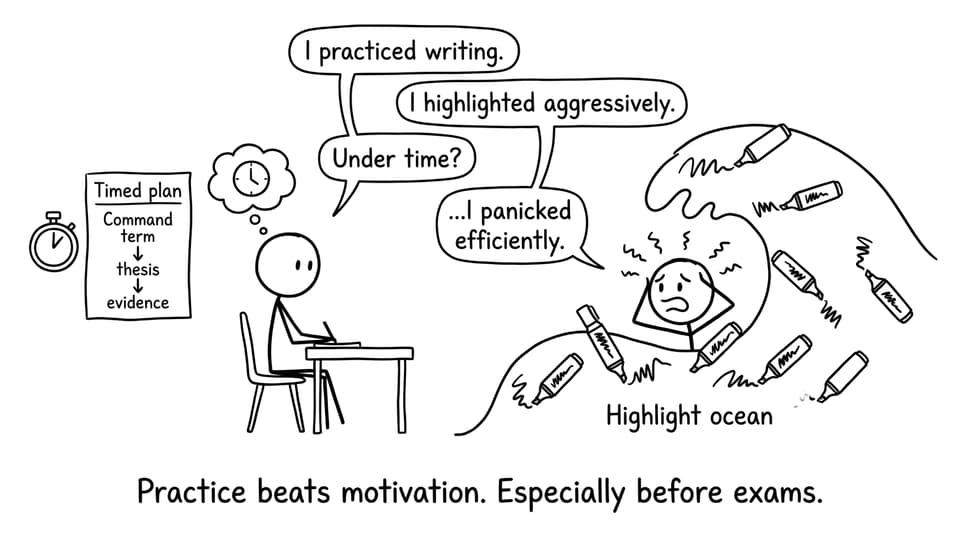
High scorers make a simple shift: they treat writing like a performance skill. They practice it under the same constraints they’ll face in the exam.
That’s where RevisionDojo’s ecosystem fits naturally:
-
Use Study Notes to get clear on a topic quickly
-
Drill weak points with the Questionbank
-
Convert recurring errors into daily Flashcards using the flashcards feature and the IB Flashcards SRS page
-
Use AI Chat to get unstuck without losing an hour to confusion
-
Run Mock Exams for pacing and stamina
-
Use Grading tools to learn what earns marks, not what feels impressive
-
Add Predicted Papers for realistic full-paper rehearsal, such as Business Management predicted papers
If you want the big-picture workflow, keep the RevisionDojo app overview for IB exam prep bookmarked. It’s basically a blueprint for turning revision into results.
Closing: make Subject Selection, then make your strategy
IB History and IB Business Management are popular because they feel learnable and meaningful. They’re also popular because they reward a certain kind of student: someone who can think clearly, write with structure, and stay specific under pressure.
If your Subject Selection includes one of these subjects, don’t just choose it. Choose a system.
Open the right RevisionDojo hub, practice with the Questionbank, rehearse with Mock Exams and Predicted Papers, tighten memory with Flashcards, and use AI Chat, Tutors, and Grading tools to keep improving when motivation dips. In the most popular subjects, that disciplined loop is what turns you from “one of many” into “hard to ignore.”