




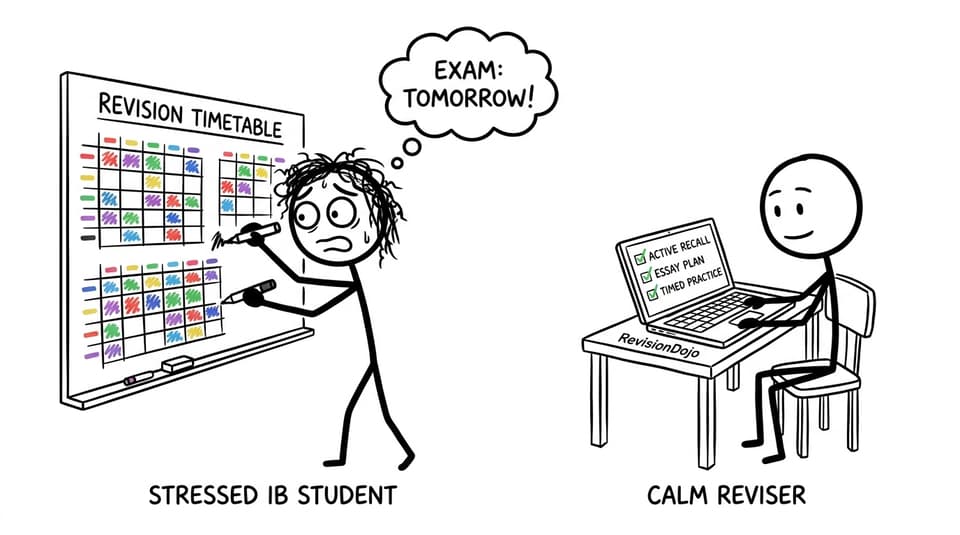
If you have ever spent a full evening rereading notes for IB History, you already know the problem: you can feel busy without getting better.
The course rewards something rarer than effort: precision. Precision about what the examiner wants. Precision about the evidence you can actually deploy under time pressure. Precision about which mistakes you keep repeating.
This is why the best IB History HL students do not “revise more.” They revise in loops: recall, write, review, repair, repeat. Below are the study techniques that make those loops work, plus the simplest way to build them with RevisionDojo.
The IB History HL reality check (what you are training for)
IB History HL asks you to perform across three exam papers and the internal assessment.
-
Paper 1: source-based analysis (1 hour)
-
Paper 2: thematic essays (1.5 hours)
-
Paper 3: in-depth regional essays (2.5 hours, HL only)
-
IA: a 2,200-word historical investigation
That means HL students are effectively training two muscles at once: fast, source-driven judgment (Paper 1) and slow, structured argument (Papers 2 and 3). If your study method does not practice both, your grade will wobble.
For a broader overview of the course and expectations, start with Understanding IB History: A Comprehensive Guide.
A simple checklist: the “study smarter” loop for IB History
Use this as your default weekly workflow for IB History:
-
Learn one subtopic quickly (Study Notes)
-
Test it immediately (exam-style questions)
-
Convert misses into flashcards (active recall + spacing)
-
Write one timed plan or paragraph (argument practice)
-
Get feedback (marking and targeted fixes)
RevisionDojo supports this loop end-to-end through its Study Notes, Questionbank, Flashcards, AI Chat, Grading tools, Predicted Papers, Mock Exams, Coursework Library, and Tutors. You can explore the subject hub here: IB History resources on RevisionDojo.
Active recall for IB History: stop “reviewing,” start retrieving
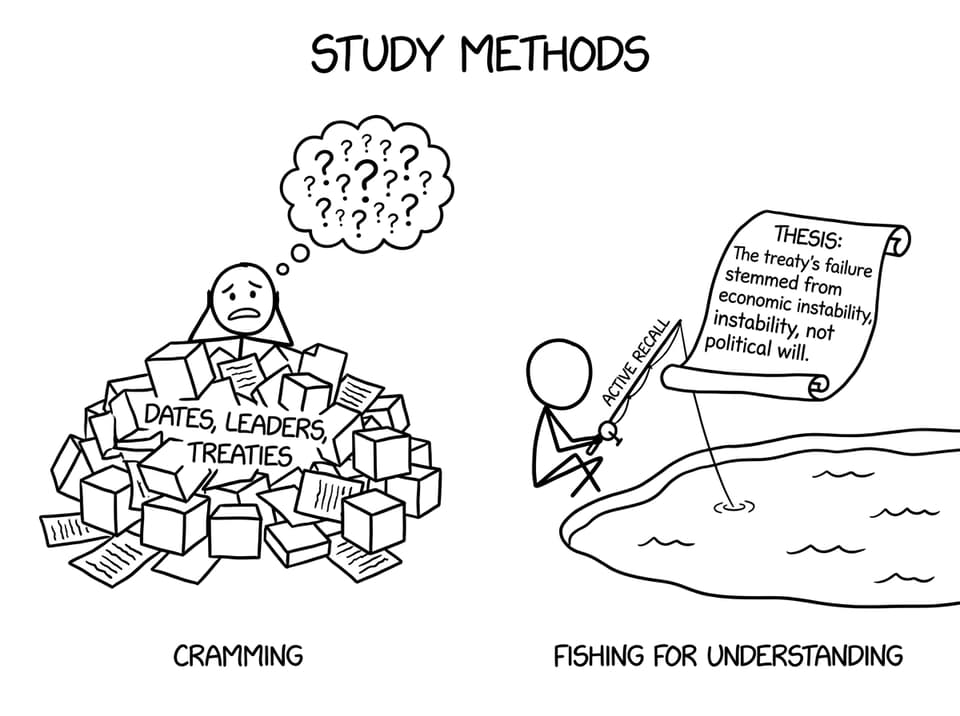
The fastest way to improve in IB History is to stop confusing recognition with mastery. When you reread, your brain says “I have seen this before.” In an exam, the question is harsher: “Can you produce it, with analysis, right now?”
Active recall forces that production.
How to do active recall (History HL edition)
-
Turn each subtopic into questions: “What were the main causes?” “Which factor mattered most?” “What is the best counterargument?”
-
Build evidence cards, not just definition cards: one event/date/statistic per card, plus what it proves
-
Do 60-second “thesis drills”: answer a Paper 2-style prompt with a one-sentence argument and 3 supporting points
RevisionDojo makes this easier with IB Flashcards with Spaced Repetition (SRS) and its dedicated Flashcards feature page, so your recall practice stays short, frequent, and targeted.
Spaced repetition for IB History: make facts show up before you forget them
IB History has a quiet tax: you need enough factual control that you can spend your limited exam time on evaluation, not searching your memory for names and dates.
Spaced repetition pays that tax efficiently. It schedules reviews so you see material right before it fades, which beats last-minute cramming.
What to space (and what not to)
-
Space: key evidence, turning points, treaties, leaders, definitions, historian claims
-
Do not space: full essays. Instead, space essay plans, thesis statements, and paragraph frames
If you want a clear explanation of how spacing works and how to structure it, read Spaced Repetition for IB: Scientific Study Method.
Timelines and “turning points”: chronological clarity without drowning in dates
Many IB History essays collapse because the student can explain events but cannot control sequence. A strong timeline is not a museum display. It is a tool for causation.
Build timelines that actually help your essays
-
Create one timeline per topic, but label each event with the role it plays: “trigger,” “long-term cause,” “turning point,” “consequence,” “continuity”
-
Add one line for domestic factors and one for international context
-
Practice turning timelines into arguments: “Why is 19XX a turning point?”
Pair this with a broader study system from 10 Proven Study Techniques for IB Students.
Thematic essay planning: how to make Paper 2 and Paper 3 feel predictable
In IB History HL, high marks come from structure that makes your thinking easy to follow. Theme-based planning does that.
A practical thematic template
For each theme (authoritarian leaders, causes of war, civil rights, independence movements):
-
3 arguments you could defend under many prompts
-
6-9 pieces of evidence total (not 40)
-
2 historian perspectives you can integrate naturally
-
1 comparison pair (two states/regions) to unlock “compare” and “contrast” questions
Then, practice writing plans under time pressure. A good plan is a promise you can keep.
If you want paper-specific technique, use:
Historiography: the simplest way to sound like a top-band student
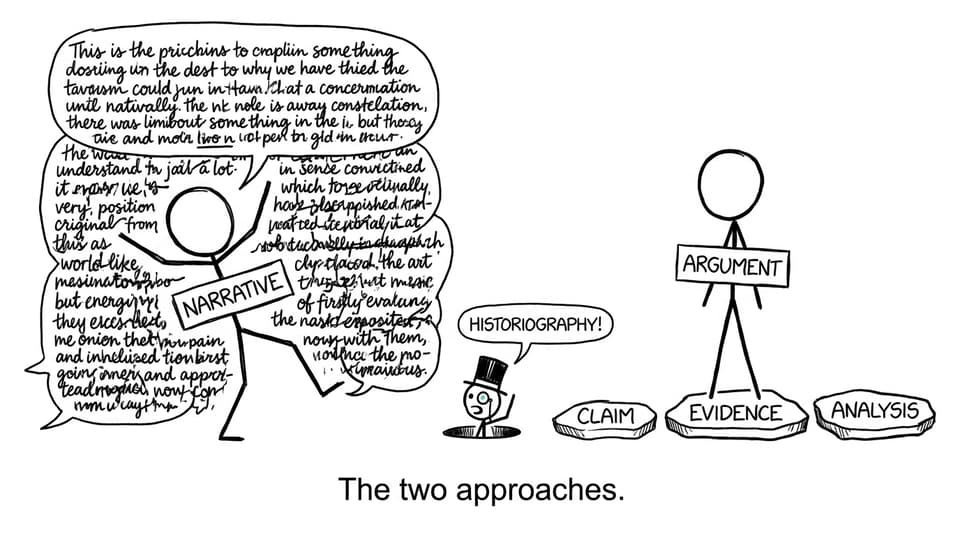
Historiography in IB History is not decoration. It is a way to show you understand that history is argued, not merely reported.
How to use historians without forcing it
-
Learn 2-3 contrasting views per major issue (intentionality vs structural explanations, for example)
-
Use them as moves in your argument: “This supports,” “This challenges,” “This reframes the cause,” “This changes significance”
-
Keep quotes short. Paraphrase clearly. The point is interpretation, not memorized lines
Your goal is to treat historians like sources in a debate: useful voices, not sacred texts.
Practice like it is the exam: Questionbank + feedback + repair
The sharpest IB History study technique is also the least glamorous: consistent exam-style practice, followed by disciplined review.
On RevisionDojo you can train directly in the format you will face:
-
Use the USA IB History Questionbank for topic-linked practice
-
Drill Paper 1-style skills with a focused set like Japanese expansion in East Asia (Paper 1) Questionbank
-
Build depth with Paper 2 structures via IB History Paper 2 hub
Then close the loop:
-
Convert your most common misses into Flashcards
-
Ask AI Chat one targeted question (“What would a counterargument look like here?”)
-
Use Grading tools to get feedback on essays and paragraphs
For a bigger-picture look at how top scorers structure revision, see How 45-Point IB Students Prepare for Exams.
Internal assessment (IA): treat it like training, not a side quest
Your IB History IA is a 2,200-word investigation, but it is also rehearsal for the exam skill of evaluation.
IA habits that reduce stress later
-
Choose a narrow question with sources you can actually access
-
Practice OPVL early (origin, purpose, value, limitations)
-
Keep an “argument spine” document: thesis, 3 claims, best evidence, best limitations
RevisionDojo’s Coursework Library and Tutors are built for moments when your IA feels like it is expanding faster than your time.
Conclusion: make IB History feel lighter by making it sharper
The hidden lesson of IB History HL is that effort is not the scarce resource, clarity is. When your revision is built on active recall, spaced repetition, themed planning, and feedback-driven practice, you stop carrying the subject around in your head all day. You start handling it in short, repeatable sessions that compound.
If you want one place to run the full IB History loop, Questionbank, Study Notes, Flashcards, AI Chat, Grading tools, Predicted Papers, Mock Exams, Coursework Library, and Tutors, start here: RevisionDojo IB History.