
Interpolation feels like the polite version of guessing. You stay between two known points, you don’t wander into the unknown, and your calculator gives you a clean number with a lot of decimals.
But in Math HL, the exam isn’t really asking, “Can you estimate?” It’s asking, “Do you understand what you’re allowed to assume?” In other words: interpolation can be valid, but it’s never automatic.
What interpolation means in Math HL (and what it quietly assumes)
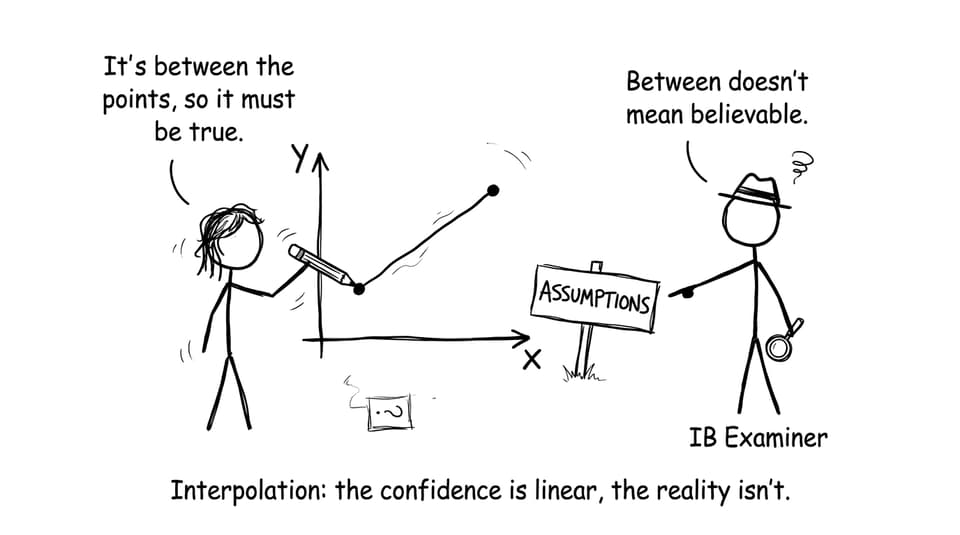
Interpolation is estimating a value between two observed data points. In Math HL, this shows up in statistics, modelling, cumulative frequency, regressions, and any situation where the question wants an “estimate” rather than an exact result.
The hidden assumption is the important part: you are assuming the behaviour between those two points is smooth enough that an intermediate value makes sense.
If the context supports gradual change, interpolation is usually acceptable. If the context suggests jumps, caps, thresholds, or discrete steps, interpolation can become misleading even though the x-value is “inside the data range.”
For topic-by-topic practice that builds this judgement, the IB Mathematics Applications & Interpretation Resources hub is a good starting point.
Quick checklist: When interpolation is valid in IB questions
Before you interpolate in Math HL, run this quick mental check:
-
Is the input inside the data range? (If not, it’s extrapolation, and risk increases.)
-
Does the graph or table look smooth between points?
-
Would intermediate values make sense in context? (Could the real-world quantity be “halfway”?)
-
Are you assuming linear change, or just local smoothness?
-
Can you justify your estimate in one sentence?
That last bullet is where marks often live.
When interpolation is usually valid in Math HL
Interpolation tends to be valid when the story of the data suggests continuity and gradual movement.
Common Math HL-friendly contexts include:
-
Temperature changes over short intervals
-
Constant-speed or steadily changing motion (over small time windows)
-
Population trends that change gradually
-
Financial growth where compounding is steady and the time gap is small
-
Smooth curves on cumulative frequency graphs where an estimate is expected
A good way to train this instinct is to practise with exam-style prompts that force you to explain your choice. RevisionDojo’s Functions - IB Questionbank is useful here because the questions repeatedly mix calculation with interpretation.
When interpolation is not valid (even inside the range)
The “inside the range” idea is comforting, but Math HL questions often punish comfort.
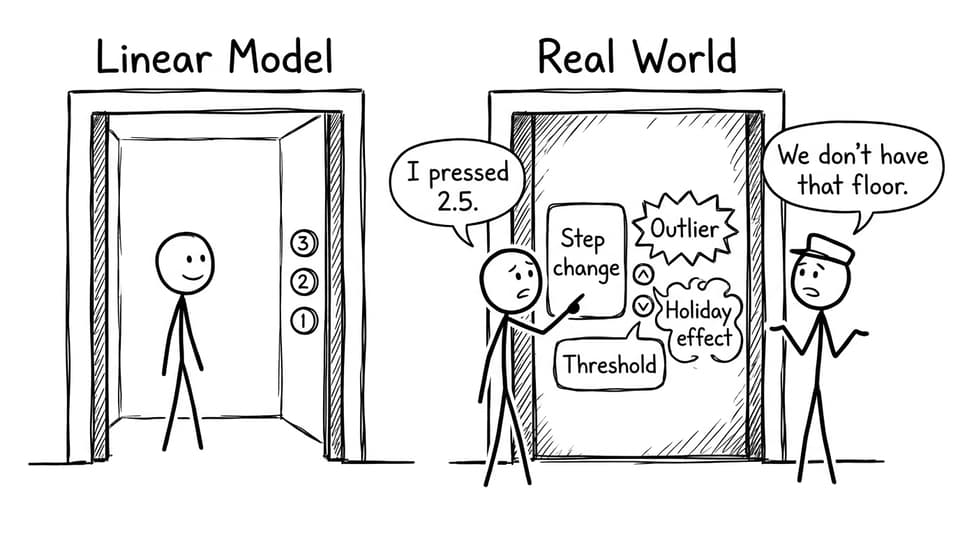
Interpolation becomes unreliable when the behaviour between points might be irregular or discontinuous, such as:
-
Step changes (prices that jump on specific dates, tariffs, subscription tiers)
-
Threshold effects (a reaction starts only above a certain temperature)
-
Caps/floors (maximum capacity, minimum wage bands)
-
Discrete outcomes treated as continuous (number of students, number of goals)
-
Sudden events between measurements (storms, policy changes, system failures)
If the context suggests “you either cross the line or you don’t,” then an in-between value may not correspond to reality.
What examiners want you to write (the one-sentence upgrade)
Most lost marks in Math HL interpolation questions come from silence: students compute an estimate and move on.
When interpretation marks are available, add one sentence like:
-
“This is an interpolation, so the estimate is reasonable because it lies within the observed range and the trend appears smooth.”
-
“This estimate assumes the relationship is approximately linear between the two nearest data points.”
-
“The value should be treated as approximate because real behaviour between measurements may vary.”
If you want to see the same thinking applied to the more dangerous cousin, read Why Extrapolation in Regression Carries Extra Risk.
How to practise interpolation like an exam skill
Interpolation is less about cleverness and more about repetition under realistic prompts.
A strong RevisionDojo loop for Math HL:
-
Use Study Notes | RevisionDojo to review the modelling assumptions you keep forgetting.
-
Drill targeted questions in the Calculus Questionbank - IB or your relevant topic bank.
-
Use How to Use the Questionbank for Targeted Math Revision to turn mistakes into a plan.
-
Ask AI Chat to critique your justification sentence (not just your number).
-
Convert your most common traps into Flashcards so the warning signs become automatic.
Closing: Treat interpolation like a claim you must earn
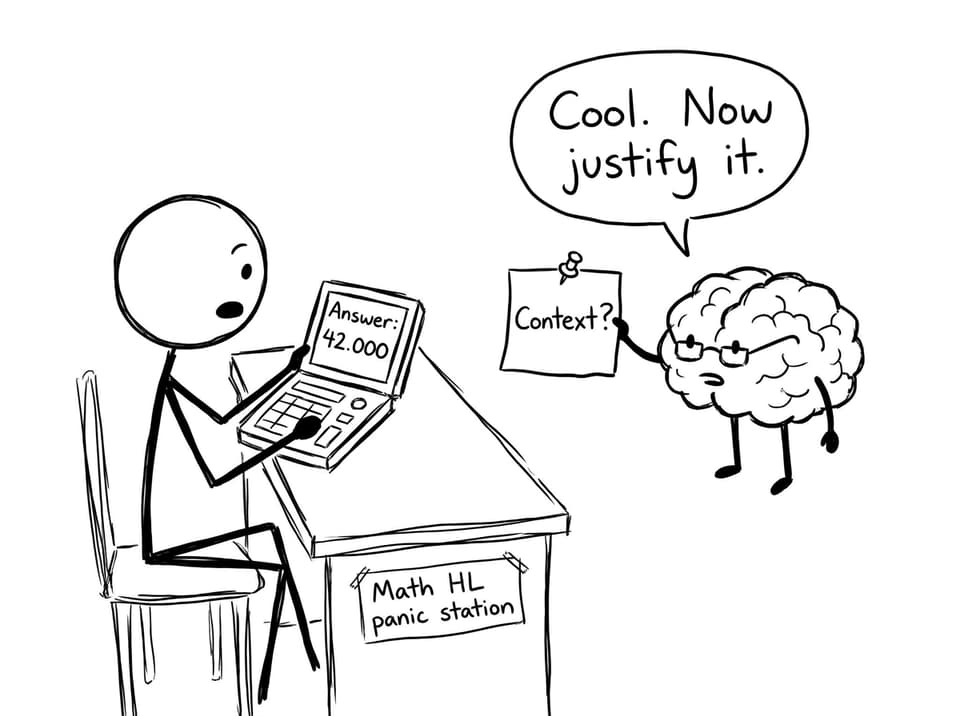
In Math HL, interpolation is valid when the context supports smooth change and when intermediate values actually mean something. Your calculator can produce a crisp number either way, but IB marks go to the student who notices the assumptions and says so calmly.
If you want to make that judgement automatic, use RevisionDojo as your training ground: sharpen concepts with Study Notes, pressure-test them in the Questionbank, build confidence with Predicted Papers and Mock Exams, and get faster feedback through AI Chat, Grading tools, the Coursework Library, and Tutors. Interpolation stops feeling like guessing when you practise explaining why it’s valid.