
A small mistake that looks like confidence
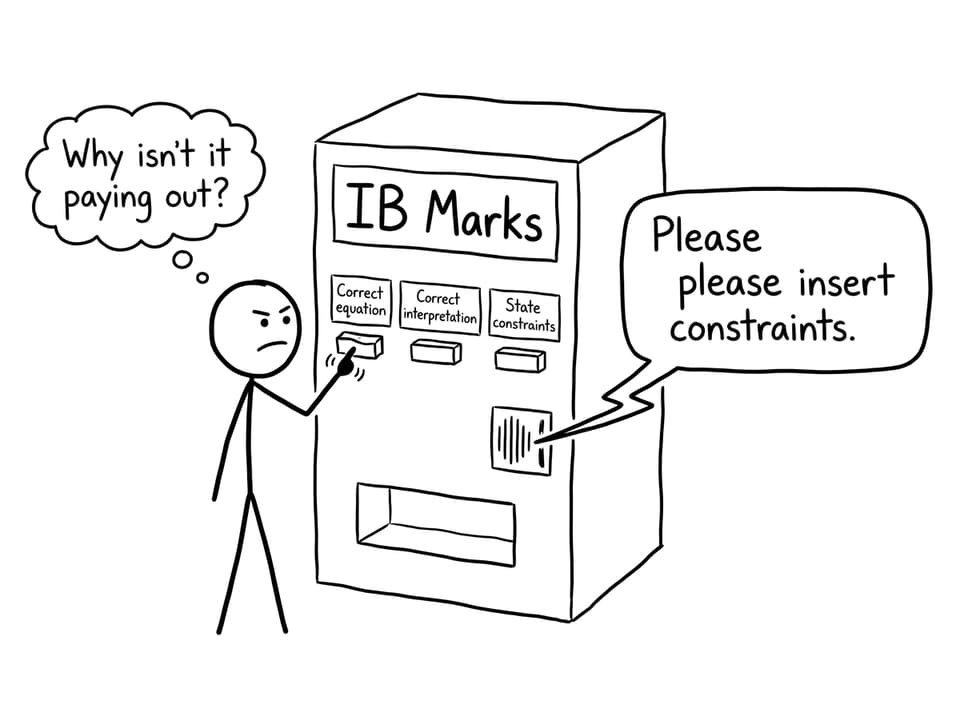
In Math HL, one of the strangest exam feelings is this: you finish a modelling question, your equation looks clean, your graph looks smooth, and your calculator agrees with everything. Then you see the markscheme later and realize you lost the interpretation marks for something you barely noticed.
It’s usually constraints.
Students ignore constraints in IB function models because constraints are quiet. They don’t shout like algebra errors. They don’t flash red like a wrong regression. They sit in the wording, politely asking you to respect reality. And in Math HL, reality is part of the maths.
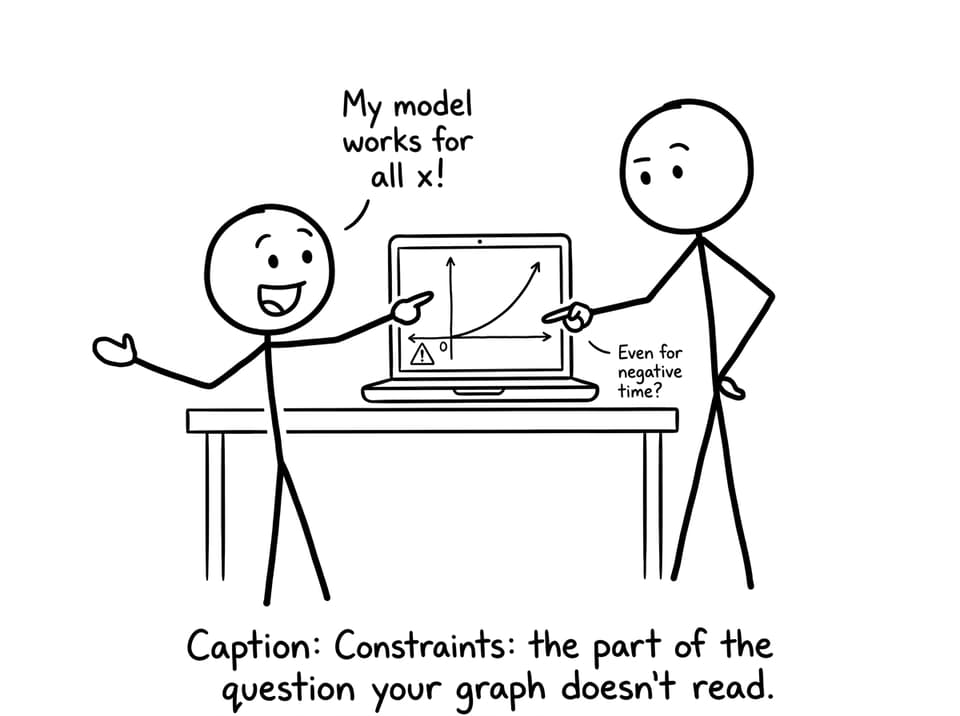
Constraint check: the 20-second habit (save marks fast)
Before you interpret any value from a function model, run this quick checklist:
-
What does the variable represent (time, length, population, money)?
-
What values are possible in context (minimum, maximum, non-negative)?
-
Is the question giving an interval explicitly (e.g., “for 0 ≤ t ≤ 12”)?
-
Does the model itself create restrictions (logarithms, denominators, square roots)?
-
Did you state the constraints in your final answer?
If you want to drill this habit with IB-style prompts, start with targeted practice in the AI Functions Questionbank or the AA Functions Questionbank.
What constraints actually are (and what IB is testing)
Constraints are the “fence” around your model: the region where the model is allowed to speak.
In Math HL, constraints usually come from four places:
-
Physical limits: length can’t be negative; capacity has a maximum.
-
Time limits: the situation starts and ends somewhere.
-
Financial limits: costs, revenue, and quantities often can’t go below zero.
-
Context rules: age ranges, maximum output, “only for the first 10 years,” etc.
IB uses constraints to check whether you understand a function model as a model. Not just a function you can manipulate.
To tighten your intuition, pair modelling questions with topic notes like HL Modelling Functions Notes (AI HL) and Modelling Functions Notes (AI SL).
Why students fixate on the equation (and forget the world)
Most students were trained for years to treat the equation as the finish line.
You do the algebra. You get the parameters. You simplify. You plot. You solve. In that mental rhythm, constraints feel like an optional footnote.
But Math HL exams reward something more adult: the ability to say, “This is mathematically possible, but contextually invalid.” That’s not extra. That is modelling.
If you feel yourself slipping into “equation-only mode,” it helps to revise functions as both graphs and stories. A good starting point is How to Master Functions and Transformations (Graphing Toolkit).
How ignoring constraints breaks interpretation (even with correct maths)
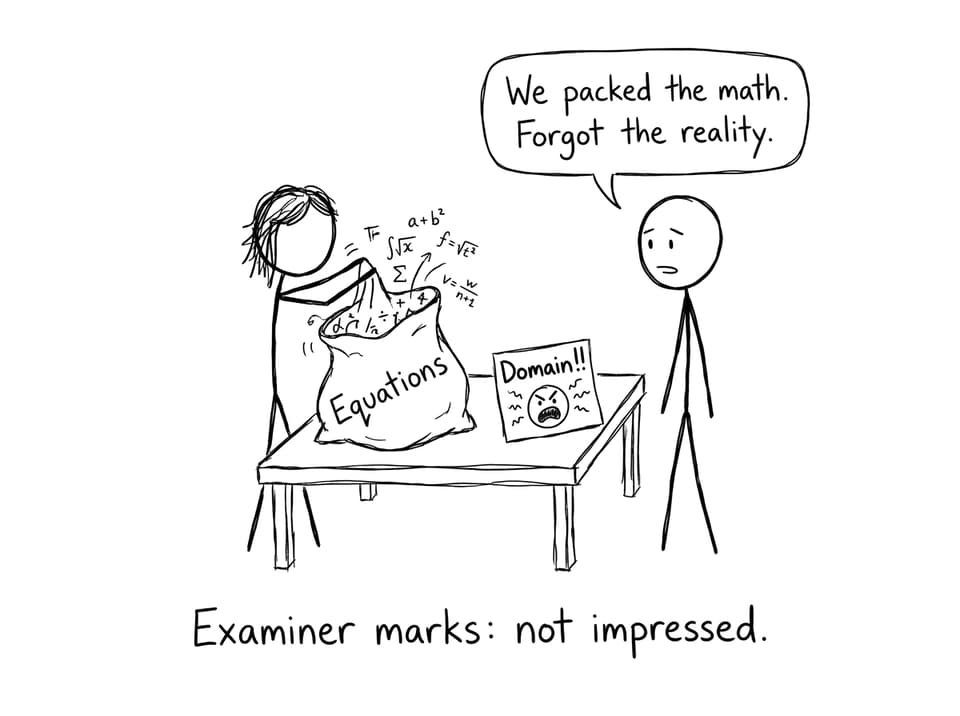
A model can be algebraically correct and still produce impossible conclusions.
-
A function might output a negative time when you solve for an intersection.
-
A regression might predict a negative population if you extrapolate too far back.
-
A logistic curve might exceed a real capacity if you use it outside the fitted range.
In Math HL, interpretation marks often depend on whether you restricted the domain and explained what it means. That’s why “valid for 0 ≤ x ≤ 20” can be worth more than another line of algebra.
For a deeper look at restrictions, read Why Is Finding the Domain of a Function So Tricky in IB Maths? and compare with Why Do Piecewise Functions Feel So Awkward in IB Maths?.
Constraints can change the model you should choose
Here’s the subtle part: constraints don’t only limit interpretation. They can decide whether your model is acceptable.
A model might fit the data well but behave badly in the realistic interval (shooting negative, exploding too fast, bending the wrong way near an endpoint). In Math HL, it’s often smarter to choose a slightly less “perfect” curve that behaves realistically under constraints.
If you’re doing this kind of thinking for your IA as well, How to Avoid Common Mistakes in IB Math IA Modeling is a solid guide.
A final thought for Math HL students
The best models in Math HL aren’t the ones that work everywhere. They’re the ones that work where the world actually exists.
If you want to stop losing marks to “invisible” errors, use RevisionDojo as your modelling training ground: Study Notes to learn the patterns, Flashcards to keep constraints top-of-mind, the Questionbank to practice under pressure, and AI Chat plus Grading tools to diagnose why an answer that looks right is still not examiner-right. Add Mock Exams and Predicted Papers when you’re close to finals, and you’ll find that constraints stop feeling like traps and start feeling like clarity.