

Math HL: why the chain rule keeps stealing marks
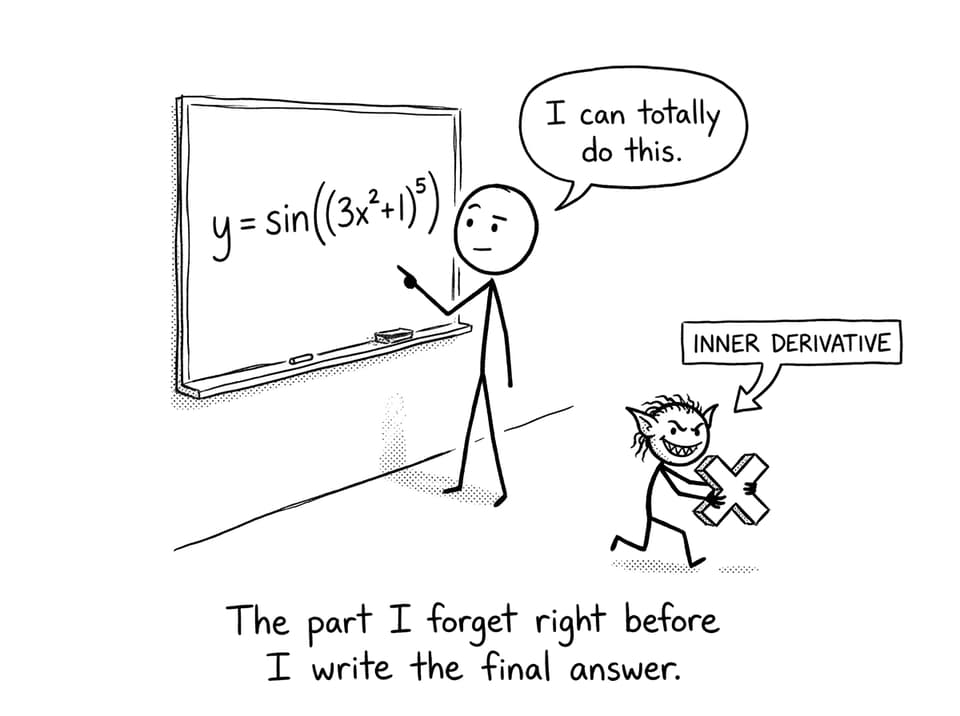
There’s a specific kind of frustration you only feel in Math HL: you finish a differentiation question, everything looks tidy, and then the markscheme quietly disagrees because one small piece is missing. Not a wild algebra slip. Not a misunderstood concept. Just one forgotten factor that turns a correct-looking method into an incorrect rate of change.
That’s why the chain rule causes so many mistakes in IB Maths. It’s not “hard calculus.” It’s the moment where structure matters more than speed. The IB uses the chain rule to test whether you can see a function inside a function, and whether you respect the layers long enough to differentiate them properly.
A quick chain rule checklist (the 20-second habit)
Before you differentiate anything composite in Math HL, pause and run this micro-checklist:
-
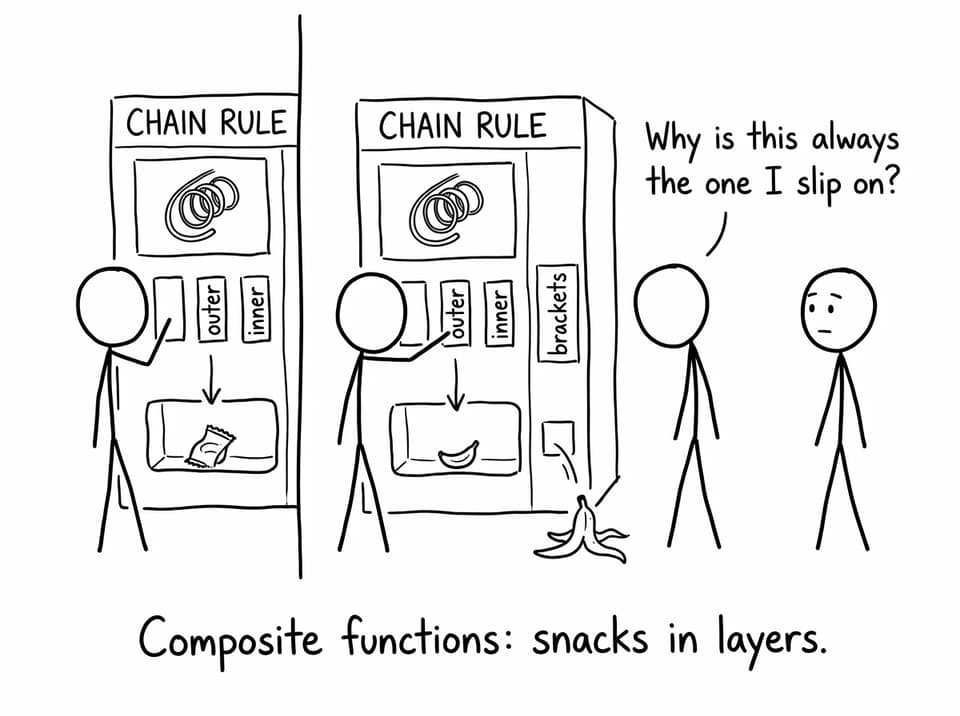
Identify the outer function (what operation is happening last?).
-
Identify the inner function (what sits inside?).
-
Differentiate the outer, keep the inside unchanged.
-
Multiply by the derivative of the inner.
-
Scan brackets and powers again: did you differentiate the correct “thing”?
If you want targeted practice on exactly these question types, start with RevisionDojo’s IB Math AA Calculus hub and then drill the Calculus Questionbank.
What the chain rule is really doing in Math HL
In Math HL, the chain rule isn’t just a formula to memorise. It’s a way to track how change moves through layers.
If a function transforms your input in steps, differentiation has to follow those steps. That’s why IB loves composite forms: trigonometric functions wrapped around polynomials, exponentials wrapped around brackets, powers wrapped around expressions.
RevisionDojo breaks these into layers cleanly inside its Chain rule (more complex composites) topic, and the difference is psychological as much as mathematical: once you label layers, the work stops feeling like guessing.
Why students forget the inner derivative
The most common chain rule mistake in Math HL is painfully consistent: you differentiate the outer function correctly, then stop.
This usually happens for three reasons:
You’re rewarding yourself too early
Your brain recognises the outer pattern (“power rule,” “sin becomes cos,” “ln becomes 1 over…”) and tries to cash out the answer immediately. The inner derivative feels like an administrative detail, so it gets skipped.
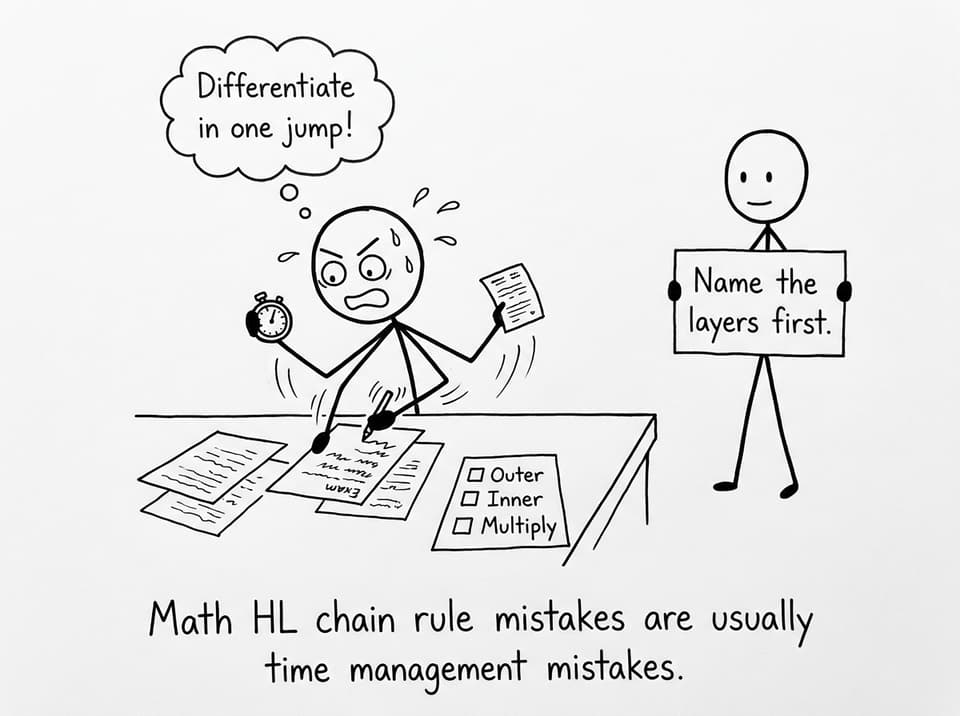
You’re compressing steps to look “efficient”
In IB marking, clarity often protects method marks. When you jump from expression to final derivative in one line, you leave no place to catch missing factors. RevisionDojo’s SL 5.6 notes on chain, product and quotient rules model the step-by-step structure IB expects.
Time pressure turns structure into a blur
Under exam conditions, composite functions look like long strings rather than nested objects. That’s when the inner derivative vanishes.
The “hidden chain rule” traps IB uses
In Math HL, the chain rule often isn’t announced. It’s disguised.
Powers hiding brackets
Example pattern: ((3x^2+1)^5). The outer layer is “raise to the power 5,” not “differentiate each term inside.”
Trig, logs, and exponentials that look familiar
(\sin(\text{something})), (e^{\text{something}}), (\ln(\text{something})). The outside derivative is easy. The inside is where marks disappear.
Implicit differentiation and related rates
As soon as (y) is a function of (x), the chain rule becomes a reflex: (\frac{d}{dx}(y^2)=2y\frac{dy}{dx}). If implicit differentiation feels confusing, connect it back to chain rule thinking using Implicit functions, related rates, optimisation notes and the Implicit Differentiation hub.
The bracket problem (why notation quietly matters)
A chain rule error is often a reading error. In Math HL, brackets are not decoration; they are the function’s boundaries.
Compare these:
-
(\sin x^2) usually means (\sin(x^2)) in IB context (chain rule needed)
-
((\sin x)^2) is different (also chain rule, but different layers)
When in doubt, rewrite the function with explicit brackets before differentiating. It’s a 3-second move that prevents 3-mark losses.
How to practise chain rule the RevisionDojo way
In Math HL, improvement is usually about repetition with feedback, not more theory. A good loop looks like this:
-
Learn the method quickly with RevisionDojo’s IB Math AA resources and the Calculus notes hub.
-
Drill exam-style items in the SL 5.6 Questionbank and the broader AA Calculus Questionbank.
-
Use RevisionDojo’s AI Chat and Grading tools to pinpoint exactly where your chain breaks (outer step, inner step, or simplification).
Then reinforce with Flashcards for trigger patterns, predicted papers for realism (without relying on forbidden shortcuts), and mock exams to rebuild calm under time.
Closing: make Math HL chain rule mistakes boring
The chain rule causes mistakes in Math HL because it’s a test of attention, not intelligence. It punishes rushing, fuzzy brackets, and the urge to differentiate “in one jump.” But it’s also one of the easiest skills to stabilise once you treat every composite function as layers.
If you want the chain rule to stop being a mark leak, build a simple routine inside RevisionDojo: learn with Study Notes, drill with the Questionbank, lock patterns with Flashcards, and use AI Chat plus Grading tools to diagnose the exact step you keep skipping. Do that for a week, and chain rule questions start to feel predictable -- almost boring. That’s the goal.