

The moment your regression line leaves the data
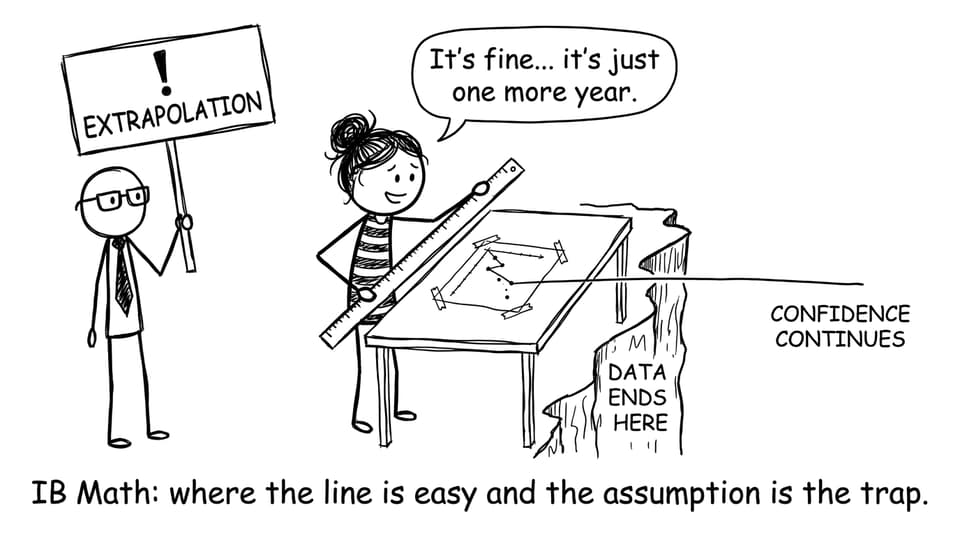
In IB Math, regression can feel like a magic trick: press a few buttons, get an equation, make a prediction. Then a question asks you to predict a value outside the data range, and suddenly the room gets quiet. That move is called extrapolation, and it carries extra risk because you’re no longer standing on evidence. You’re standing on an assumption.
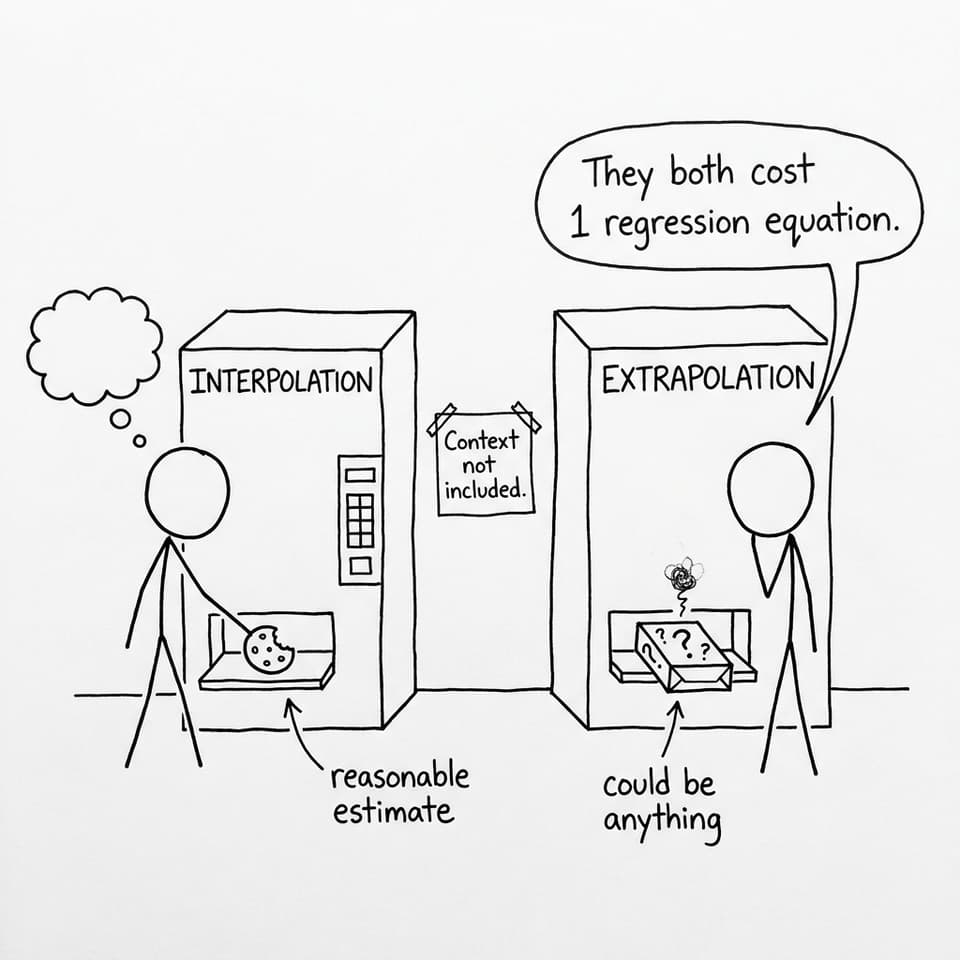
When you interpolate, you’re estimating between known points. When you extrapolate, you’re extending the model beyond where you actually observed anything. In exams, that difference matters because IB Math markers want judgement, not blind trust.
A quick IB Math checklist before you extrapolate
Before you write your conclusion, pause and run this quick checklist:
-
Are you predicting outside the observed x-values (extrapolation)?
-
Is the relationship likely to stay the same in the real context?
-
Are there limits (caps, saturation, physical constraints) the model ignores?
-
How far beyond the data are you going (slightly or wildly)?
-
Can you mention uncertainty using conditional language?
For a bigger workflow around tech + interpretation, use How to Interpret Data in IB Math AI Using Technology.
Why extrapolation in regression carries extra risk
Your model is local, not a law of nature
A regression line summarizes the trend within the data you collected. In IB Math, that line is best understood as a local description, not a permanent rule.
Extrapolation quietly assumes the relationship continues unchanged. But outside the observed range, you have no data confirming the same slope still makes sense. That’s why examiners reward students who explicitly say the prediction may be unreliable.
If you want to sharpen how you explain regression (not just calculate it), read Why Is Linear Regression Easy to Calculate but Hard to Explain in IB Maths.
Context has ceilings, floors, and turning points
Regression equations rarely “know” about reality. Populations plateau. Prices hit demand limits. Efficiency saturates. Even if a line fit the past, the future might bend.
That’s why extrapolation can be wrong for reasons that aren’t visible on the scatter plot. In IB Math, naming a plausible contextual limitation is often the difference between an average explanation and an examiner-ready one.
For a contrast with the safer case, see When Is Interpolation Actually Valid in IB Maths?.
Small errors grow as you move away
A regression line is already an estimate. The slope and intercept come with uncertainty, even if your calculator prints them neatly.
When you extrapolate, that uncertainty expands. A tiny slope error becomes a big vertical miss when x moves far beyond the original range. In IB Math, it’s smart to comment on distance from the data (slight vs far extrapolation).
Strong correlation doesn’t make extrapolation safe
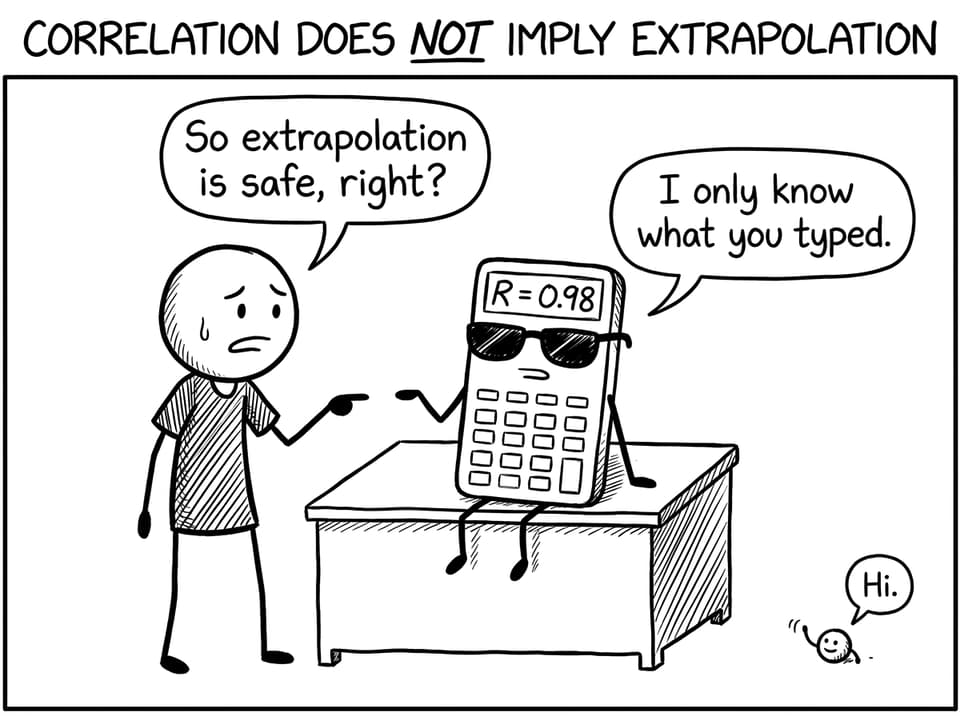
Students often think a high correlation coefficient is a “trust badge.” But correlation strength only describes how well the model matches the observed range. It does not guarantee the relationship continues outside it.
To deepen this idea, connect it with Why Do Regression Models Never Fit Perfectly in IB Maths? and Why Regression Predictions Become Less Reliable Over Time.
How to write what IB Math examiners want
In IB Math, the best phrasing is cautious and explicit. Try lines like:
-
“This is an extrapolation, so the estimate may be unreliable because there is no supporting data beyond the observed range.”
-
“The model assumes the trend continues; however, real-world constraints could cause the relationship to change.”
-
“Since the prediction is far from the data, small regression errors could lead to a large prediction error.”
Then practice on real prompts: SL 4.10 X on y Regression Line Questionbank and SL 4.4 Pearsons and scatter diagrams Questionbank.
Conclusion: treat the equation like a flashlight, not a prophecy
Extrapolation in regression carries extra risk because IB Math is really testing your judgement: do you know where the model ends and the assumptions begin?
If you want to get consistently strong at these explanations, build a routine on RevisionDojo: practice with the Questionbank, tighten concepts with Study Notes and Flashcards, ask tricky “is this valid?” questions in AI Chat, and simulate pressure with Mock Exams and Predicted Papers. When you’re ready for detailed feedback, use the Grading tools, explore the Coursework Library, or get targeted help from Tutors. In IB Math, the safest prediction is the one you know how to doubt wisely.