
Evaluating research methods IA work is not about admitting that your investigation was imperfect. It is about showing how each method shaped what you could reasonably conclude.
In the World Religions investigative study, strong evaluation connects each interview, observation, visit, or textual source to the research question. It identifies what the method revealed, what it could not reveal, how those limits affected the findings, and what a better investigation might do next. Although this analysis is most visible in Criterion D, effective evaluation begins with preliminary research and continues across all five criteria.
The investigative study is worth 30 marks and must be 1,500-1,800 words. The goal is to select the methodological decisions that materially affected your answer and evaluate them with precision.
Your research methods checklist
Before submitting, check that your investigation:
- States a focused question about religious belief, practice, or experience.
- Explains why each method suits that question.
- Distinguishes adherent testimony from scholarly interpretation.
- Identifies limitations without dismissing all the evidence.
- Explains how each limitation affects a particular finding.
- Considers bias, assumptions, contradictions, and internal diversity.
- Proposes realistic improvements or further research.
- Uses informed consent and respectful fieldwork practices.
- Follows the required headings, references, and word limit.
RevisionDojo's World Religions IA criteria guide explains the assessment structure. The central principle is connection: Criterion A creates the intellectual foundation, B turns it into a workable plan, C presents significant evidence, D evaluates that evidence, and E makes the investigation traceable.
Criterion A: Build evaluation into preliminary research
Criterion A, worth 8 marks, covers the rationale and preliminary research. You cannot judge whether a method worked unless you first establish what the investigation needed to discover.
Begin with a focused question. “How important is service in Sikhism?” is too broad for a short investigation. A more manageable question could ask how volunteers at one named gurdwara understand the relationship between sewa and participation in langar. This identifies a community, practice, and interpretive issue.
Preliminary reading should reveal what evidence is needed. Scholarship can clarify theological concepts and historical context. Religious texts may communicate normative teachings. Interviews can explore how particular adherents interpret those teachings, while observation can show how practice unfolds in one setting.
These sources are not interchangeable. A scriptural passage does not prove what every adherent does, and one interview cannot represent an entire tradition. Your rationale should explain why combining different forms of evidence is appropriate and what scope of claim those sources can support.
Use the investigative study requirements overview to check whether your proposed focus fits the task before fieldwork begins.
Criterion B: Design a focused and ethical plan
Criterion B is worth 3 marks and rewards an appropriate, clearly focused plan. Its weighting is small, but a weak plan creates problems that become visible in Criteria C and D.
Write down what each method should contribute. A semi-structured interview may reveal an adherent's understanding and motivation. Observation may document actions, language, space, or ritual sequence. Scholarship can supply concepts for interpreting fieldwork. A community publication may communicate an institutional perspective, but not necessarily every member's view.
Plan triangulation where practical. This means comparing evidence with different strengths, not collecting as much material as possible. An interview might explain why a ritual matters, observation can show how that meaning appears in practice, and scholarship can place both findings in a wider debate.
Your plan must acknowledge scale. Two interviews can provide meaningful perspectives, but they cannot establish what millions of adherents believe. The World Religions IA timeline offers a practical route from reading and planning to fieldwork, analysis, and revision.
Protect participants and research quality
Obtain informed consent before interviewing, recording, photographing, or quoting anyone. Explain the investigation's purpose, how information will be used, and whether the participant will be named or anonymized. Follow school requirements, particularly when participants are minors.
Ask permission before entering restricted areas or observing worship. Respect a participant's right not to answer, and remove identifying details wherever anonymity has been promised.
Ethics also affects evidence quality. A participant who feels uncomfortable or misrepresented may give guarded answers. Disrespectful observation can alter the practice being studied and weaken the credibility of your findings.
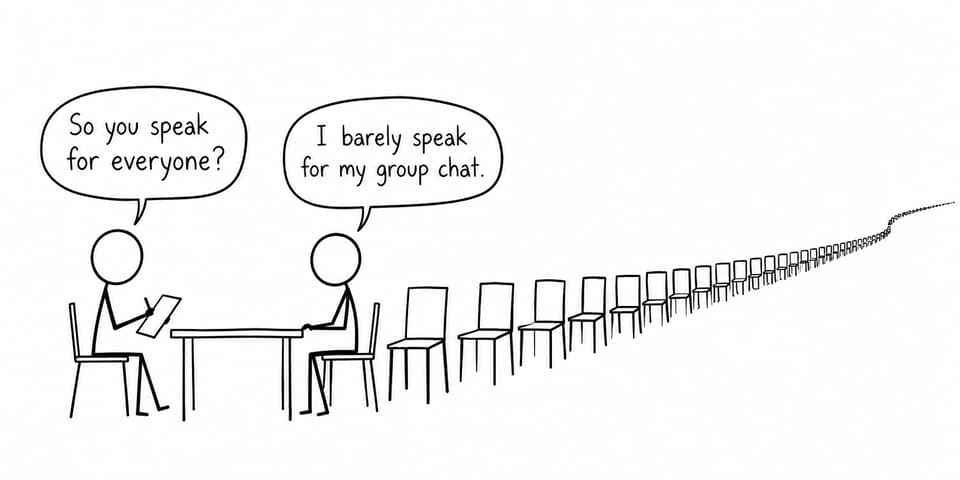
One thoughtful interview can provide depth, but it cannot speak for an entire religious community.
Criterion C: Present significant findings
Criterion C is worth 6 marks. It is not a fieldwork diary. It should summarize the findings that directly help answer your research question.
Organize evidence by idea rather than chronology. Instead of narrating a visit step by step, structure the section around findings such as religious duty, communal identity, equality, or personal transformation. Make the origin of each finding clear.
Consider this hypothetical example:
One volunteer described participation in langar as both service to others and a discipline that reduces social distinction. This interpretation was consistent with the observed sharing of tasks, although one visit could not establish whether participation operates similarly elsewhere.
This reports evidence while establishing its scope. Save detailed discussion of representativeness and observational limitations for Criterion D, but provide enough context to show where the evidence came from.
A finding is significant when it answers the question, complicates an assumption, reveals variation, or creates a useful contrast between lived experience and preliminary research. RevisionDojo's guidance on meeting Criteria A-D can help you audit these connections.
Criterion D: Evaluate what each method changed
Criterion D carries 10 marks, making critical reflection and evaluation the largest part of the assessment. This is where evaluating research methods IA work becomes more than listing generic strengths and weaknesses.
Apply this chain to every important method:
- Purpose: What was the method intended to discover?
- Strength: What evidence did it produce well?
- Limitation: What could it not establish reliably?
- Consequence: How did that limitation affect a finding?
- Improvement: What realistic change would address it?
Suppose you conducted one semi-structured interview with a community leader. A weak evaluation says, “The interview was useful, but it may have been biased.” A stronger evaluation explains that open questions produced detailed interpretations, but the participant's leadership role may have encouraged an institutional account. The evidence therefore supports conclusions about that leader's interpretation, not the community's full range of experiences. Interviewing people with different roles or levels of involvement could reveal whether the account is widely shared.
Apply the same reasoning to observation. It can record visible behaviour and context, but it cannot independently establish private motives. Your presence may affect behaviour, one event may be atypical, and unfamiliarity may cause you to miss meaningful details. Discuss the limitations that influenced your investigation, then explain their consequences.
Source-based research also requires evaluation. Ask who produced each source, for what audience, and with what authority. An official community website may communicate accepted teaching clearly, yet offer an idealized institutional account. Scholarship may provide analytical distance, but its framework may not transfer perfectly to your setting.
Strong reflection also examines the researcher. Preliminary reading may have created expectations that shaped your questions, while leading wording may have restricted a participant's response. Recognizing these effects does not destroy your argument. It demonstrates intellectual control.
The critical reflection and evaluation guide provides further prompts for turning methodological limitations into reasoned analysis.
Use contradictions as evidence
Contradictory evidence is often valuable. If published teaching emphasizes one meaning while participants offer others, do not simply decide which source is correct. Consider whether the difference reflects role, generation, culture, personal history, local practice, or the distinction between normative teaching and lived religion.
Keep your conclusion proportional. A small study may support a thoughtful conclusion about particular participants in a particular context. It rarely justifies a universal claim about a religion.
Criterion E: Make the investigation transparent
Criterion E is worth 3 marks and covers references and compliance with format. Evaluation becomes credible only when readers can trace the evidence behind it.
Use the required headings, reference borrowed ideas consistently, and provide a comprehensive reference list. Identify interview and observation evidence according to your teacher's required approach while preserving promised anonymity. Check quotations, dates, authors, and access details against the original sources.
The investigation must remain within 1,500-1,800 words. If it exceeds 1,800 words, assessment is based on the first 1,800 words and Criterion E is affected. Do not move essential reasoning into appendices. Ask your teacher to confirm what the current course instructions include in the word count.
Complete a final method audit
Read each conclusion and ask, “Which evidence permits me to say this?” Then ask, “What is the narrowest accurate version of this claim?” This catches overgeneralization quickly.
You can use the World Religions IA Grader to review your draft criterion by criterion. RevisionDojo Study Notes and AI Chat can clarify unfamiliar concepts, while the Coursework Library demonstrates effective academic structure. Grading tools create another revision checkpoint, and Tutors can help you test whether your evaluation is sufficiently specific without writing the investigation for you.
Across the wider IB, RevisionDojo also brings together Flashcards, the Questionbank, Predicted Papers, and Mock Exams. Each tool supports a different stage of learning, but all reflect one useful principle: improvement comes from finding where reasoning breaks down, not merely collecting more material. The RevisionDojo IB resource overview explains how these resources support the broader process.
A convincing World Religions IA does not pretend that its methods were flawless. It shows that the student understands their reach. When each claim remains proportional to the evidence behind it, limitation becomes insight, and evaluation becomes the investigation's strongest feature.