



You don’t notice it at first.
It starts as a small, slightly awkward moment: you’re in class, you want to say something simple in German, and your brain offers you three options, two are wrong, and one is… maybe French.
But you say it anyway.
That single decision is the hidden curriculum of IB Languages. In IB German Ab Initio, you’re not just collecting vocabulary. You’re practicing the art of communicating when you don’t feel ready yet. And that skill, quietly built over two years, leaks into everything else you do in the Diploma.
This 2025 guide breaks down what skills you’ll gain from taking IB German Ab Initio, and how to turn those skills into exam marks using RevisionDojo.
Quick checklist: what you’ll gain from IB German Ab Initio
If you want the fastest overview, here it is. IB German Ab Initio builds:
-
Practical ability across the four core language skills (listening, speaking, reading, writing)
-
Exam-ready communication skills for timed tasks and oral discussion
-
Cultural awareness across German-speaking contexts
-
Study discipline through routines (especially vocabulary and grammar)
-
Transferable thinking skills: inference, paraphrasing, and structured expression
And because it sits inside the wider world of IB Languages, it also trains you in something the IB rewards everywhere: expressing meaning clearly, even with limited tools.
For a big-picture look at the course itself, start with What Is IB German Ab Initio? Complete 2025 Guide.
IB Languages skill: building real-world communication (not perfection)
A common myth about IB Languages is that strong students speak “perfectly.” Ab Initio quietly teaches the opposite: you can communicate well while staying simple.
By the end of the course, most students reach about A2 level on the CEFR scale. That translates into real, practical outcomes:
-
You can understand short, everyday speech when the context is clear
-
You can speak in short bursts about routines, preferences, plans, and experiences
-
You can read for meaning in simple texts (menus, adverts, short articles)
-
You can write structured texts that make sense to someone else
The bigger skill is control. German Ab Initio trains you to choose accurate, manageable grammar and vocabulary under pressure, the same kind of pressure you feel in every IB exam.
To see how those skills are tested, read IB German Ab Initio Exam Format (2025 Guide).
IB Languages skill: exam strategy for Paper 1, Paper 2, and the Individual Oral
German Ab Initio is one of the few places in the Diploma where you repeatedly practice a full loop:
-
understand input (reading/listening)
-
respond with output (writing/speaking)
-
stay calm while being assessed
That loop is the heart of IB Languages assessment.
Writing skills you’ll gain (Paper 1)
Paper 1 rewards clarity more than complexity. You learn to:
-
Plan quickly (a simple intro, 2-3 main points, a short ending)
-
Use text-type conventions (email, blog, diary entry, article)
-
Control register (formal vs informal)
-
Reuse reliable sentence frames instead of improvising everything
A huge part of writing improvement is feedback. RevisionDojo’s AI Chat and Grading tools help you test a draft, see what breaks the markscheme, then rewrite with purpose.
Reading and listening skills you’ll gain (Paper 2)
Paper 2 isn’t about understanding every word. It trains you to:
-
infer meaning from context
-
scan for detail under time pressure
-
notice distractors (the “almost right” option)
-
tolerate uncertainty without panicking
These are academic skills, not just language skills. They show up in IB Psychology studies, Biology data questions, and even History source analysis.
Speaking skills you’ll gain (Individual Oral)
The oral is where many beginners change.
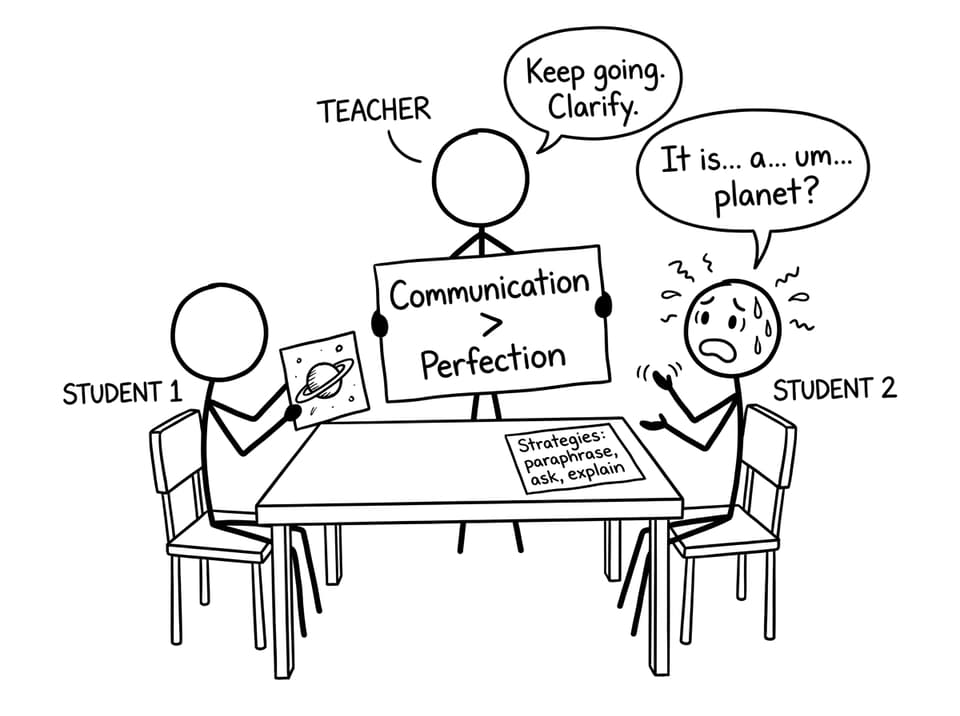
Not because they suddenly become fluent, but because they learn to keep moving. You develop strategies like:
-
paraphrasing when you don’t know the word
-
asking for clarification
-
extending answers with simple connectors (because, but, however)
-
describing what you can see, then adding opinion
If you want a focused plan, use Revision Tips for the IB German Ab Initio Oral Exam.
IB Languages skill: confidence from “imperfect” practice
Confidence isn’t something you wait for. In German Ab Initio, confidence is what happens after you survive enough small failures.
You will misgender nouns. You will forget word order. You will say a sentence that sounds brilliant in your head and confusing out loud.
And then something else happens: you keep talking.
That skill, continuing despite mistakes, is the quiet superpower of IB Languages students. It improves your presentations in other subjects too, because you get used to public imperfection.
RevisionDojo supports this with low-friction practice: you can build routine speaking prompts from your notes, generate mini dialogues in AI Chat, and then recycle the best phrases into Flashcards.
IB Languages skill: cultural awareness you can actually use
The IB themes are sometimes treated like wallpaper. In reality, they are training grounds for perspective.
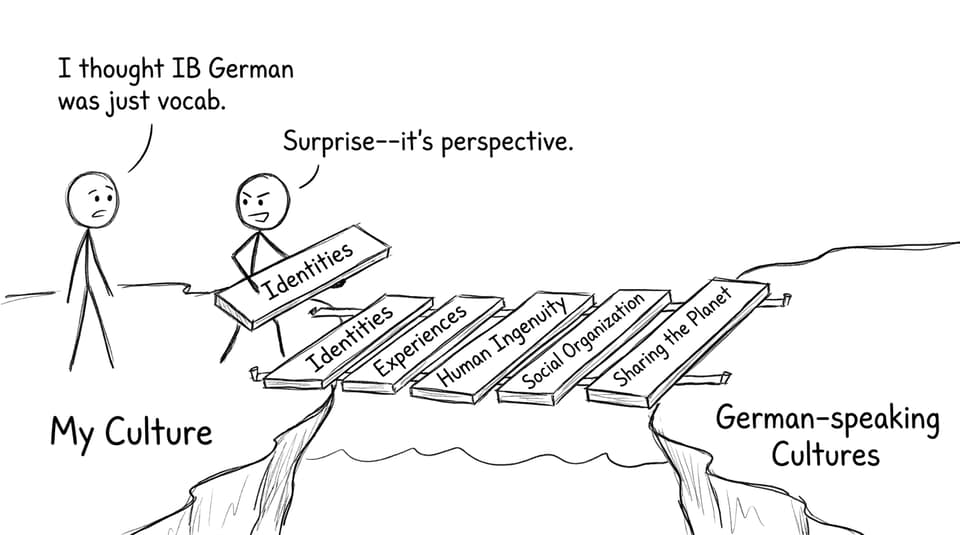
Through themes like Identities, Experiences, Social Organization, Human Ingenuity, and Sharing the Planet, you practice:
-
comparing your daily life with life in German-speaking contexts
-
noticing values inside simple texts (what is praised, what is criticized, what is normal)
-
discussing global issues using language that is accessible but meaningful
Cultural awareness becomes a skill when it changes how you interpret information. That’s international-mindedness in action, and it’s central to IB Languages.
IB Languages skill: learning how to learn (vocabulary, grammar, routines)
German Ab Initio rewards consistency more than intensity.
Most students don’t struggle because German is “too hard.” They struggle because language learning punishes long gaps. When you return after two weeks, it feels like starting over.
That’s why the most valuable long-term skill in IB Languages is building a system.
A strong beginner system looks like this:
-
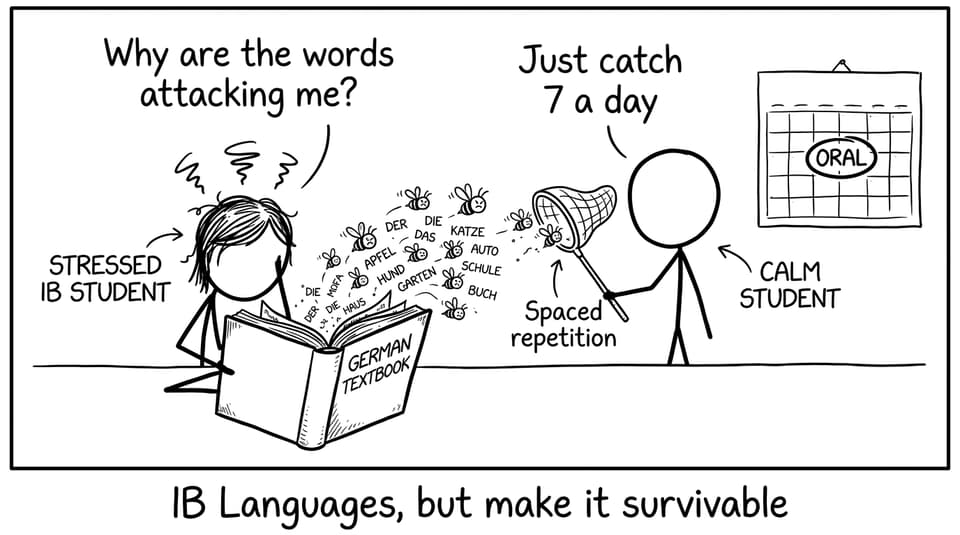
7 minutes daily vocabulary review
-
2 theme-based writing tasks per week
-
1 oral practice session (low stakes, short, repeatable)
-
error tracking: the same 5 mistakes fixed repeatedly
RevisionDojo makes this easier because everything is connected: Study Notes for the concept, Flashcards for spaced repetition, Questionbank for targeted skill questions, and Mock Exams plus Predicted Papers to test timing and stamina closer to exams.
For vocabulary in particular, Effective Ways to Review Vocabulary: Supercharge Your Language Learning is a useful routine guide, and the Flashcards feature helps you keep it consistent.
How RevisionDojo helps IB German Ab Initio students (without chaos)
The hardest part of IB revision is not effort. It’s scattered effort.
If you’re preparing for exams, RevisionDojo works like a single desk where everything is already laid out:
-
The German ab initio hub for a full overview
-
IB German ab initio Revision Notes (SL/HL) when you need quick clarity
-
Questionbank for skill-focused practice with feedback
-
AI Chat for explanations, rephrasing, and oral-style prompts
-
Grading tools to diagnose writing weaknesses early
-
Mock Exams to rehearse timing (the underrated differentiator)
-
Coursework Library and Tutors when you want real examples and human support
If you’re also studying other IB Languages, you’ll benefit from broader strategy too. How to Effectively Revise for Language B Exams is worth reading even if you’re Ab Initio, because the habits transfer.
Conclusion: the real value of IB German Ab Initio
The best part of IB German Ab Initio is that it teaches you something bigger than German.
It teaches you how to move forward while you’re still learning.
That’s why students who take it often become surprisingly strong across the Diploma: they’ve practiced clarity, structure, resilience, and perspective, the hidden toolkit of IB Languages.
If you want those skills to show up as exam results, build your routine inside RevisionDojo: start with the German ab initio hub, drill weak areas with the Questionbank, lock in vocabulary with Flashcards, and rehearse performance with Mock Exams and Predicted Papers.
When the exam comes, you won’t feel fluent.
You’ll feel ready.